Country · South America
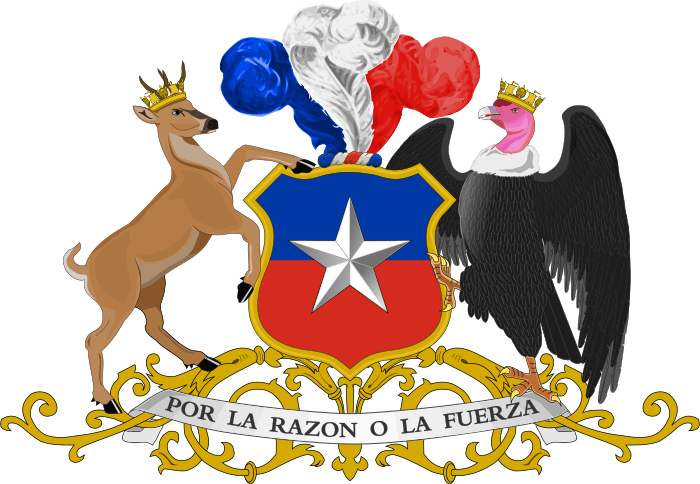
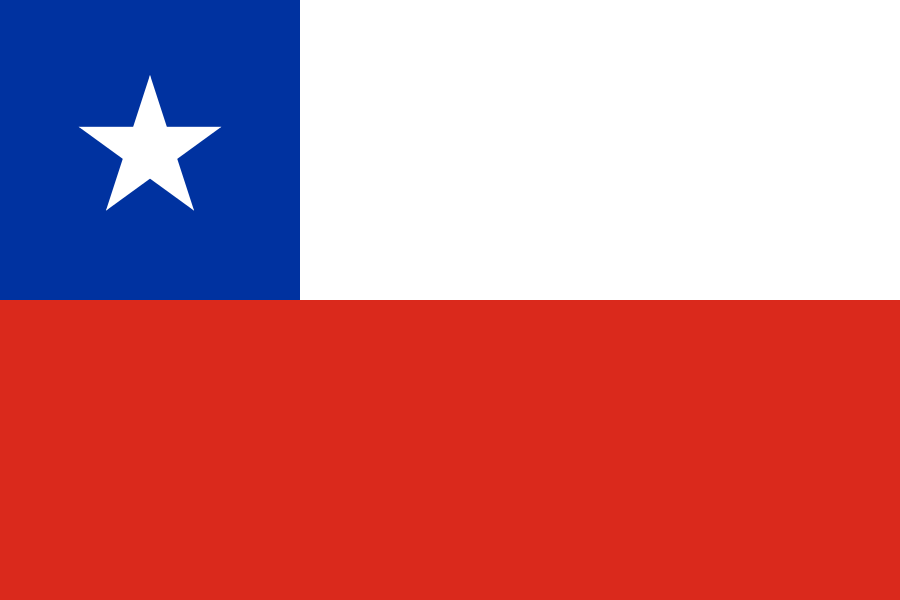
Chile flies one of the most recognisable flags in the Americas: the Lone Star — a single white star on a blue canton, above bands of white and red. It was adopted on 18 October 1817, in the first months of independence. Its coat of arms, the work of the English artist Charles Wood Taylor and adopted in 1834, brings together two animals found nowhere else on earth — the huemul and the condor — beneath the motto Por la razon o la fuerza (“By right or might”).
Click on a country to learn more
| Country | Republic of Chile |
|---|---|
| Flag adopted | 18 October 1817 |
| Coat of arms adopted | 26 June 1834 |
| Designer of the arms | Charles Wood Taylor |
| Supporters | Huemul and condor (with naval crowns) |
| Motto | Por la razon o la fuerza (“By right or might”) |
| Colours | Blue, white, red |
| Territorial divisions | 16 regions |
Coat of Arms — Party per fess azure and gules, a silver star; supporters a huemul and a condor with naval crowns; crest of blue, white and red plumes; motto Por la razon o la fuerza.
Party per fess: the chief azure and the base gules; in the centre a mullet (five-pointed star) argent. For supporters, on the dexter a huemul and on the sinister a condor, both crowned with golden naval crowns. For crest, a plume of blue, white and red. Below, a scroll with the motto Por la razon o la fuerza.
The arms were adopted on 26 June 1834, under President Joaquin Prieto, following a competition launched in 1832. The winning design was the work of the English artist Charles Wood Taylor. The silver star, inherited from the flag, historically stands for the province of Santiago and for the southern position of Chile.
Like most of the Andean republics, Chile chose supporters from its own soil rather than the imperial eagle of Europe. The huemul, a rare deer of the southern cordillera, and the Andean condor flank the shield. Both wear golden naval crowns that commemorate Chile's maritime victories over Spain in the Pacific. The tricolour plume of the crest alludes to the presidential insignia.
The motto Por la razon o la fuerza — “By right or might” — was made official by decree in 1920 and ratified in 1967. It declares that the Republic is governed first of all by reason, and turns to force only when reason does not suffice.
Flag — White over red; a blue canton with a white five-pointed star, the Lone Star.
The flag is composed of two equal horizontal bands — white over red —; the upper hoist quarter bears a square blue canton with a white five-pointed star. Its proportion is 2:3. It was adopted on 18 October 1817, under Bernardo O'Higgins; its design is attributed to the soldier Antonio Arcos, and its general conception to Jose Ignacio Zenteno.
The star, known as the “Lone Star” (la Estrella Solitaria), represents Chile as a unitary state. According to O'Higgins it evoked the estrella de Arauco — the morning star, Venus — bound to the Mapuche tradition of the Wunelfe.
The traditional reading of the colours is a landscape: blue for the clear sky, white for the snow-capped peaks of the Andes, and red for the blood of the heroes of independence. The combination of blue, white and red is traced by some authors to the bands that Alonso de Ercilla describes among the Mapuche warriors in La Araucana (1569).
Decree 1534 of 1967, from the Ministry of the Interior, fixed the exact technical characteristics of the flag; Law 20,537 of 2011 authorised its free use by citizens. Its display is compulsory on national days such as 21 May and 18–19 September.
Like the emblems of the whole continent, Chile's combine the republican grammar inherited from independence with references to its own land. Against the shared vocabulary of its neighbours — the Sun of May, the Phrygian cap, the cornucopia — Chile went a somewhat different way: its flag, raised in 1817, predates the spread of the sun, and its resemblance to the flag of Texas (adopted twenty-two years later) has produced much comparison but no documented link.
What is most distinctly Chilean is the choice of the southern fauna — the huemul and the condor — as guardians of the shield, and the Mapuche memory carried in the estrella de Arauco and in the colours of La Araucana. The naval crowns of the supporters, for their part, recall that Chilean independence was in good part decided at sea, by the squadron that carried liberty as far as the coast of Peru.
Chile is divided into 16 regions, from Arica y Parinacota in the northern desert to Magallanes and the Chilean Antarctic in the far south. Each region has its own coat of arms, and many cities and communes also bear their own emblems, most of them Hispanic and municipal rather than republican in tradition.
The regions of Chile can be explored one by one on the interactive map on this page.
The current flag of Chile was adopted on 18 October 1817, under the supreme director Bernardo O'Higgins. Its design is attributed to the soldier Antonio Arcos, while the general conception is credited to Jose Ignacio Zenteno, the secretary of war.
Known as the Lone Star (la Estrella Solitaria), the white five-pointed star stands for Chile and its unitary character. According to Bernardo O'Higgins it evoked the estrella de Arauco, the morning star (Venus) of Mapuche tradition.
They are two animals native to Chile: the huemul, a deer of the southern mountains, and the Andean condor. They support the shield and wear golden naval crowns that commemorate Chile's maritime victories over Spain in the Pacific.
The motto is Por la razon o la fuerza, usually translated as “By right or might”. It has appeared on the arms since it was made official by decree in 1920 and ratified in 1967, expressing that the nation is governed first by reason, resorting to force only when necessary.
By the traditional reading, blue stands for the clear sky, white for the snow-capped peaks of the Andes and red for the blood shed by the heroes of independence. The three colours are traced by some authors to the bands described in Alonso de Ercilla's La Araucana (1569).
Last reviewed by the Emblema Mundi editorial team on 21 September 2026.