State
Tocantins is Brazil's youngest state, carved out of the northern reaches of Goiás by the 1988 Constitution after more than a century of autonomist agitation. Its emblems — a coat of arms and a flag, both adopted in 1989 — share a single central image: a golden sun rising over blue water and white peace, a birth-of-a-nation motif for Brazil's newest federal unit. The state takes its name from the Tocantins River, and its capital, Palmas, is the only Brazilian state capital built entirely from scratch on open cerrado land. Beyond the symbols lie landscapes found nowhere else in Brazil — the golden dunes and spring-fed fervedouros of the Jalapão, and the vast Bananal Island, formed by the Araguaia River.
Flag
Not available
Coat of Arms
Not available
| State | Tocantins (TO) |
|---|---|
| Capital | Palmas — Brazil's only entirely planned state capital, inaugurated 20 May 1989 |
| Region | North (Norte) |
| Created | 5 October 1988, by Article 13 of the Transitional Constitutional Provisions of the 1988 Constitution; installed 1 January 1989 |
| Historical note | The most recently created of Brazil's 26 states, split from the northern portion of Goiás |
| Population | Roughly 1.6 million (2022 estimate) |
| Coat of arms adopted | 17 November 1989, State Law 92/89 |
| Flag adopted | 17 November 1989, State Law 94/89 (text later amended by Law 159/1990) |
| Designer | Heraldist José Luiz de Moura Pereira, known as “Zeluiz” — credited in most sources with both the arms and the flag, though at least one vexillological source attributes the flag to a different designer |
| Motto | Co Yvy Ore Retama (Tupi, “this land is ours”) |
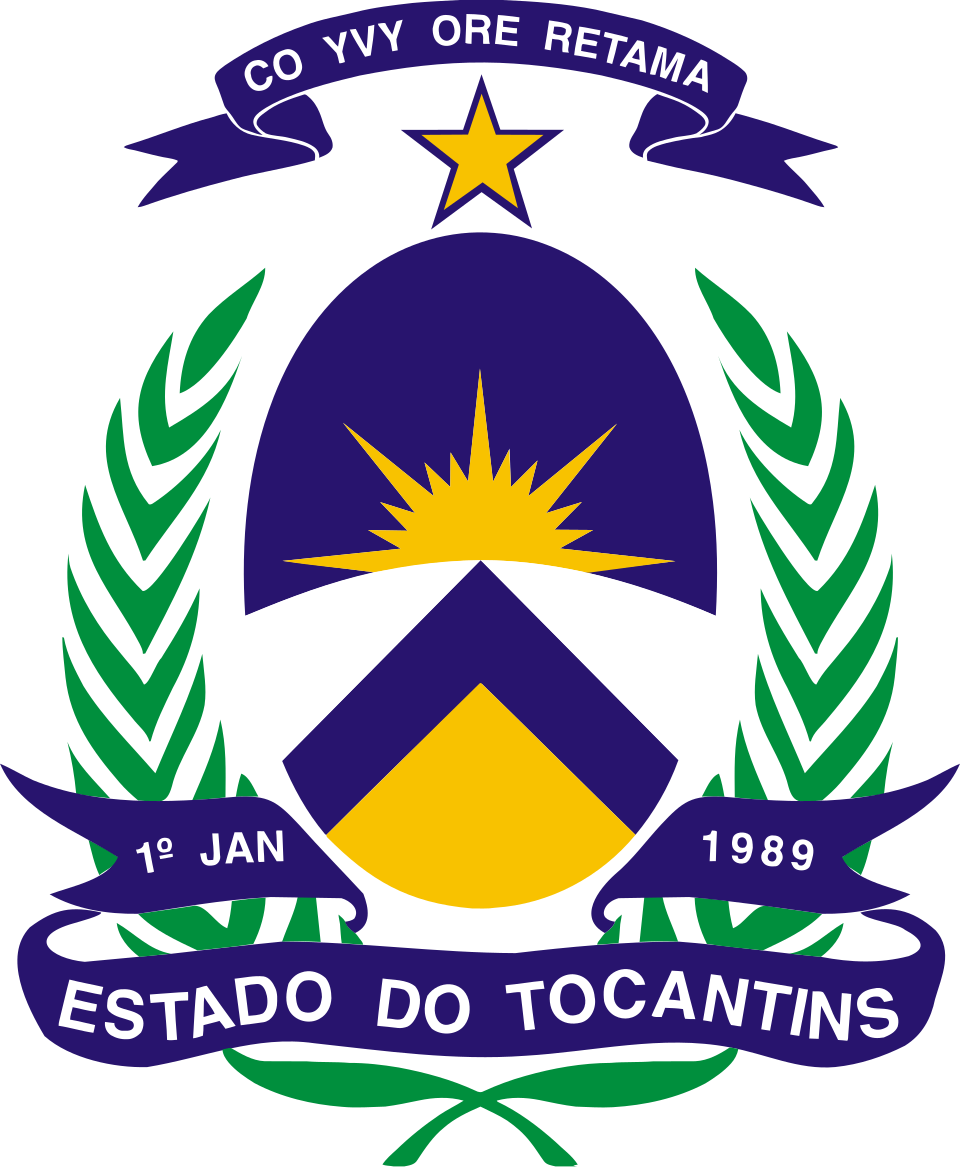
Coat of Arms — An elliptical shield with a rising gold sun over an azure sky and a blue-and-white asna, crested by a star and a Tupi-language motto.
Unlike most Brazilian state arms, which borrow the oval or circular medallion format of the First Republic, the shield of Tocantins is elliptical and divided horizontally (parted per fess). The upper half is azure, charged with half of a stylised gold sun rising directly from the line of division, its rays — larger and smaller alternating — radiating into the blue field above. The lower half shows an asna (a chevron-like heraldic band) in blue, flanked on both sides by white, with gold-yellow at the base.
Below the shield, a blue ribbon carries the inscription ESTADO DO TOCANTINS and the date 1º DE JANEIRO DE 1989 in white lettering — the day the state was formally installed. Above the shield, in place of a conventional helm, sits a five-pointed gold star bordered in blue, and above that a scroll bearing the state motto in the Tupi language: CO YVY ORE RETAMA.
The idea of separating northern Goiás dates back to the nineteenth century, when the region was known as the Comarca do Norte. Distance from the Goiás state capital, poor communications, and a persistent sense of neglect fed a long-running autonomist movement. The politician José Wilson Siqueira Campos became its most prominent champion, campaigning for decades and, during the 1987–1988 National Constituent Assembly, staging a hunger strike on the assembly floor to force debate on the new state's creation.
The Constitution of 5 October 1988 settled the question: Article 13 of its Transitional Constitutional Provisions created the state of Tocantins from the northern two-fifths of Goiás. The state was formally installed on 1 January 1989, with Siqueira Campos as its first governor. Both the coat of arms and the flag followed within the year, adopted by State Laws 92/89 and 94/89 on 17 November 1989.
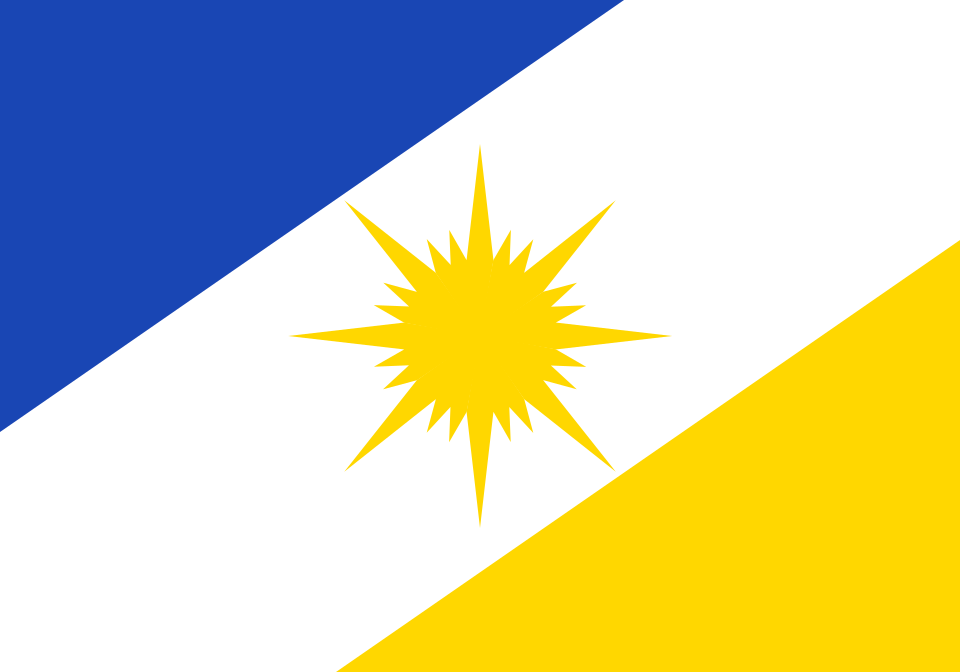
Flag — A blue triangle and a gold-yellow triangle divided by a white diagonal band bearing a radiant gold sun.
The flag was adopted on 17 November 1989 by State Law 94/89, the same day as the coat of arms, with its wording later refined by Law 159 of 1990. It was not the first flag proposed for the territory: a 1956 separatist movement had already flown a design of thirteen alternating green-and-white stripes crossed by a red diagonal band, and in 1987–1988 the former Araguaína mayor Raimundo (Gomes) Marinho presented a separate proposal during the Constituent Assembly debates. Neither preceding design was retained; the flag adopted in 1989 was a new composition built around the same rising-sun motif as the coat of arms. Most Brazilian and Portuguese-language sources credit the heraldist José Luiz de Moura Pereira (“Zeluiz”) as designer of both the flag and the arms, though the attribution for the flag specifically is less consistently sourced than for the coat of arms, so it is worth treating with some caution.
The flag is a rectangle in 7:10 proportion. A wide white diagonal band runs from the lower hoist-side corner to the upper fly-side corner, splitting the rectangle into two right triangles: a blue triangle in the upper hoist and a gold-yellow triangle in the lower fly. Centred on the white band is a stylised gold sun with alternating larger and smaller rays (commonly described as eight major and sixteen minor points).
The flag flies alongside the national flag of Brazil on all state government buildings and is a fixture of Tocantins's official iconography, from license plates to public-sector branding. It has become closely tied to the state's ongoing self-presentation as Brazil's youngest and fastest-developing federal unit, a theme reinforced by the deliberately futuristic, geometric layout of its planned capital, Palmas, inaugurated on 20 May 1989 and made the permanent seat of government on 1 January 1990. Beyond the capital, Tocantins's economy rests heavily on soybean farming and cattle ranching, alongside a growing ecotourism sector centred on the Jalapão — a region of golden dunes and fervedouros, natural springs whose upward water pressure is strong enough to keep a person from sinking — and on Bananal Island, formed between two arms of the Araguaia River. Bananal is often described as the world's largest river island, though this claim is contested: Guinness World Records recognises India's Majuli as the largest true river island, with some geographers arguing Bananal is technically an interfluve rather than an island in the strict sense; by simple land area, however, Bananal is far larger than Majuli and is home to the Karajá indigenous people and the Araguaia National Park.
Tocantins was created by Article 13 of the Transitional Constitutional Provisions attached to the 1988 Constitution, which split the sparsely populated northern portion of the state of Goiás into a separate federal unit. It was formally installed on 1 January 1989, making it the most recently created of Brazil's 26 states.
The name comes from the Tocantins River, whose Tupi-derived name is generally translated as “toucan's beak,” a reference either to the shape of the river on early maps or to the abundance of toucans along its banks.
Palmas is the only Brazilian state capital that was entirely planned and built from open cerrado land after its state's creation. Construction began in late 1988, the city was inaugurated on 20 May 1989, and it became the permanent seat of government on 1 January 1990 — one of the very few purpose-built state or federal capitals in Brazil, alongside Brasília.
The motto is Co Yvy Ore Retama, rendered in the Tupi language and generally translated as “this land is ours.” It appears on a scroll above the crest, beneath a gold star bordered in blue, and is one of the few Brazilian state emblems to draw its motto from an indigenous language rather than Portuguese or Latin.
According to the official 1989 justification, the blue triangle represents the state's rivers, the gold-yellow triangle its mineral and agricultural wealth, and the white band peace; the golden sun rising over the white band symbolises a state where “the sun rises for all” its citizens, echoing Tocantins's birth as a new federal unit.
Last reviewed by the Emblema Mundi editorial team on 4 July 2026.