State
Sergipe's emblems belong to the earliest wave of Brazilian Republican heraldry. Its coat of arms, adopted in 1892 barely two years after the fall of the Empire, is unusual among Brazilian state arms for its allegory: the Indigenous figure Serigi boarding a hot-air balloon inscribed Porvir ("the future"), beneath the Latin motto Sub Lege Libertas. Its flag, born as a merchant's private house-flag before being adopted by the state in 1920, carries green-and-yellow stripes and five stars marking the river mouths of Brazil's smallest state by area.
Flag
Not available
Coat of Arms
Not available
| State | Sergipe (Brazil, Northeast Region) — the smallest Brazilian state by area, about 21,910 km², larger only than the Federal District |
|---|---|
| Capital | Aracaju (capital since 17 March 1855; previously São Cristóvão, founded January 1590) |
| State admitted | Captaincy of Sergipe founded 1590 as a subordinate "comarca" of Bahia; separated by royal charter of 8 July 1820; consolidated as an independent province under the 1824 Imperial Constitution; state with the Proclamation of the Republic, 15 November 1889 |
| Coat of arms adopted | State Law 2 of 5 June 1892, designed by Professor Brício Cardoso, ratified by the Legislative Assembly on 5 July 1892 |
| Flag adopted | State Law 795 of 19 October 1920, under governor José Joaquim Pereira Lobo; design attributed to the Sergipe merchant Bastos Coelho; first hoisted 24 October 1920 at the Palácio Olímpio Campos |
| Flag colours | Green, yellow, blue, white |
| Coat of arms motto | Sub Lege Libertas ("Liberty under the Law") |
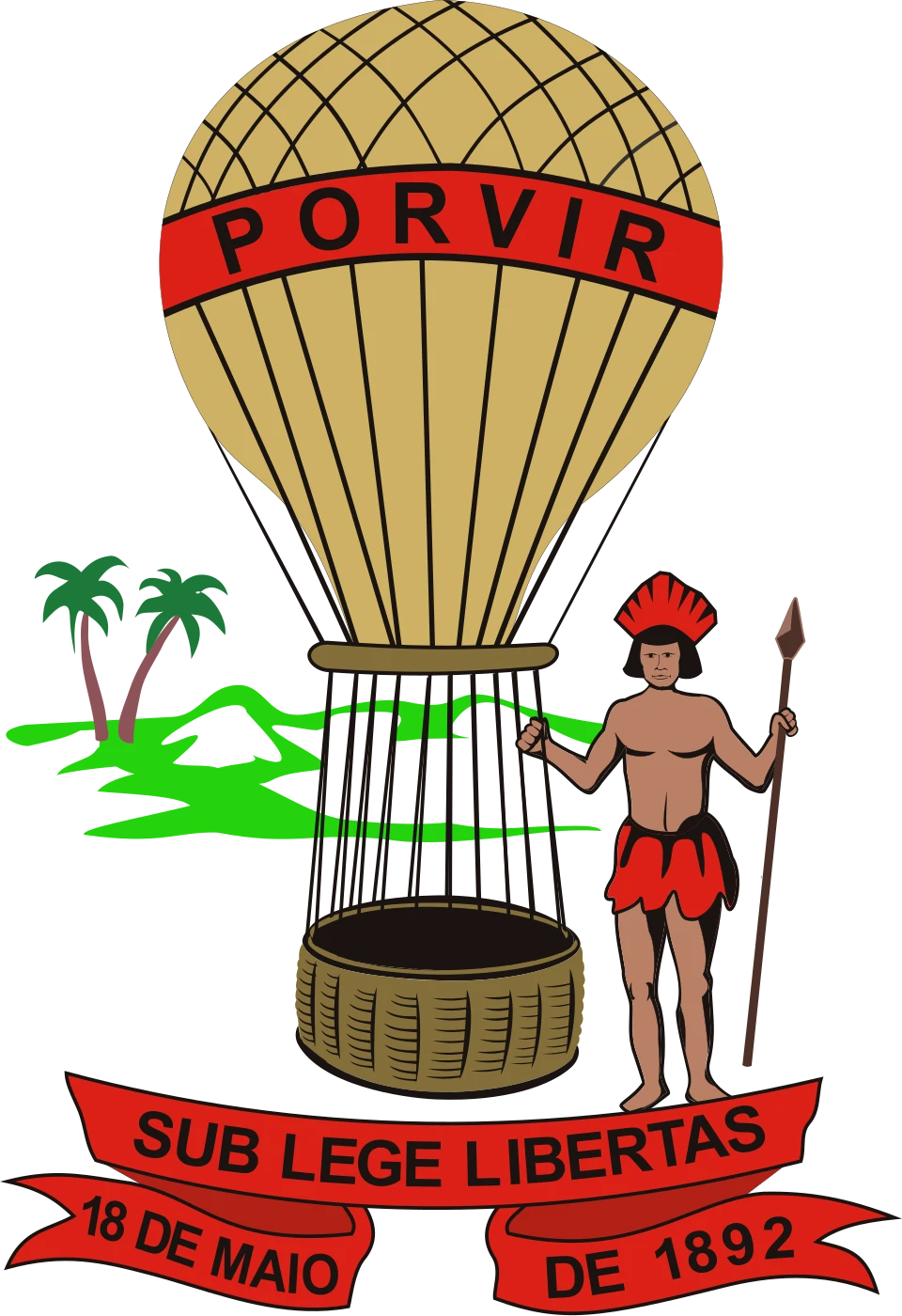
Coat of Arms — The Indian Serigi boarding the balloon of Porvir, above the motto Sub Lege Libertas.
The coat of arms of Sergipe was designed by Professor Brício Cardoso and adopted by State Law 2 of 5 June 1892, ratified by the state's Legislative Assembly on 5 July 1892 — placing it among the earliest state arms fixed under the new Republican order, barely two and a half years after the fall of the Empire. Its central device is unusual among Brazilian state emblems: the shield shows the Indigenous figure of Serigi in the act of boarding a hot-air balloon, at the centre of which appears the single word PORVIR ("the future" or "the time to come").
Below the shield, a ribbon carries the Latin motto SUB LEGE LIBERTAS ("Liberty under the Law"), and beneath it the date 18 DE MAIO DE 1892 — the date of Sergipe's first republican state constitution. The seal is used on official documents and printed papers of the state government; more recently, State Law 8,504 of 4 January 2019 formally regulated the coat of arms' use as an official symbol of the state administration.
Note on accuracy: the Portuguese-language description previously published on this site's own Sergipe page gave only a vague, generic account of the arms — an unspecified "star," "agricultural elements," and colonial references with no decree number or designer — without describing the balloon, the figure of Serigi, or the motto at all. That description could not be verified against the sources consulted for this page and has been superseded here by the sourced blazon above.
Portuguese settlement of the region began in 1590, when the captain Cristóvão de Barros subdued the Tupinambá and founded São Cristóvão, now reckoned the fourth-oldest city in Brazil and, since 2021, officially titled "Cidade Mãe de Sergipe" (Mother City of Sergipe). For more than two centuries the Captaincy of Sergipe — sometimes called Sergipe d'El Rei in older usage — was administered as a subordinate comarca of the Captaincy of Bahia, supplying cattle, sugar and cotton to the port of Salvador.
Growing resentment over taxation and a desire for fiscal autonomy, fed by the expanding sugar economy of the Cotinguiba valley, led to a first attempt at separation: a royal charter (Carta Régia) of 8 July 1820, issued under Dom João VI, granted Sergipe its own captaincy status. Bahian forces resisted this almost immediately, deposing the newly appointed governor Burlamaqui by force in March 1821 and reincorporating Sergipe as a comarca of Bahia by August of that year. Sergipe's separation was only definitively consolidated with Brazil's first Imperial Constitution of 1824, after which the territory functioned as an independent province. In July of that same year, the neighbouring Confederação do Equador invited Sergipe, alongside Pernambuco, Piauí, Ceará, Rio Grande do Norte and Paraíba, to join its short-lived separatist republic; despite the movement's echoes being felt in the province through the second half of 1824, Sergipe itself did not formally adhere, remaining under Imperial authority. The province became a state of the federation with the Proclamation of the Republic on 15 November 1889.
São Cristóvão remained the seat of government until 17 March 1855, when provincial president Inácio Joaquim Barbosa transferred the capital to the newly planned coastal town of Aracaju, laid out on a grid to better serve the export of sugar through its port. The Praça São Francisco in São Cristóvão, with its Franciscan convent complex, was inscribed as a UNESCO World Heritage Site in 2010.
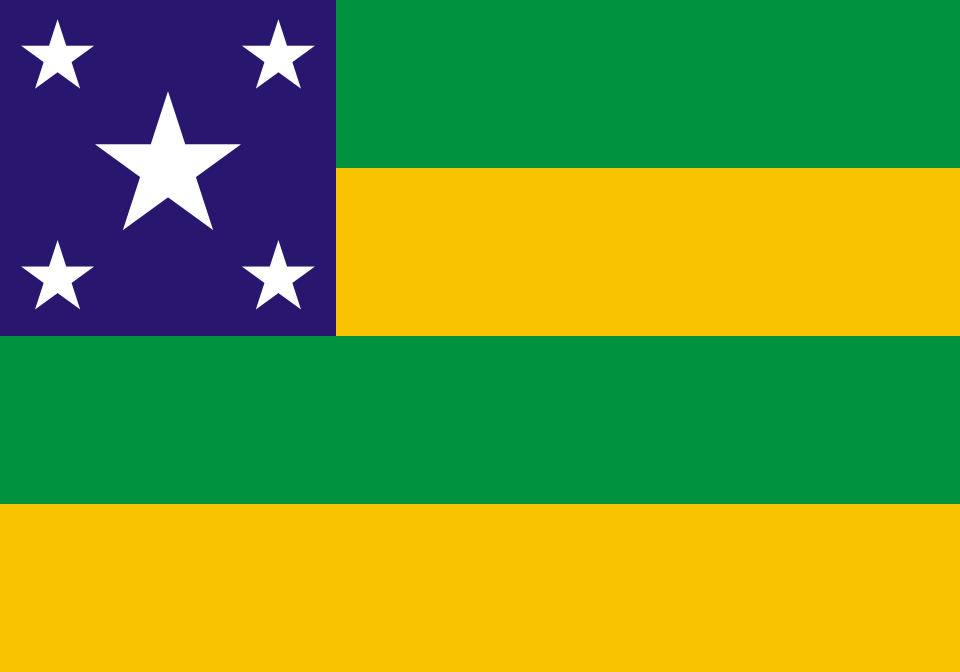
Flag — Four stripes of green and yellow, with a blue canton bearing five stars for the state's river mouths.
Unlike the coat of arms, the flag of Sergipe began life as a private emblem. In the nineteenth century, the Sergipe merchant Bastos Coelho — identified in some sources by the fuller name José Rodrigues Bastos Coelho — devised the green-yellow-and-blue design to mark his own trading vessels. The flag gained wider popular recognition as an unofficial symbol of the state before governor José Joaquim Pereira Lobo made it official through State Law 795 of 19 October 1920 — fittingly, the centennial year of the 1820 royal charter that first separated Sergipe from Bahia. It was raised officially for the first time on 24 October 1920, on the façade of the Palácio Olímpio Campos.
The flag's design was altered once, briefly: a modification of 30 October 1951 replaced the five stars with a field of about forty-two stars representing the state's municipalities. This change proved unpopular and was reversed a little over a year later by State Law 458 of 3 December 1952, which restored the original five-star design that remains in use today.
The flag is a rectangle of four alternating horizontal stripes, green and yellow, with green at the top. In the upper-left corner sits a blue rectangular canton, proportioned to occupy half the flag's height, bearing five white five-pointed stars arranged in a quincunx (a cross-like pattern of four outer stars around a larger central one). Official colour specifications describe the shades as a cobalt blue, an emerald-toned green, and a golden yellow. Sources are consistent that the stars mark five river mouths reaching the Atlantic along the Sergipe coast, though they differ slightly on the exact list: most commonly cited are the São Francisco, Japaratuba, Sergipe, Vaza-Barris and Real rivers, with the larger central star generally identified with the Rio Sergipe, from which the state's own name derives. The green and yellow stripes echo Brazil's national colours, expressing the state's integration into the federation.
The flag flies over Sergipe's public buildings and presides over official state ceremonies alongside the national flag. It is a fixture of civic commemorations of Sergipe's emancipation from Bahia, marked each year on 8 July, and of the state's Independence Day observances tied to Brazil's own 7 September holiday.
Serigi is the figure whose name popular etymology links to the state's own name. On the 1892 coat of arms, designed by Brício Cardoso, he is shown boarding a hot-air balloon inscribed with the word PORVIR (the future) — a composition read as representing the state's Indigenous past giving way to a future of progress and civilization.
Sub Lege Libertas is Latin for "Liberty under the Law." It appears on a ribbon beneath the shield of the Sergipe coat of arms, alongside the date 18 de maio de 1892 — the date of the state's first republican constitution — expressing the young state's commitment to constitutional order after the fall of the Empire.
The five white stars in the flag's blue canton represent the mouths of Sergipe's five principal rivers reaching the Atlantic: the São Francisco, the Japaratuba, the Sergipe, the Vaza-Barris and the Real. The larger central star is generally identified with the Rio Sergipe, from which the state takes its name.
The flag's green-and-yellow striped design with a starred blue canton was created in the nineteenth century by the Sergipe merchant Bastos Coelho to mark his trading vessels. It became the state's official flag under governor José Joaquim Pereira Lobo by State Law 795 of 19 October 1920, the centennial year of Sergipe's separation from Bahia, and was first raised over the Palácio Olímpio Campos on 24 October 1920.
Sergipe covers about 21,910 square kilometres, the smallest area of Brazil's 26 states (larger only than the Federal District). Its compact size reflects its origin as a subordinate "comarca" of the Captaincy of Bahia for over two centuries, formally separated only by royal charter in 1820 and consolidated as an independent province after the 1824 Imperial Constitution.
Last reviewed by the Emblema Mundi editorial team on 2026-07-05.