State
São Paulo was, remarkably, the last Brazilian state to acquire an official coat of arms — it took the upheaval of the 1932 Constitutionalist Revolution to give it one. The coat of arms, designed by the painter José Wasth Rodrigues and adopted that same year, bears a silver sword crossing branches of laurel and oak, framed by fruiting coffee branches, beneath the Latin motto Pro Brasilia Fiant Eximia ("For Brazil let great things be done") — a wording chosen deliberately to insist that the rebel state was fighting for Brazil, not against it. The flag, its thirteen black-and-white stripes conceived decades earlier by the writer Júlio Ribeiro, became the revolution's own banner before finally gaining legal status in 1946.

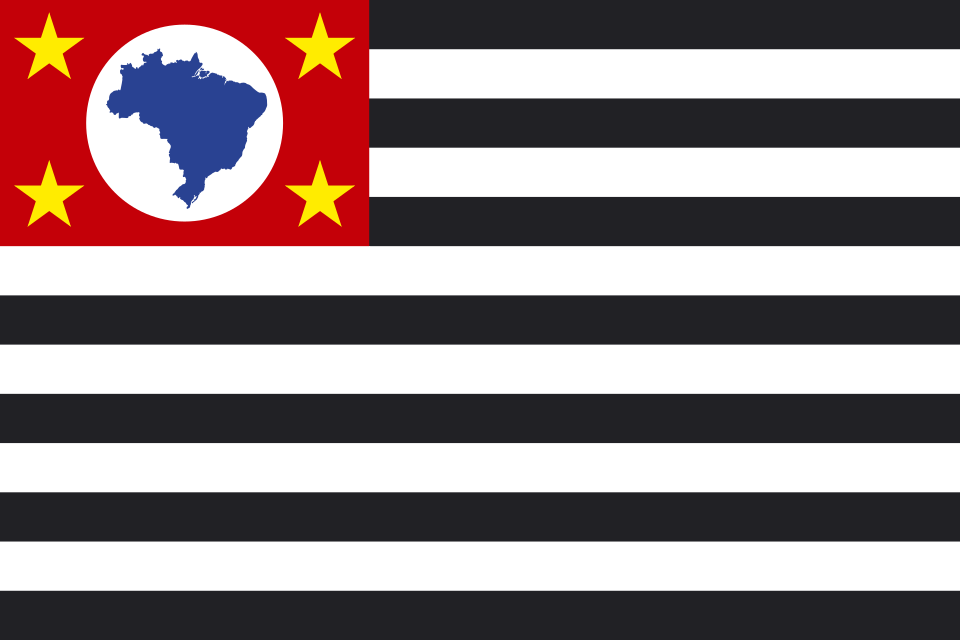
Flag
Not available
Coat of Arms
Not available
| State | São Paulo (Brazil, Sudeste / Southeast Region) — note: uniquely among Brazil's states, São Paulo shares its exact name with its own capital city |
|---|---|
| Capital | São Paulo city (founding mass at the Jesuit College of São Paulo de Piratininga, 25 January 1554, by Manuel da Nóbrega and José de Anchieta; today South America's most populous city) |
| State admitted | Hereditary Captaincy of São Vicente created 6 October 1534 by King João III of Portugal, granted to Martim Afonso de Sousa; province of the Empire from the 1820s; state of the federation with the Proclamation of the Republic, 15 November 1889 |
| Coat of arms adopted | Decree 5.656 of 29 August 1932, signed by federal interventor Pedro de Toledo during the Constitutionalist Revolution; designed by José Wasth Rodrigues; restated by State Law 145 of 3 September 1948 |
| Flag adopted | Designed 1888 by Júlio Ribeiro; flown informally from the Proclamation of the Republic (1889) and as the emblem of the 1932 Constitutionalist Revolution; officially adopted by State Decree-Law 16.349 of 27 November 1946; restated by State Law 145 of 3 September 1948 |
| Flag colours | Black, white, red, silver/white, blue, gold |
| Motto | Pro Brasilia Fiant Eximia ("For Brazil let great things be done") |
Coat of Arms — A red shield with a silver sword, laurel and oak branches, and the motto Pro Brasilia Fiant Eximia.
The coat of arms of São Paulo was designed by the painter José Wasth Rodrigues and adopted by Decree 5.656 of 29 August 1932, signed by Pedro de Toledo, the civilian interventor who led the state government during the Constitutionalist Revolution against Getúlio Vargas's provisional government. Its design and specifications for official use were later restated, without altering the blazon, by State Law 145 of 3 September 1948.
The shield is a Portuguese-style shield in gules (red). Across it stands a silver sword, its hilt pointing downward, its blade separating the silver letters S and P and crossing over two silver sprigs — a laurel branch on the dexter side (the viewer's right) and an oak branch on the sinister side (the viewer's left). Above the shield, as a crest, sits a silver five-pointed star. Flanking the shield are two fruiting coffee branches in their natural colour, crossed at the base. Below, a red ribbon bears the Latin motto PRO BRASILIA FIANT EXIMIA in silver letters.
Until 1932, São Paulo was, unusually, the only state in the Brazilian federation without an official coat of arms. That changed only in the extraordinary circumstances of the Constitutionalist Revolution, the armed uprising launched in July 1932 by paulista political and military leaders demanding that Getúlio Vargas's provisional government — installed after the 1930 Revolution — restore constitutional rule and hold elections. Wasth Rodrigues had already designed an emblem for the "Ouro para o Bem de São Paulo" campaign, which called on the population to donate gold jewellery and valuables to help finance the state's war effort; this emblem was adapted into the coat of arms proper and formally adopted by Decree 5.656 on 29 August 1932, in the middle of the three-month conflict. The revolution itself was defeated militarily by early October 1932, but its political goals were substantially achieved: a new Constitution was promulgated in 1934, and São Paulo's defeat did not prevent its coat of arms, born in revolt, from becoming the state's permanent official emblem.
The territory's own history reaches back much further. The Hereditary Captaincy of São Vicente was created on 6 October 1534 by King João III of Portugal and granted to Martim Afonso de Sousa, one of the earliest such grants on the Brazilian coast. From the coastal settlements, Jesuit missionaries climbed the Serra do Mar to the Piratininga plateau, where Manuel da Nóbrega and the young José de Anchieta celebrated the founding mass of the College of São Paulo de Piratininga on 25 January 1554 — the feast day of the conversion of the Apostle Paul, from whom the settlement, and eventually the whole state, took its name. From this plateau in the following century and a half set out the bandeiras, the armed inland expeditions that searched for indigenous captives and mineral wealth and, in doing so, extended Portuguese-claimed territory far beyond the line fixed by the 1494 Treaty of Tordesillas. From the mid-nineteenth century, a wholly different economic force — the coffee boom — remade the state again, funding railways, drawing millions of immigrants (chiefly Italian, but also Japanese, Spanish, Portuguese and others), and laying the foundations for the twentieth-century industrialisation that made São Paulo Brazil's economic centre.
Flag — Thirteen black-and-white stripes with a red canton bearing the silhouette of Brazil and four gold stars.
The flag of São Paulo was conceived far earlier than the coat of arms. In an article published in the newspaper O Rebate on 16 July 1888, the philologist and Republican propagandist Júlio Ribeiro proposed a design for a paulista flag, working out its visual layout with his brother-in-law, the graphic artist Amador Amaral. Ribeiro's flag was flown informally from as early as the Proclamation of the Republic in November 1889, but it held no official standing for decades. It was during the Constitutionalist Revolution of 1932 that the flag became the paulistas' own rallying banner, carried into a conflict fought under the same explicitly national, not separatist, framing later written into the coat of arms's motto. Formal legal recognition came only after the return to constitutional rule, by State Decree-Law 16.349 of 27 November 1946, itself made possible by a clause of the new 1946 Federal Constitution restoring to Brazilian states the right to adopt their own symbols; the flag's design and technical specifications were then restated by State Law 145 of 3 September 1948, still the governing law today.
The flag consists of a field of thirteen equal horizontal stripes, alternating black and white and beginning and ending with black. In the upper hoist corner sits a red canton charged with a silver circle bearing the geographic silhouette of Brazil in blue, and surrounded by four gold five-pointed stars. According to Ribeiro's own explanation and the account repeated in reference sources, the black, white and red were chosen to represent the three peoples whose mixture, in the racial thinking of his era, was seen as forming the Brazilian population. The alternating stripes are commonly glossed as a symbol of constant, unbroken vigilance — "night and day" — while the red canton is read as a sign of readiness to shed blood in Brazil's service, and the four stars as a reference to the Southern Cross. The number of stripes settled at thirteen only after some evolution in the design; a few later commentators have also associated the number with the United States' thirteen founding colonies or with Saint Paul's traditional place as the church's thirteenth apostle, though these remain secondary associations rather than the flag's original stated rationale.
The state flag of São Paulo, described here, should not be confused with the separate flag of the city of São Paulo, which follows an entirely different design tied to the municipality's own coat of arms and history.
The flag is flown over São Paulo's public buildings and official ceremonies alongside the national flag. It is given particular prominence each 9 July, the state holiday commemorating the outbreak of the Constitutionalist Revolution of 1932, when the flag's origin as a movement banner is most visibly remembered across the state.
Pro Brasilia Fiant Eximia is Latin for "For Brazil let great things be done." Designer José Wasth Rodrigues had first proposed a version honouring São Paulo alone, Pro São Paulo Fiant Eximia, but the interventor Pedro de Toledo had it changed to the Brazil-facing wording before the coat of arms was adopted in 1932 — a deliberate statement that the paulistas fighting in the Constitutionalist Revolution saw themselves as acting for the whole country, not seceding from it. The phrase itself is traced to an 1895 Latin inscription on a São Paulo water-utility reservoir.
The painter José Wasth Rodrigues designed the coat of arms, adapting an emblem he had created for the "Ouro para o Bem de São Paulo" gold-donation campaign that helped finance the Constitutionalist Revolution. It was adopted by Decree 5.656 of 29 August 1932, signed by the revolution's federal interventor, Pedro de Toledo. Until that date São Paulo was the only Brazilian state without an official coat of arms.
The flag was proposed in 1888 by the writer and Republican propagandist Júlio Ribeiro, who explained the black, white and red as representing the three peoples whose mixture he saw as forming the Brazilian population. The stripes are commonly glossed as standing for constant, unbroken vigilance, day and night, though the number thirteen itself only settled into place over time; some later commentators have also linked it to the United States' thirteen founding colonies or to Saint Paul's traditional numbering as the thirteenth apostle.
Although it was flown informally from as early as 1889 and became the paulistas' rallying banner during the Constitutionalist Revolution of 1932, the flag gained no official status under Getúlio Vargas's Estado Novo, which suppressed all state symbols. It was formally adopted only after redemocratization, by State Decree-Law 16.349 of 27 November 1946, and its design and specifications were then restated by State Law 145 of 3 September 1948, still in force today.
No. The state flag, in black-and-white stripes with a red canton, silver circle and Brazil silhouette, is a distinct symbol from the municipal flag of the city of São Paulo, which uses its own separate design tied to the city's own coat of arms and history. The two are easily confused online but are legally and visually different emblems.
Last reviewed by the Emblema Mundi editorial team on 2026-07-05.