State
Santa Catarina's official emblems were fixed in the years just after the Proclamation of the Republic, and both still carry that founding moment at their centre. The coat of arms, adopted in 1895, sets an eagle gripping a key and an anchor before a silver star, with a small shield on its breast reading 17 de novembro de 1889 — the day Santa Catarina itself joined the new republican order. The flag, restored to its present form in 1953, is not the plain red-and-white lozenge often assumed: it is three horizontal bands, red at top and bottom and white in the centre, overlaid by a light-green lozenge bearing the arms. Both emblems sit atop a state shaped as much by Azorean, German and Italian settlement as by its Portuguese colonial founding.
Flag
Not available
Coat of Arms
Not available
| State | Santa Catarina (Brazil, Sul / South Region) |
|---|---|
| Capital | Florianópolis — built principally on the Island of Santa Catarina, one of the few Brazilian state capitals sited mainly on an island, joined to the mainland by bridges; founded in 1675 as Nossa Senhora do Desterro, renamed Florianópolis by State Law 111 of 1 October 1894 |
| Administrative history | Captaincy of Santa Catarina created 11 August 1738, government installed 7 March 1739; province of the Empire from 1822; became a state of the Federation on 17 November 1889, days after the national Proclamation of the Republic |
| Coat of arms adopted | State Law 126 of 15 August 1895, under Governor Hercílio Luz; design attributed to Henrique Boiteux; consolidated in its current form by State Law 17.308 of 6 November 2017 |
| Flag adopted | Original tricolour-with-stars design also fixed by State Law 126 of 1895 (design by José Artur Boiteux); present three-band design fixed by State Law 975 of 29 October 1953 and regulated by Decree 605 of 19 February 1954; consolidated by State Law 17.308 of 6 November 2017 |
| Designers | Henrique Boiteux (coat of arms, 1895); José Artur Boiteux (flag, 1895) |
| Flag colours | Red, white, light green (plus the arms' own gold/brown, silver and red) |
| Inscription on the arms | 17 DE NOVEMBRO DE 1889 (small shield on the eagle's breast) and ESTADO DE SANTA CATARINA (ribbon beneath) |
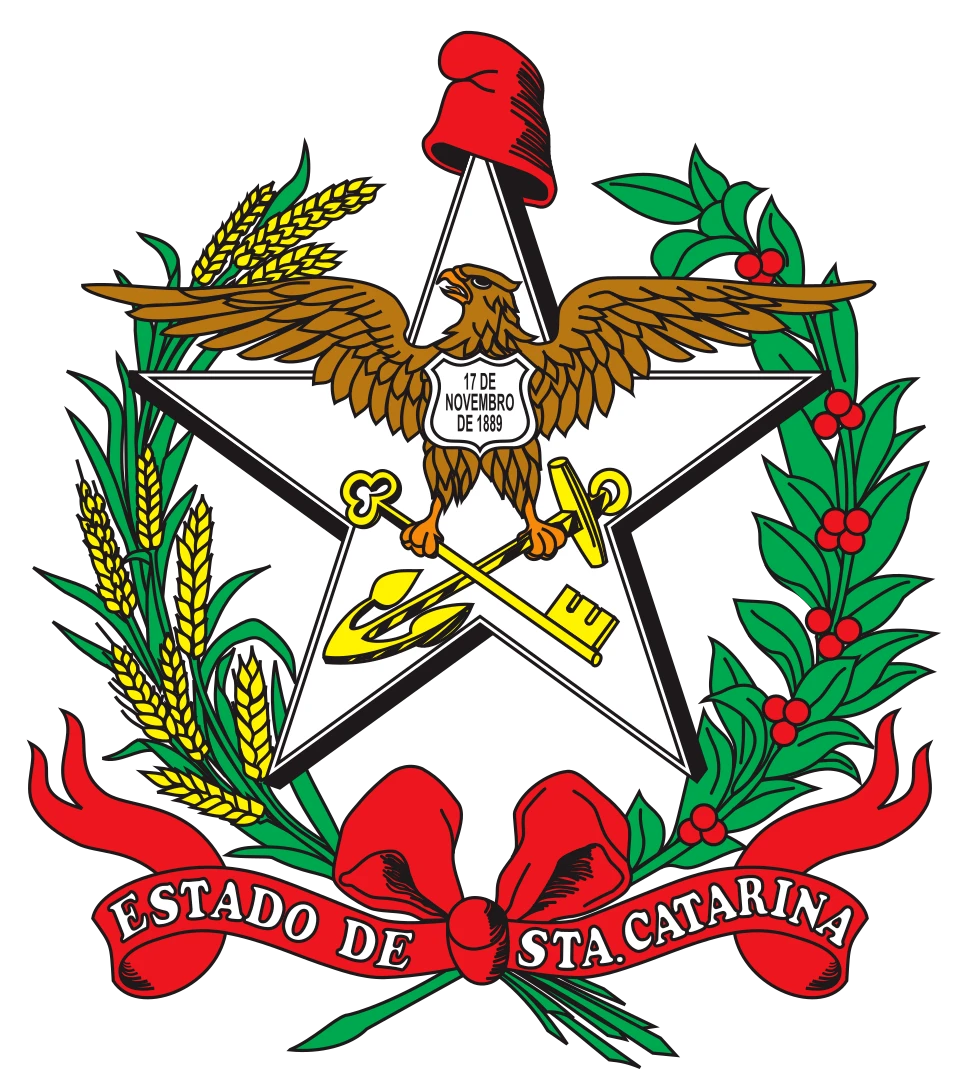
Coat of Arms — An eagle before a silver star, holding a key and an anchor in saltire, crowned by a Phrygian cap and flanked by wheat and coffee.
The coat of arms of Santa Catarina is built around a silver five-pointed star, in front of which stands an eagle displayed — shown facing the viewer with its wings fully extended. The eagle grips a gold key in its right talon and a silver anchor in its left, the two charges crossing each other in saltire in front of its body. A small shield ornaments the eagle's breast, inscribed 17 DE NOVEMBRO DE 1889 in a single horizontal line.
A red Phrygian cap rests on the star's uppermost point, above the eagle's head. Below, a branch of wheat on the dexter side (the viewer's right) and a branch of coffee on the sinister side (the viewer's left) frame the composition, their stems joined at the base by a red ribbon with floating ends, which bears the inscription ESTADO DE SANTA CATARINA in white lettering.
The coat of arms was established by State Law 126 of 15 August 1895, during the government of Hercílio Luz, with the design attributed to the historian and jurist Henrique Boiteux. The same 1895 legislation also fixed the state's first flag, designed by his relative José Artur Boiteux. Some historians, notably Lucas Alexandre Boiteux, have traced a still earlier heraldic precedent to the short-lived separatist República Juliana of 1839, which used a stylised shield with maize and coffee branches — though this earlier emblem had no legal continuity with the 1895 state arms.
Like the symbols of nearly every Brazilian state, official use of the coat of arms was suspended under the centralising Estado Novo (1937–1945) by decree of President Getúlio Vargas, and restored once constitutional government returned to the states after 1945. The arms' current wording and specification are consolidated, without substantive change to the 1895 blazon, in State Law 17.308 of 6 November 2017, which brings together the coat of arms, the flag, the state anthem, and several natural-heritage symbols of Santa Catarina into a single legal text.
Santa Catarina's own colonial and immigration history is not depicted directly in the coat of arms, but frames the state the arms represent. European settlement began with mainland Portuguese outposts in the seventeenth century — Nossa Senhora do Desterro, now Florianópolis, was founded in 1675 — before the Portuguese Crown organised the emigration of some five thousand Azorean and Madeiran settlers to the island and coastline between 1748 and 1756, whose descendants remain culturally prominent along the coast. From the mid-nineteenth century, private colonisation companies brought waves of German immigrants inland: the Colônia Blumenau (from 1850, founded by the pharmacist Hermann Otto Blumenau) and the Colônia Dona Francisca at what became Joinville (from 1851). Italian immigration followed from the 1870s, concentrated in the Urussanga and Criciúma valleys in the state's south. A distinct, later episode — the Contestado War (1912–1916), a messianic sertanejo rebellion in the disputed timber-rich borderlands with Paraná — produced its own green-cross-on-white banner; this Contestado flag is not part of the state's official coat of arms or flag, though State Law 17.308 of 2017 separately recognises it as a regional symbol of Santa Catarina.
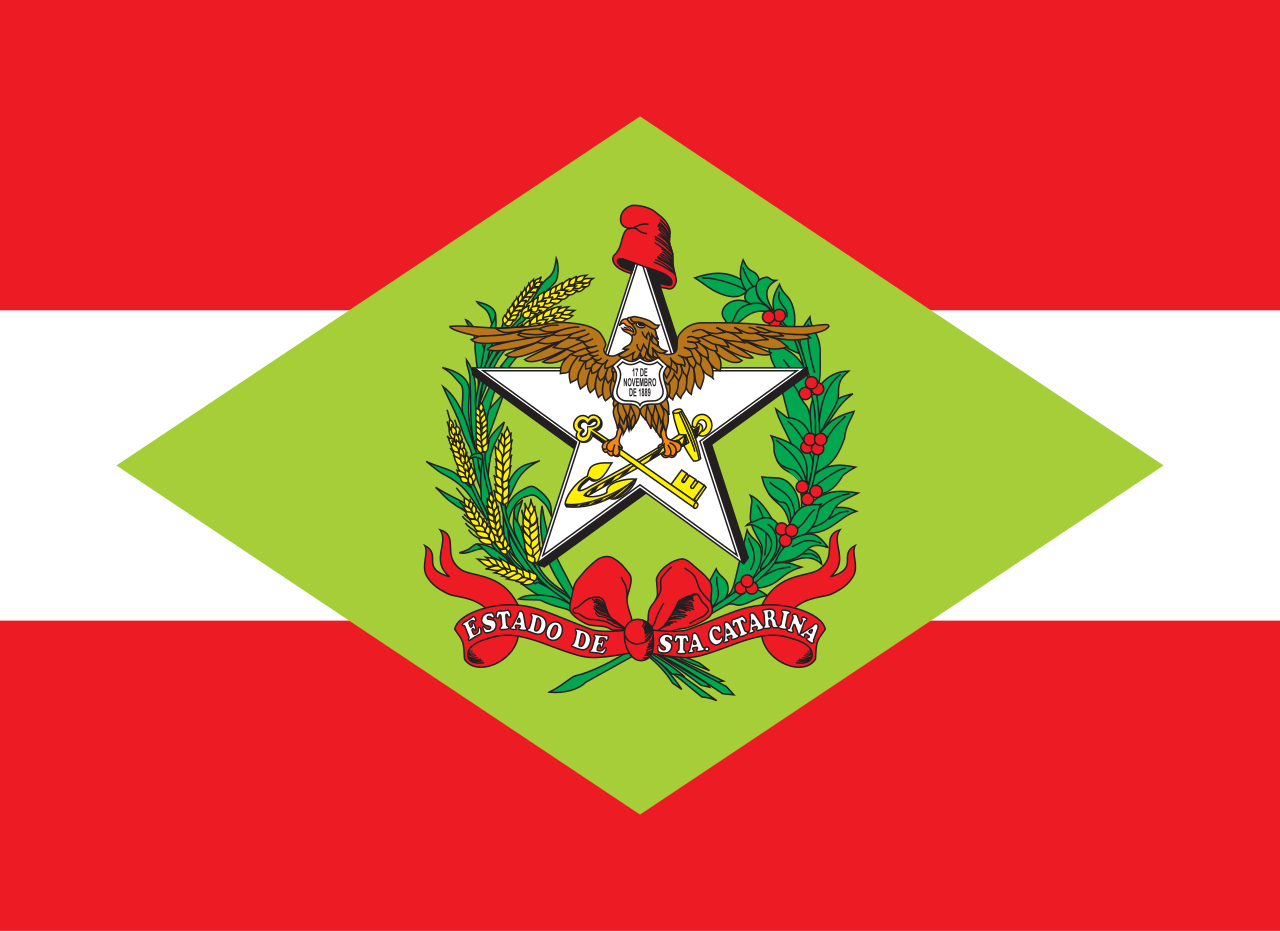
Flag — Red-white-red horizontal bands with a light-green lozenge bearing the coat of arms at the centre — not a plain white lozenge on red.
Santa Catarina's first official flag was fixed by the same State Law 126 of 15 August 1895 that established the coat of arms, with the flag's design credited to José Artur Boiteux, a historian, journalist and lawyer. That original flag carried horizontal white and red stripes whose number matched the state's judicial districts — thirteen at the time — with a green lozenge at the centre charged with small yellow stars, one for each municipality. Like the state's other official symbols, this flag was suppressed under the Federal Constitution of 1937 and Decree-Law 1.202 of 8 September 1939, part of Getúlio Vargas's Estado Novo campaign against regional symbols.
Following the return to constitutional government, State Law 975 of 29 October 1953, sanctioned by Governor Irineu Bornhausen, restored and substantially redesigned the flag, simplifying it to a fixed three-band format and replacing the multiple municipal stars with the full state coat of arms at the centre of the lozenge. This design was regulated in further technical detail by Decree 605 of 19 February 1954, and both remain consolidated, without change to the essential design, in State Law 17.308 of 6 November 2017.
The flag is composed of three horizontal bands of equal width — red at the top and bottom, and white in the centre — in a proportion of 11 units fly by 8 units hoist. Superimposed over all three bands, centred on the flag, is a light-green lozenge (described in the governing law as verde-claro) whose four points fall short of the flag's edges, so that the red and white bands remain visible around it. At the centre of the lozenge sits the state coat of arms in full. Official state government colour guidance specifies the red as Pantone 485 and the light green as Pantone 376.
This is a materially different design from the earlier 1895 flag, which used a variable number of white-and-red stripes (matching judicial districts) and a plain green lozenge scattered with small yellow municipal stars rather than the full coat of arms. Some general-audience sources describe the current flag simply as "a white lozenge on a red field," omitting the horizontal banding and the lozenge's actual light-green colour and coat-of-arms centrepiece — this is not accurate to the design fixed by Law 975 of 1953 and confirmed by the state government's own published specification and by international vexillological references.
The flag is flown over Santa Catarina's public buildings and official ceremonies alongside the national flag of Brazil. It appears at civic occasions across the state, including celebrations tied to the Azorean, German and Italian communities whose settlement shaped modern Santa Catarina — among them Blumenau's Oktoberfest and the Festas do Divino of Azorean tradition on the coast — where the state flag is generally displayed together with municipal flags reflecting this layered colonial and immigrant heritage.
No. The flag is three horizontal bands of equal width, red at the top and bottom and white in the centre, over which sits a light-green lozenge bearing the state coat of arms. This design was fixed by State Law 975 of 29 October 1953 and remains in force today, consolidated by State Law 17.308 of 6 November 2017.
The eagle, shown displayed with its wings extended, represents the state's productive forces; it holds a gold key in its right talon, symbolising Santa Catarina's strategic position in southern Brazil, and a silver anchor in its left, referring to the ocean and the state's maritime tradition. Both charges cross in saltire in front of the eagle's breast.
The coat of arms was established by State Law 126 of 15 August 1895, under Governor Hercílio Luz, with the design attributed to Henrique Boiteux. It was suspended along with the state flag during the centralising Estado Novo (1937–1945) and restored afterward; both symbols are consolidated in their current form by State Law 17.308 of 6 November 2017.
Florianópolis is built principally on the Island of Santa Catarina, connected to the mainland portion of the city by bridges, making it one of the few Brazilian state capitals sited mainly on an island. Founded in 1675 as Nossa Senhora do Desterro, it was renamed Florianópolis by State Law 111 of 1 October 1894 in honour of Marechal Floriano Peixoto, the president who suppressed the Federalist Revolution.
No. The green-cross-on-white flag associated with the Contestado War (1912–1916) was the banner of the sertanejo rebels in the contested border region between Santa Catarina and Paraná, not a state government symbol. State Law 17.308 of 2017 formally recognises the Contestado flag as a regional symbol of Santa Catarina, distinct from the official state flag fixed by Law 975 of 1953.
Last reviewed by the Emblema Mundi editorial team on 2026-07-05.