State
Rondônia carries in its own name the memory of Marechal Cândido Mariano da Silva Rondon, the army engineer and indigenist who spent decades stringing telegraph lines across thousands of kilometres of Amazonian frontier in the early twentieth century. Created in 1943 as the Federal Territory of Guaporé, renamed Rondônia in 1956, and raised to statehood in 1981–82, the territory passed through successive booms — rubber, then cassiterite (tin ore), then the opening of the BR-364 highway and a wave of agricultural settlement. Washed by the Madeira river, with its capital Porto Velho on its banks, and bordering Bolivia, Rondônia combines Amazon rainforest, cerrado grassland, and an economy today built on soy, cattle, and mineral extraction.
Flag
Not available
Coat of Arms
Not available
| State | Rondônia (Federal Territory of Guaporé from 1943, renamed Rondônia in 1956, state since Complementary Law 41 of 22 December 1981) |
|---|---|
| Capital | Porto Velho (founded 1907, on the banks of the Madeira river) |
| Region | North (Norte) |
| Coat of arms & flag adopted | Both instituted together by State Decree-Law 7 of 31 December 1981 |
| Designer (flag) | Sílvio Carvajal Feitosa, 17 years old, winner of a state design competition |
| Designer (coat of arms) | Marco Aurélio do Nascimento Anconi, a heraldry-versed journalist whose unofficial design was adopted over the competition finalists |
| Historical note | Named for Marechal Cândido Rondon (1865–1958); statehood installed 4 January 1982 under first governor Jorge Teixeira de Oliveira |
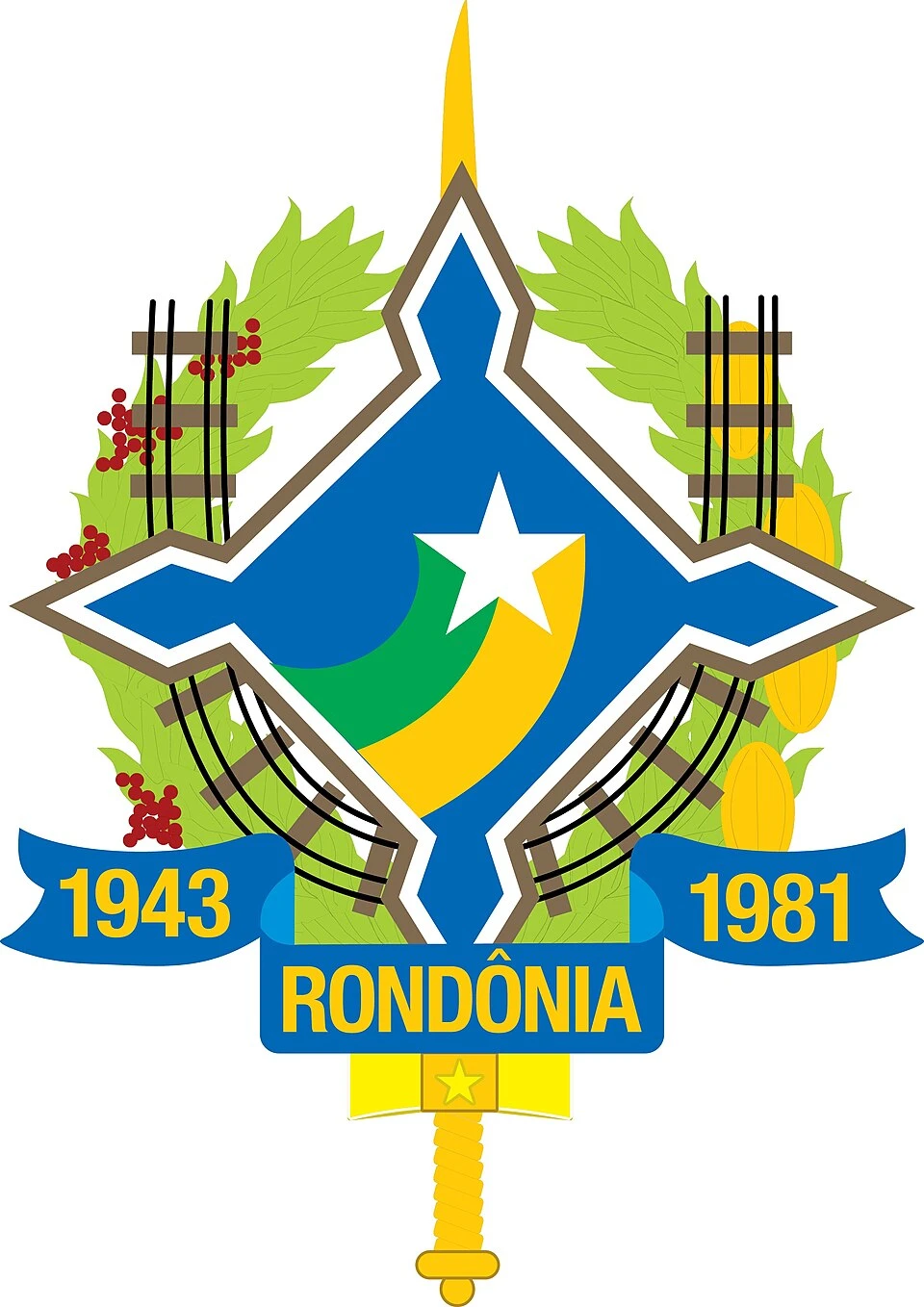
Coat of Arms — A fort-shaped shield combining the Madeira-Mamoré railway, cacao and coffee branches, and the sword of Marechal Rondon.
Like most Brazilian state arms, Rondônia's emblem sets aside classical European heraldic form in favour of a composition built from local landscape, history, and economy. The shield takes the shape of a lozenge with red-and-silver borders, deliberately recalling the outline of the Real Forte Príncipe da Beira, the Portuguese fortress raised between 1776 and 1783 on the Guaporé river, on today's border with Bolivia. At its centre, a blue field carries a white five-pointed star trailing tails of yellow and green.
Below the star, the numerals 1943 and 1981 mark, respectively, the creation of the Federal Territory of Guaporé and the elevation of Rondônia to statehood. A pair of U-shaped rails crossing the lower field recalls the Madeira-Mamoré railway, and the shield is flanked by a coffee branch (representing the migrant settlers who developed commercial agriculture) and a cacao branch (representing the region's older, native crop). Above the shield rises a silver helm with green mantling, crested by an unsheathed sword associated with Marechal Cândido Rondon, pointed upward.
Non-indigenous occupation of the region dates to the rubber boom of the late nineteenth and early twentieth centuries, when migrant workers from Brazil's north-east moved into the Madeira and Guaporé valleys to tap wild rubber trees. To move Bolivian rubber around the Madeira's rapids, an American-financed consortium built the Madeira-Mamoré Railway between 1907 and 1912 — a costly, disease-ridden project that gave rise to the settlement of Porto Velho. In 1943, President Getúlio Vargas carved the Federal Territory of Guaporé out of the states of Mato Grosso and Amazonas as part of his wartime "March to the West" strategy of settling the interior. It was renamed the Federal Territory of Rondônia on 17 February 1956, in honour of Marechal Cândido Rondon, and gained a second economic wave in the 1960s–1980s as one of the world's leading producers of cassiterite (tin ore).
The opening of the BR-364 highway in the 1970s and INCRA colonisation projects drew hundreds of thousands of settlers from the south and north-east. On 22 December 1981, Complementary Law 41 elevated Rondônia to statehood; the state was formally installed on 4 January 1982 under its first governor, Jorge Teixeira de Oliveira. The coat of arms itself has an unusual origin story: its designer, the journalist Marco Aurélio do Nascimento Anconi, entered the state's official design competition but was not among the finalists selected; when officials later compared his heraldic submission with the winning entries, Governor Teixeira judged it superior and ordered it adopted instead, alongside the flag and state anthem, by State Decree-Law 7 of 31 December 1981.
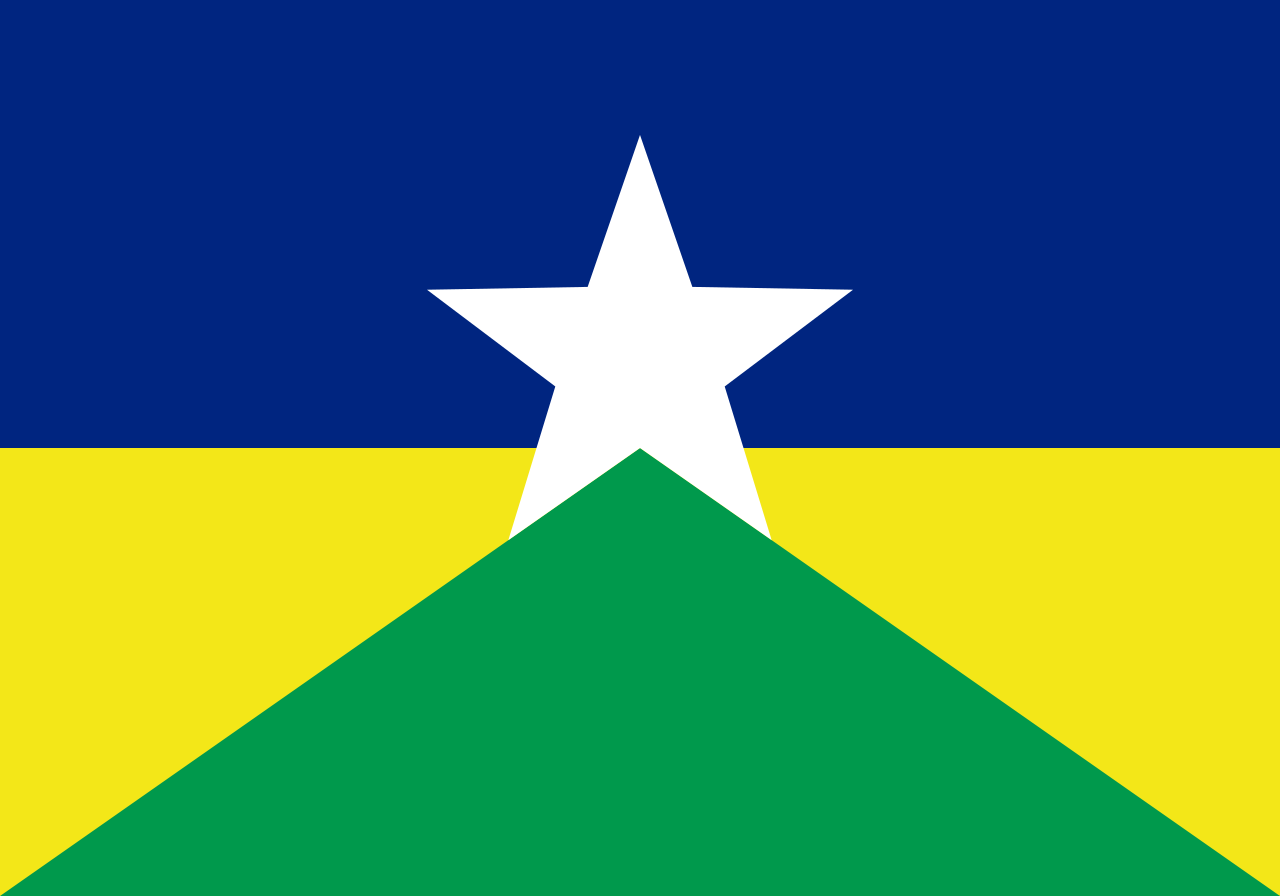
Flag — National colours arranged around a single white star, designed by a 17-year-old contest winner.
The flag of Rondônia was instituted, together with the coat of arms and the state anthem, by State Decree-Law 7 of 31 December 1981 — just over a week after Complementary Law 41 had created the state itself. Rather than commission a single designer, the new state government ran a public competition for its official symbols; the flag design submitted by Sílvio Carvajal Feitosa, then only 17 years old (later an architect and municipal civil servant), was declared the winner. One condition of the competition was that the flag reuse the same four colours as the Brazilian national flag, to visibly affirm Rondônia's place within the federation.
The flag is a rectangle in 7:10 proportions. A blue field occupies the upper half, charged at its centre with a white five-pointed star. Below, green triangles rise from the two lower corners of the rectangle to meet the lower points of the star, while two yellow fields fill the remaining space to either side. Some descriptions of the design read the green area as a road running to the horizon and the star as the state itself, newly risen in the sky of the federation.
The flag flies over all state public buildings and presides over official ceremonies. It is especially prominent on 4 January, the anniversary of the state's installation, and at events marking Porto Velho's municipal anniversary. At regional cultural festivals such as the Guajará-Mirim Folklore Festival and the Arraial Flor do Maracujá, the state flag is displayed alongside municipal banners as a marker of regional identity.
The state is named after Marechal Cândido Mariano da Silva Rondon (1865–1958), the army engineer and indigenist who spent decades stringing telegraph lines across the north-western frontier and made contact with dozens of indigenous peoples, generally under a policy of avoiding violence wherever possible. The former Federal Territory of Guaporé, created in 1943, was renamed Rondônia in his honour in 1956.
The white star trailing yellow and green on the shield is generally said to honour Colonel Jorge Teixeira de Oliveira, the state's first governor, who led the transition from federal territory to statehood in 1981–82. It is a distinct device from the star assigned to Rondônia on the national flag, which represents the star Muliphein (Gamma Canis Majoris).
Rondônia was elevated to statehood by Complementary Law 41 of 22 December 1981, with the state formally installed on 4 January 1982 under its first governor, Jorge Teixeira de Oliveira.
The flag uses the four colours of the Brazilian national flag: blue for the sky, green for the forest, yellow for mineral wealth, and white for peace, arranged around a central five-pointed star.
The lozenge-shaped shield recalls the walls of the Real Forte Príncipe da Beira, an eighteenth-century Portuguese fortress on the Guaporé river; the U-shaped rails recall the Madeira-Mamoré railway built in 1907–1912 to move rubber to market; and the coffee and cacao branches represent, respectively, the region's immigrant-driven agriculture and its older native crop.
Last reviewed by the Emblema Mundi editorial team on 4 July 2026.