State
Rio Grande do Sul is the only Brazilian state whose flag is instantly identifiable by its geometry alone: a diagonal tricolour of green, red and yellow, with no horizontal stripe in sight. Both the flag and the oval coat of arms that sits at its centre trace back to the Riograndense Republic (also called the Republic of Piratini), the breakaway state proclaimed by the Farrapos in 1836 during the decade-long Ragamuffin War (Guerra dos Farrapos, 1835–1845) against the Empire of Brazil. Suppressed, revived, banned again, and finally fixed by state law in 1966, these emblems still carry a republican Phrygian cap, a revolutionary motto, and the exact date the war began.
Flag
Not available
Coat of Arms
Not available
| State | Rio Grande do Sul (Brazil, Sul / South Region) — colloquially "gaúcho" territory |
|---|---|
| Capital | Porto Alegre |
| Administrative history | Comandância Militar do Rio Grande de São Pedro (1737–1760) → Capitania do Rio Grande de São Pedro (1760–1807) → Capitania de São Pedro do Rio Grande do Sul (1807–1821) → Province of São Pedro do Rio Grande do Sul (1821–1889) → State of Rio Grande do Sul, with the Proclamation of the Republic, 15 November 1889 |
| Riograndense Republic | Proclaimed by the Farrapos at Piratini in September 1836 (the rebellion itself had begun on 20 September 1835); defeated by imperial forces in 1845 |
| Flag first raised | 6 November 1836 at Piratini, formally adopted by the Riograndense Republic on 12 November 1836; design traditionally credited to the Italian revolutionary Tito Livio Zambeccari, though Bernardo Pires and José Mariano de Mattos are also credited in different accounts |
| Flag as state symbol | Revived informally after the Proclamation of the Republic (1889); the coat of arms was added at its centre around 1891; banned under the Estado Novo (1937–1946); restored after 1946; current specification fixed by State Law 5.213 of 5 January 1966 |
| Coat of arms | Continues the arms associated with the Riograndense Republic of 1836; traditionally attributed to Father Hidelbrando (design) and Major Bernardo Pires (final execution); current official description fixed by the same State Law 5.213 of 5 January 1966 |
| Flag colours | Green, red, yellow, plus white (central ellipse) and the arms' own gold, silver, blue and black |
| Motto | Liberdade, Igualdade, Humanidade ("Liberty, Equality, Humanity") |
| Inscription on the arms | REPÚBLICA RIO-GRANDENSE and 20 DE SETEMBRO DE 1835 (the day the Farroupilha Revolution broke out) |
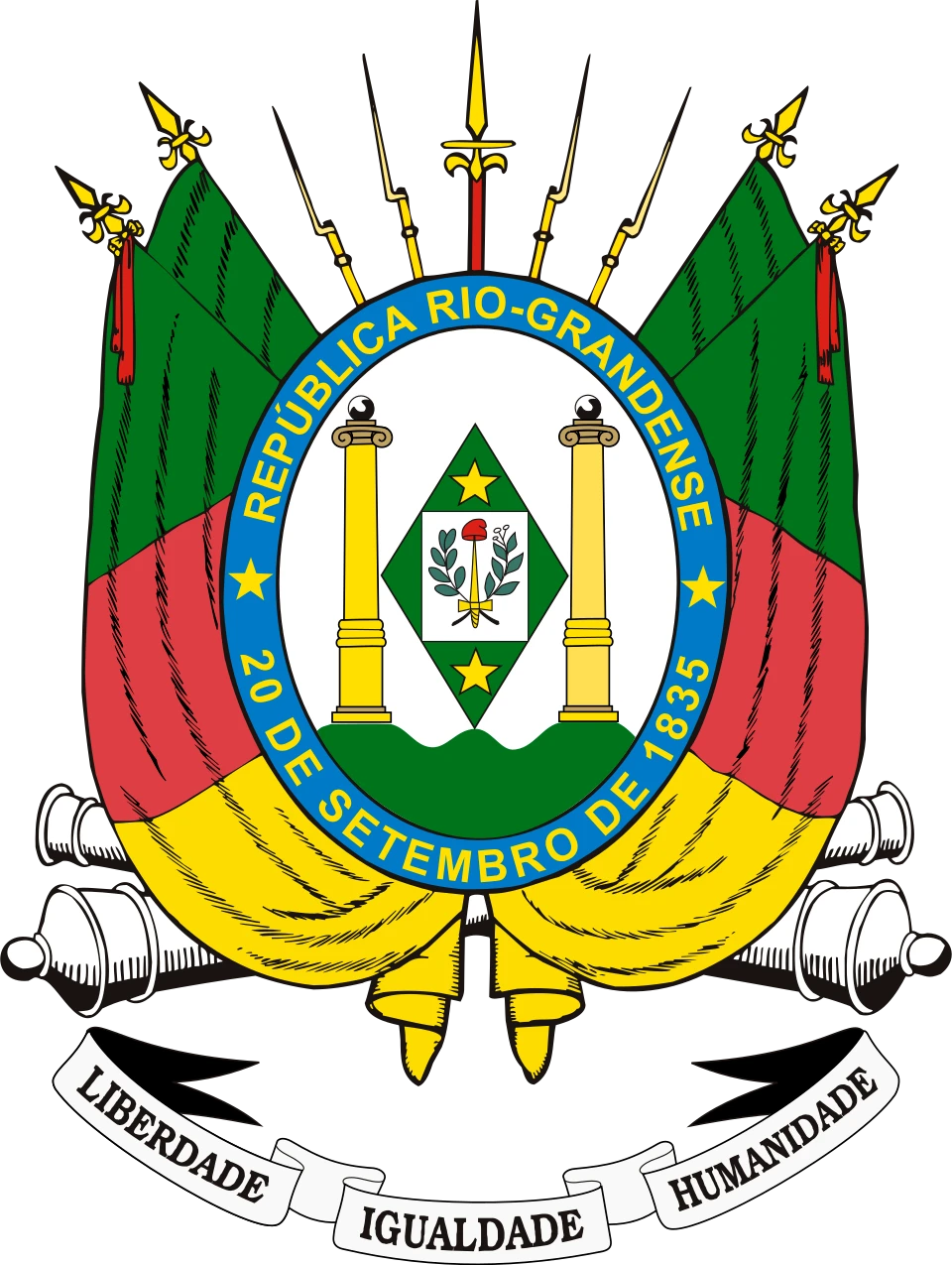
Coat of Arms — The oval Farrapo shield with its Phrygian cap, sabre and 1835 inscription, unchanged since the Riograndense Republic.
The coat of arms of Rio Grande do Sul takes the form of an oval silver shield. At its centre stands a quadrilateral bearing a gold sabre set upright, its point supporting a red Phrygian cap; sprigs of tobacco and yerba mate, shown in their natural colours, cross at the sabre's hilt. This central group is itself inscribed within a green lozenge charged with two gold five-pointed stars, one at the upper angle and one at the lower.
The shield stands on a green wavy field and is flanked by two gold Ionic columns, each with a capital and three rings on the lower third of an otherwise plain shaft, each column topped by a black cannonball. A blue border, edged in black, runs around the whole shield and carries, in gold lettering separated by two five-pointed gold stars, the inscription REPÚBLICA RIO-GRANDENSE and the date 20 DE SETEMBRO DE 1835.
The entire shield is laid over four tricolour flags (green, red and yellow) crossed in pairs, their staffs tipped with an inverted gold fleur-de-lis; the two outermost flags carry a red-and-gold band tied near the fleur-de-lis tip. Also emerging from behind the shield are a cavalry lance in red with a gold inverted fleur-de-lis point, four bayoneted rifles in gold, and, at the base, two crossed cannon in black, half-hidden by the flags. A ribbon beneath the whole composition bears the motto LIBERDADE IGUALDADE HUMANIDADE ("Liberty, Equality, Humanity").
The Farroupilha Revolution (Guerra dos Farrapos) broke out on 20 September 1835, when rebels seized Porto Alegre and deposed the provincial president. The rebellion was not, at first, a bid for full independence; only after further military successes did part of the Farrapo leadership, gathered around General Antônio de Sousa Neto, proclaim the Riograndense Republic (República Rio-Grandense), with its seat at the small town of Piratini, in September 1836. The arms now in use are traditionally said to date from this period, with the design credited to Father Hidelbrando and its final execution to Major Bernardo Pires — though, as with much Farroupilha-era iconography, contemporary documentation is thin and some attributions rest on later tradition rather than surviving primary sources.
The war ended in 1845 with a negotiated peace (the Ponche Verde Accord) that returned the province to the Empire without the harsh reprisals the Farrapos had feared. Their republican emblem nonetheless endured in regional memory and was revived, without a clear single legal act, once Brazil itself became a republic in 1889. Like the arms of most Brazilian states, official use was suppressed during the centralising Estado Novo (1937–1946) under President Getúlio Vargas, then restored once the 1946 federal Constitution returned to the states their authority over their own symbols. The coat of arms reached its present, precisely codified form together with the state flag under State Law 5.213 of 5 January 1966, which — rather than modernising the design — formally readopted the historic Farrapo arms largely as they stood in the nineteenth century.
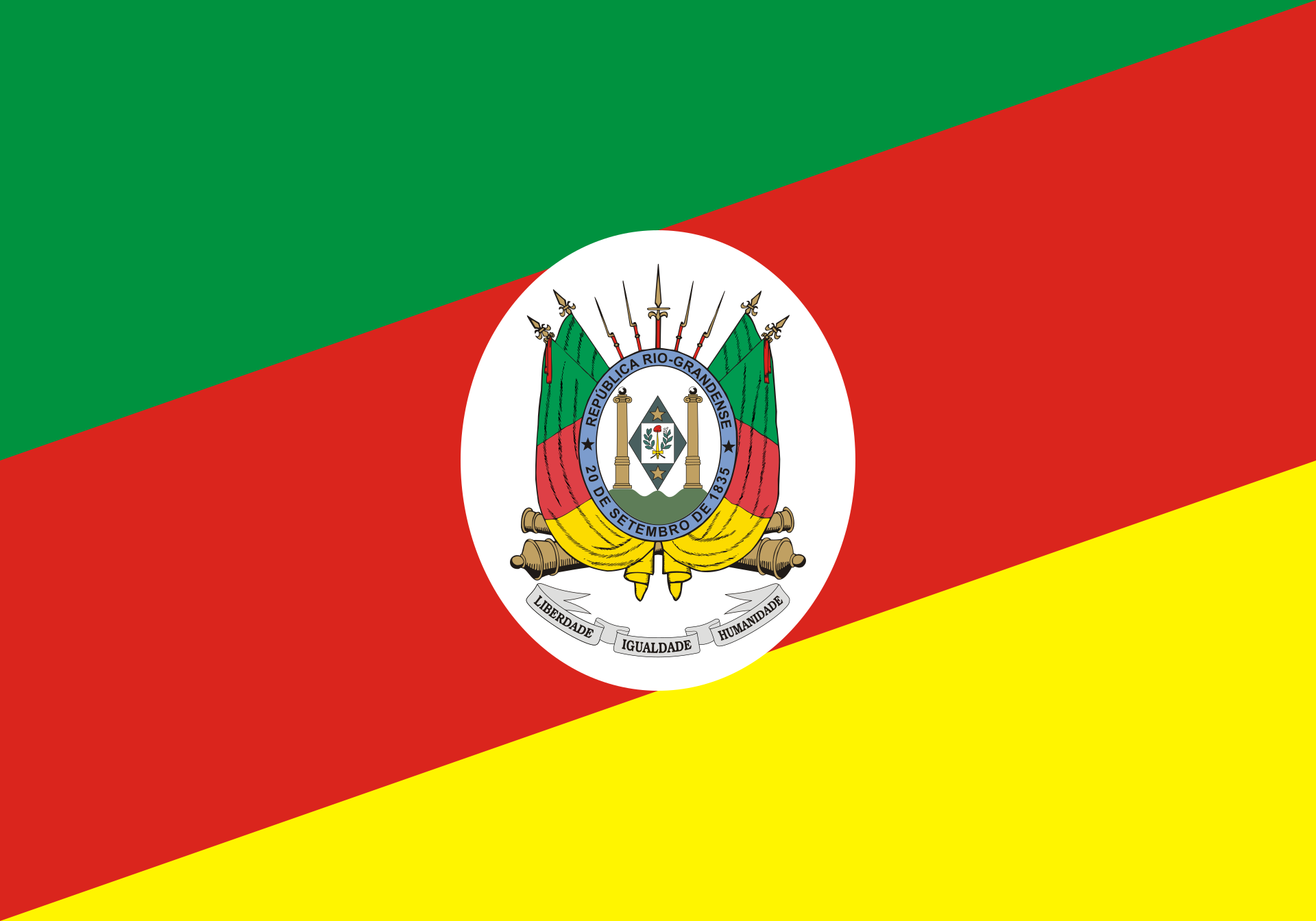
Flag — Green and yellow triangles separated by a rising red band, with the coat of arms at the centre — not horizontal stripes.
The flag of Rio Grande do Sul descends directly from the flag of the Riograndense Republic. According to Farroupilha-era accounts, it was first hoisted at Piratini on 6 November 1836 and formally adopted by decree six days later, on 12 November 1836. Authorship is disputed: the Italian revolutionary and painter Tito Livio Zambeccari, who fought alongside the Farrapos, is one traditionally credited designer, while other accounts name Bernardo Pires or José Mariano de Mattos; a proposal by the Farrapo priest Father Francisco das Chagas for a tricolour with livestock imagery was reportedly considered and rejected in favour of the simpler geometric design.
After the Riograndense Republic's defeat in 1845 the flag lapsed as an official symbol, but it was not forgotten. It reappears in regional use following the Proclamation of the Republic in 1889, and the state coat of arms was added at its centre around 1891, the year of the state's first republican constitution. Like the coat of arms, the flag was banned as an official symbol during the Estado Novo (1937–1946) and restored once the 1946 federal Constitution returned symbolic autonomy to the states. Its current, precisely specified design — proportions, angles and the exact placement of the central ellipse — was fixed only decades later by State Law 5.213 of 5 January 1966, the same law that regularised the coat of arms and established the state anthem.
The flag is a rectangle in 7:10 proportions, matching the ratio of Brazil's national flag; State Law 5.213 specifies a modular grid of 200 modules in length by 140 in width. It is composed of three panels — green, red and yellow — arranged not as horizontal stripes but as a diagonal design: a green right triangle occupies the upper hoist, its right angle at the top left of the flag, and a yellow right triangle occupies the lower fly, its right angle at the bottom right; between them a red quadrilateral rises diagonally, connecting the two triangles. At the centre of the flag sits a white vertical ellipse, measuring 70 by 60 modules under the 1966 law, within which the state coat of arms is placed. The law further specifies that both faces of the flag must be identical, made as a single cloth rather than one side sewn from the reverse of the other.
There is no single agreed meaning for the three colours, and state sources themselves acknowledge the lack of consensus. Among the readings recorded: that green and yellow echo Brazil's own national colours, divided by the red of the war fought against the Empire; that green stands for the pampas and forests, red for revolutionary courage and the blood of the conflict, and yellow for the territory's wealth; and a nineteenth-century interpretation, attributed to a contemporary observer, holding that green signified hope of maintaining independence, yellow signified firmness and resolve, and red served as a warning that the Farrapos would fire on anyone who tried to stop them.
The flag flies over Rio Grande do Sul's public buildings alongside the national flag and is central to the state's most prominent civic festival, the Semana Farroupilha (Farroupilha Week), held around 20 September each year to mark the anniversary of the 1835 revolt. During the Semana Farroupilha, gaúchos across the state wear traditional dress (pilcha), light open-air bonfires, and gather at the Centros de Tradições Gaúchas (CTGs) that promote gaúcho regional culture throughout Rio Grande do Sul and in gaúcho communities elsewhere in Brazil. The flag's diagonal geometry — quite unlike the horizontal or vertical bands used by most Brazilian state flags — makes it one of the most visually distinctive state flags in the country.
No. Although it is often loosely called a tricolour, the flag is not divided into horizontal bands. It is built from a green right triangle at the upper hoist and a yellow right triangle at the lower fly, with a red quadrilateral rising diagonally between them, and a white vertical ellipse at the centre bearing the state coat of arms. This diagonal geometry, fixed by State Law 5.213 of 5 January 1966, is one of the most distinctive designs among Brazil's 27 state flags.
The flag descends directly from the flag of the Riograndense Republic (also called the Republic of Piratini), the breakaway state proclaimed by the Farrapos in September 1836 during the Ragamuffin War. That flag, first raised at Piratini on 6 November 1836 and formally adopted on 12 November 1836, already used the same green-red-yellow palette, traditionally credited to the Italian revolutionary Tito Livio Zambeccari, though other accounts credit Bernardo Pires or José Mariano de Mattos. After the war ended in 1845 the design lapsed, was revived informally in the Republican period from 1889, gained the coat of arms at its centre around 1891, and was banned entirely under the Estado Novo (1937–1946) before being restored and finally regularised by State Law 5.213 in 1966.
There is no single agreed meaning. State sources themselves note the absence of consensus: one long-standing reading holds that the green and yellow echo Brazil's own national colours, split apart by the red of the war fought for independence from the Empire; another reads green for the pampas and forests, red for revolutionary courage and bloodshed, and yellow for the state's natural wealth; a nineteenth-century account by a contemporary observer described green as hope of maintaining independence, yellow as firmness and resolve, and red as a warning that the Farrapos would fire on anyone who tried to stop them.
The red Phrygian cap, mounted on the point of a gold sabre at the centre of the shield, is the classic republican liberty cap inherited from the French Revolution (via the fall of the Bastille and the figure of Marianne). Its presence on the arms of the Riograndense Republic, proclaimed in 1836, signalled the Farrapos' republican and anti-monarchist ideals during their revolt against the Empire of Brazil, and it survives unchanged on the modern state arms fixed by State Law 5.213 of 1966.
The modern state arms deliberately preserve, essentially unaltered, the arms associated with the Riograndense Republic (Republica Rio-Grandense), the short-lived breakaway state proclaimed at Piratini in September 1836 during the Ragamuffin War and defeated in 1845. Rather than replace this revolutionary inscription with the current state's name, State Law 5.213 of 1966 formally readopted the historic design as-is, together with its border inscription of the date 20 DE SETEMBRO DE 1835, marking the war's outbreak, as a permanent civic homage to the Farroupilha Revolution.
Last reviewed by the Emblema Mundi editorial team on 2026-07-05.