State
Rio Grande do Norte's emblems read like a working inventory of the state's coastline and backlands. The coat of arms, fixed in 1909, puts a fisherman's jangada on the open sea beside cotton bolls and sugar cane, flanked by a coconut palm and a carnaúba palm — the tree of the semi-arid interior prized for its wax. The flag, designed nearly half a century later by the folklorist Luís da Câmara Cascudo, is a plain green-and-white field carrying that same shield at its centre, a quiet emblem for a state whose modern history includes a Dutch-granted coat of arms, a fort built against French traders in 1598, and a decisive role as an Allied airbase in the Second World War.
Flag
Not available
Coat of Arms
Not available
| State | Rio Grande do Norte (Brazil, Northeast Region) |
|---|---|
| Capital | Natal (founded 25 December 1599, following the Forte dos Reis Magos, begun 6 January 1598) |
| Coat of arms adopted | State Decree 201 of 1 July 1909, under governor Alberto Maranhão; designed by the sculptor Corbiniano Vilaça |
| Flag adopted | State Law 2,160 of 3 December 1957, under governor Dinarte Mariz; designed by Luís da Câmara Cascudo |
| Flag proportions | 2:3 (one metre by one and a half metres) |
| Flag colours | Green, white, and gold (in the central shield) |
| State admitted | 15 November 1889, with the Proclamation of the Republic (a province since 1822; a captaincy before that) |
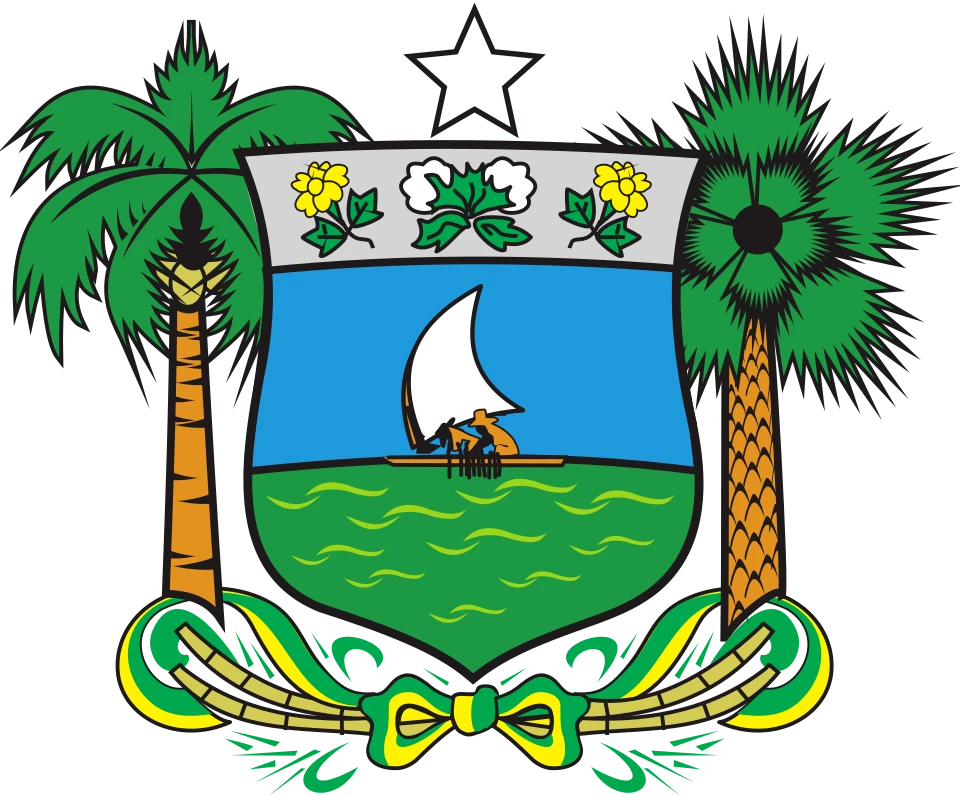
Coat of Arms — A fisherman's jangada on the sea, cotton and sugar cane, flanked by a coconut palm and a carnaúba palm.
The coat of arms of Rio Grande do Norte was established by State Decree 201 of 1 July 1909, during the administration of governor Alberto Maranhão (1908–1914), and was designed by the sculptor Corbiniano Vilaça. The decree describes an open shield divided at two-thirds height. The lower field shows the sea, on which a fisherman's jangada sails — a device the decree itself explains as representing "the salt and fishing industries" together, since salt flats and jangada fishing shared the same stretch of coast. The upper third, on a field of silver, carries two flowers at the sides and two cotton bolls at the centre.
The shield is flanked along its full height by two trees: a coconut palm on one side and a carnaúba palm (Copernicia prunifera) on the other — sources describe the pairing consistently but differ on which side each tree stands, so no fixed dexter/sinister claim is made here. Their trunks are joined by two stalks of sugar cane, tied at the centre by a bow in the national colours. Above the shield rests a white star, described in the original decree as symbolising Rio Grande do Norte's place within the Brazilian federal union.
Portuguese authorities moved to secure the mouth of the Potengi river at the end of the sixteenth century to block French traders who had allied with the Potiguara people against Portuguese colonization. A fleet reached the river mouth on 25 December 1597, and construction of the Forte dos Reis Magos began on 6 January 1598 (Epiphany, hence its name, honouring the three Magi). The city of Natal was founded the following 25 December 1599, taking its name — Portuguese for "Christmas" — from the date of its founding.
During the Dutch occupation of the Brazilian Northeast, the fort was captured in December 1633 and renamed Castelo Ceulen, remaining under Dutch control for roughly two decades until the general capitulation of January 1654. Around 1638, the administration of Johan Maurits van Nassau-Siegen granted the captaincy of Rio Grande its own coat of arms: a river with a rhea (a large flightless bird then abundant on its banks) on the bank, crowned and encircled by a garland of orange blossoms alluding to the House of Orange-Nassau. This Dutch-era shield bears no relation to the arms adopted in 1909 and fell out of use after the Portuguese restoration.
After the restoration, the Capitania do Rio Grande continued under Portuguese administration, becoming an imperial province after Brazilian independence in 1822 and a state of the federation on 15 November 1889, with the Proclamation of the Republic. The 1909 coat of arms dates from this Republican period, in the naturalistic, resource-based idiom common to Brazilian state arms of the era. In the twentieth century, the state's strategic Atlantic-facing coast again drew outside attention: during the Second World War, the American-run Parnamirim Field near Natal became one of the United States' largest airbases outside its own territory, so pivotal to Allied logistics across the South Atlantic that it earned the nickname "Trampolim da Vitória" ("Springboard of Victory"). Two decades later, on 12 October 1965, the Brazilian Air Ministry established the Barreira do Inferno Launch Center near Natal, the first rocket-launch facility in South America.
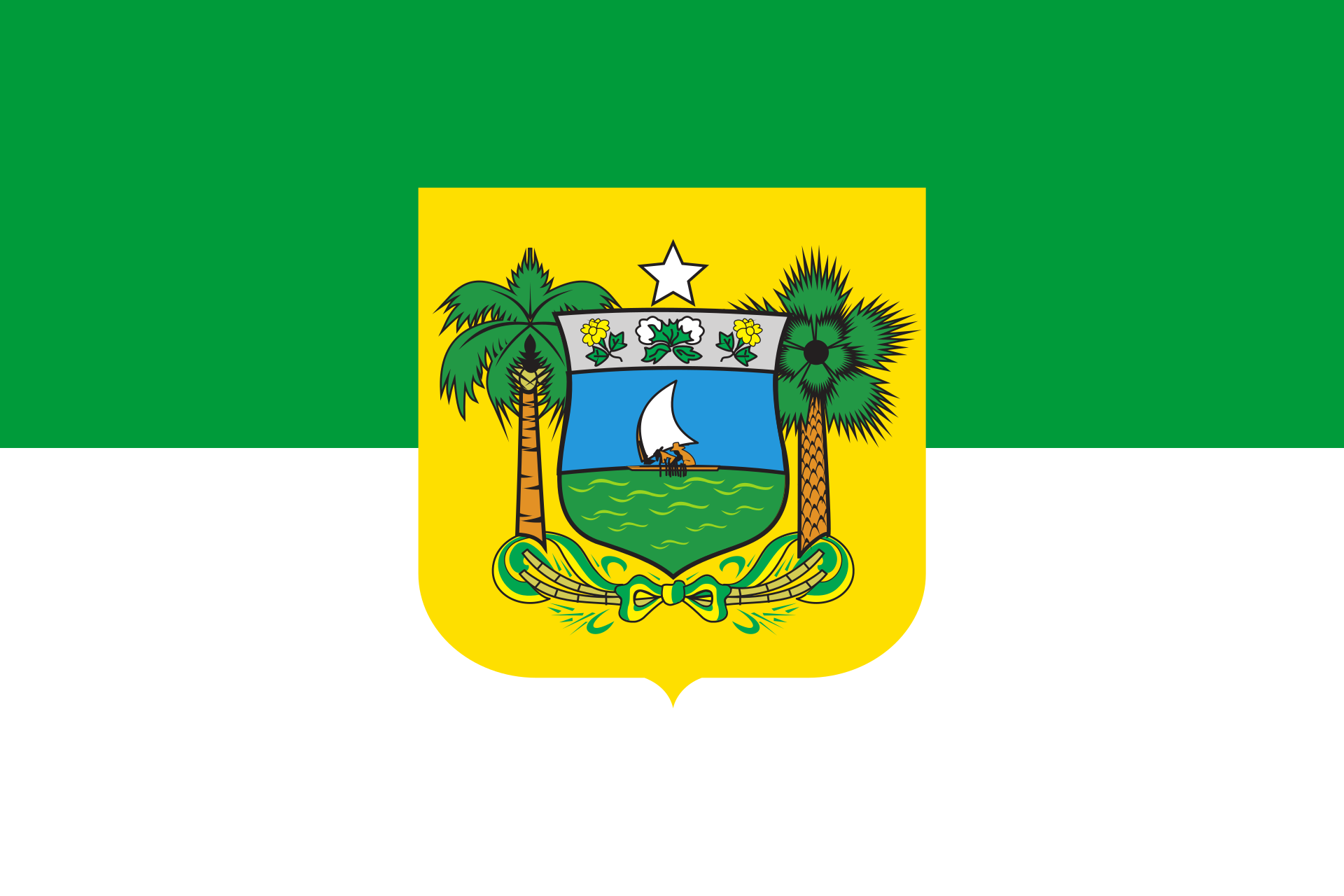
Flag — Green and white fields with the state coat of arms on a golden shield at the centre.
Unlike the coat of arms, the flag of Rio Grande do Norte was a comparatively late addition to the state's official symbols, adopted nearly half a century after the arms it carries. It was established by State Law 2,160 of 3 December 1957, under governor Dinarte Mariz, and its design is credited to Luís da Câmara Cascudo, the state's most prominent folklorist and historian, known for his studies of Potiguar popular culture. Before 1957, the state flew no fixed, legally defined flag of its own; a circa-1930 illustration on a soap-company collector's card shows a blue-and-white design that may reflect an unofficial, informal usage rather than any statute.
The flag is a rectangle in 2:3 proportion (one metre by one and a half metres), divided horizontally into two equal fields: green above — in the same shade as the green of Brazil's national flag — and white below. At the centre sits a golden, French-style shield bearing the state coat of arms established in 1909. In the state's own description, green stands for hope and white for peace, echoing the colour symbolism used on Brazil's national flag itself.
The flag flies over Rio Grande do Norte's public buildings and presides over official state ceremonies alongside the national flag. It is a fixture of the state's June festival season, including Mossoró's Chuva de Bala no País de Mossoró reenactment of the town's 1927 resistance to the bandit Lampião's gang, and appears at major tourism events such as Natal's off-season Carnatal celebration.
The jangada is a traditional sailing raft used by fishermen along the Rio Grande do Norte coast. On the 1909 coat of arms it sails on the sea in the lower third of the shield, and the state's official description explains that it stands for two of the region's historic economic pillars together: the fishing industry and the sea-salt industry, since jangadas and salt flats shared the same coastline.
The shield is flanked by a coconut palm on one side and a carnaúba palm (Copernicia prunifera) on the other. The coconut palm reflects the state's sandy Atlantic coastline, while the carnaúba, native to the semi-arid interior, was historically prized for its wax, used in candles, polishes, and later phonograph records and cosmetics; together the two palms sum up the coastal and backland halves of Rio Grande do Norte's territory.
The flag was designed by Luís da Câmara Cascudo, the state's leading folklorist and historian, and formally adopted by State Law 2,160 of 3 December 1957 under governor Dinarte Mariz. Cascudo set the flag's proportions and its green-over-white field, onto which the state coat of arms, adopted separately in 1909, was placed on a golden shield.
Yes. During the Dutch occupation of the Brazilian Northeast, the administration of Johan Maurits van Nassau-Siegen granted the captaincy of Rio Grande a coat of arms around 1638 showing a river with a rhea (a large flightless bird then abundant on its banks), crowned and bordered by a garland of orange blossoms referencing the House of Orange-Nassau. It was replaced after the Portuguese restoration and bears no relation to the current 1909 design.
The former Capitania do Rio Grande became an imperial province in 1822 after Brazilian independence, and became a state of the federation on 15 November 1889 with the Proclamation of the Republic. Its capital, Natal, had been founded on 25 December 1599, following the construction of the Forte dos Reis Magos, begun on 6 January 1598 to secure the Potengi river mouth against French traders allied with the Potiguara.
Last reviewed by the Emblema Mundi editorial team on 2026-07-05.