State
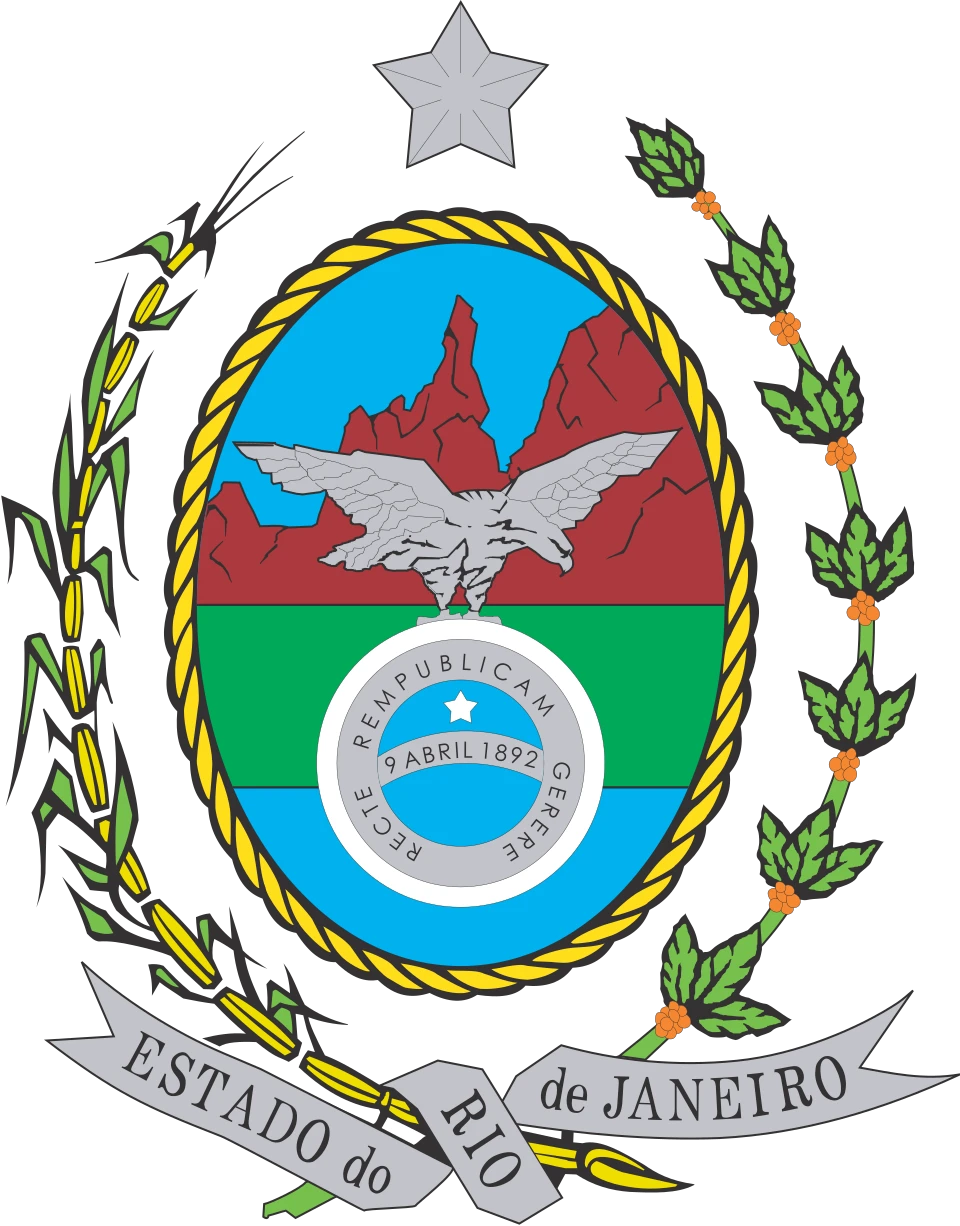
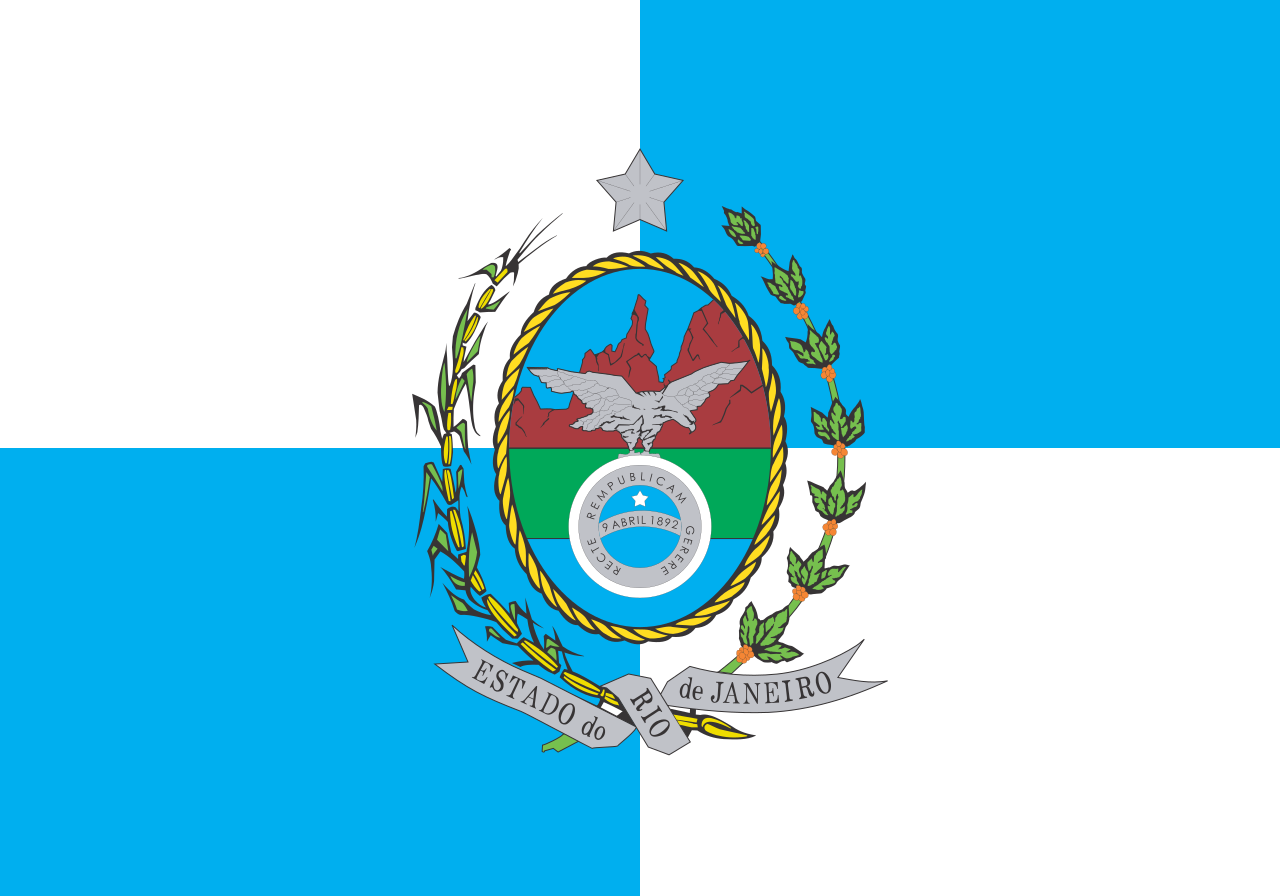
The state of Rio de Janeiro is unusual among Brazil's 27 federative units in sharing its exact name with its own capital city — and its heraldry is equally shaped by an unusual political history. The coat of arms, in use since 1892 and fixed in its present form in 1965, places an eagle above an oval shield bearing the Serra dos Órgãos mountains, flanked by branches of coffee and sugarcane. The state flag — a plain rectangle quartered in white and light blue, with the coat of arms at its centre — is a wholly different design from the much more famous armillary-sphere flag that belongs only to the city of Rio de Janeiro. Both symbols predate, and survived, the state's most consequential twentieth-century event: the 1975 fusion with the short-lived state of Guanabara.
Flag
Not available
Coat of Arms
Not available
| State | Rio de Janeiro (Brazil, Sudeste / Southeast Region) — the state shares its exact name with its capital city, unlike most Brazilian states |
|---|---|
| Capital | City of Rio de Janeiro (capital of the merged state since 15 March 1975; previously the separate state of Rio de Janeiro was governed from Niterói, 1894/1903–1975) |
| Province / state created | Province of the Empire from the 1820s; state of the federation with the Proclamation of the Republic, 15 November 1889 |
| 1960–1975 split | When the national capital moved to Brasília in 1960, the city of Rio de Janeiro became its own federative unit, the state of Guanabara, while the separate state of Rio de Janeiro (capital Niterói) continued alongside it |
| 1975 fusion | Complementary Law 20 of 1 July 1974 merged the states of Rio de Janeiro and Guanabara into a single state, named Rio de Janeiro, effective 15 March 1975, with the city of Rio de Janeiro as capital |
| Coat of arms adopted | State Law 3 of 29 June 1892 (original design by engineer Ricardo Honorato Pereira de Carvalho); suspended 1937–1962/63; current description fixed by State Law 5.588 of 5 October 1965 (revision by Alberto Rosa Fioravanti) |
| Flag adopted | State Law 5.588 of 5 October 1965, same law as the coat of arms; both later consolidated, together with the state anthem, by Decree-Law 553 of 25 November 1976 |
| Designer (1965 revision) | Alberto Rosa Fioravanti, commissioned by governor Paulo Torres |
| Flag colours | White and light blue (celeste), quartered; no third colour |
| Motto | Recte Rempublicam Gerere ("To conduct public affairs with integrity") |
Coat of Arms — An oval shield with the Serra dos Órgãos, an eagle above bearing the star Beta Crucis, flanked by coffee and sugarcane.
The coat of arms of the state of Rio de Janeiro — distinct from the coat of arms of the city of the same name — takes the oval shield form traditionally used by clergy, said to symbolise the Christian aspirations of the fluminense people. The shield is divided into three horizontal sections: the upper half is blue, representing the sky and standing for justice, truth and loyalty, charged with the silhouette of the Serra dos Órgãos mountain range, its Dedo de Deus ("Finger of God") peak the most prominent feature; the middle quarter is green, for the lowlands of the Baixada Fluminense; and the lower quarter is blue again, recalling the sea along the state's beaches. A gold cord encircles the whole shield, read as a symbol of the union of the fluminense people.
Above the shield stands an eagle in natural colour, wings open as if taking flight, perched upon a small round blue escutcheon fimbriated in silver. This inner roundel bears two inscriptions: a silver fess reading 9 DE ABRIL DE 1892 (the date of the state's first republican constitution) and a silver orle carrying the Latin motto RECTE REMPUBLICAM GERERE ("to conduct public affairs with integrity" or "with righteousness"). Surmounting the eagle is a single silver five-pointed star, identified in the official description as Beta Crucis, the star that represents Rio de Janeiro among the Southern Cross stars on the flag of Brazil. Flanking the shield as supporters are a fruiting coffee branch and a sugarcane stalk, both described in the state legislation as representing "the principal products of the land."
The present design descends from State Law 3 of 29 June 1892, adopted only months after Rio de Janeiro's first republican state constitution, and credited to the fluminense engineer Ricardo Honorato Pereira de Carvalho. Like the arms of most Brazilian states, it went out of official use between 1937 and the early 1960s under the centralising Estado Novo Constitution of 1937, which suppressed regional symbols; state emblems generally became legal again after the 1946 federal Constitution restored the states' authority to adopt them. At the request of governor General Paulo Torres, the design was reinstated and formally re-described by State Law 5.138 of 7 February 1963, then revised in detail — adjusting the eagle's posture and the position of the star — by State Law 5.588 of 5 October 1965, the work of the heraldist Alberto Rosa Fioravanti. Both the coat of arms and the flag were later reconsolidated, together with the state anthem, by Decree-Law 553 of 25 November 1976, issued the year after the Guanabara fusion but without altering the 1965 designs.
Because the current arms and flag date from 1965 — a decade before the 1975 merger with Guanabara — neither emblem was created to commemorate that fusion, and neither incorporates any element from the former state of Guanabara's own coat of arms or flag, which went out of official use once the merger took effect.
Flag — Quartered white and light blue, with the state coat of arms at the centre.
During the Empire, the then-province of Rio de Janeiro flew a naval pavilion broadly similar to today's flag, though without a coat of arms and used informally rather than by law. After the Proclamation of the Republic, the design was adapted with an adjusted quartering and, in time, the addition of the state arms. Like the coat of arms, the flag was banned as an official symbol between 1937 and the mid-1940s under the Estado Novo Constitution, returning to use once the 1946 federal Constitution restored the states' right to their own symbols. The flag's current, precisely specified form was fixed by State Law 5.588 of 5 October 1965 — the same law that redescribed the coat of arms — designed by Alberto Rosa Fioravanti for governor Paulo Torres.
Because this law dates from a decade before the 1975 fusion with Guanabara, the flag was not created to mark that merger, and Guanabara's own, separate state flag (in use 1960–1975) lapsed once the fusion took effect rather than being combined with the Rio de Janeiro design.
The flag is a rectangle in 7:10 proportions (specified in the state law as 20 modules in length by 14 in width, matching the ratio of Brazil's national flag), divided by a horizontal and a vertical axis into four equal quarters alternating white and light blue (azul-celeste): at the hoist, the upper quarter is white and the lower blue; at the fly, the pattern reverses, with the upper quarter blue and the lower white. The state coat of arms is placed at the centre of the flag, sized to occupy roughly five-sevenths of its height. Unlike the flags of some other Brazilian states, no third colour appears — the palette is strictly white and light blue throughout.
State sources describe blue and white as inherited from the traditional colours of the Portuguese monarchy. In the coat of arms placed at the flag's centre, white and light blue are further read heraldically as standing for innocence, purity and peace (white) and justice, loyalty, knowledge and vigilance (blue).
Note on a very different, more famous flag: The white flag with a blue saltire and a red shield bearing three silver arrows, a Phrygian cap and an armillary sphere — instantly recognisable and widely photographed in Rio's Carnival and beach culture — belongs specifically to the city (municipality) of Rio de Janeiro, adopted on 8 July 1908, not to the state. The two flags are unrelated in design beyond sharing a Portuguese-derived blue-and-white palette, and this page concerns the state flag only.
The state flag flies over Rio de Janeiro's public buildings and official ceremonies alongside the national flag, and is flown at half-mast or displayed prominently during state civic commemorations such as the anniversary of the 1975 fusion. It is administratively distinct from, and considerably less visible in popular culture than, both the national flag and the city of Rio de Janeiro's own armillary-sphere flag.
No, they are entirely different designs. The state arms show an oval shield with the Serra dos Órgãos mountains, an eagle above, and coffee and sugarcane branches. The city (municipal) coat of arms, by contrast, is a red shield bearing three silver arrows and an armillary sphere beneath a Phrygian cap, supported by two dolphins beneath a mural crown — a design tied to the city's own founding in 1565 and its patron saint, Sebastian.
No. The widely recognised white flag with a blue saltire and a red shield bearing an armillary sphere belongs specifically to the city (municipality) of Rio de Janeiro, adopted in 1908. The state flag is a plain rectangle quartered in white and light blue with the state coat of arms at its centre, fixed by State Law 5.588 of 5 October 1965. The two flags share a blue-and-white Portuguese-derived palette but are otherwise unrelated designs belonging to different levels of government.
Guanabara was created in 1960 out of the former Federal District when Brazil's capital moved to Brasília, covering only the city of Rio de Janeiro; the state of Rio de Janeiro itself continued to exist alongside it, with its capital at Niterói. Complementary Law 20 of 1 July 1974 merged the two into a single state, effective 15 March 1975, under the name Rio de Janeiro, with the city of Rio de Janeiro as its capital; Guanabara's own flag and arms went out of official use at the merger.
The eagle, shown in natural colour with open wings as if taking flight above the shield, is officially described as representing a strong, honest and just government, carrying a message of confidence and hope to every corner of the state. It rests upon a small round blue escutcheon inscribed with the date of the state's first constitution and the Latin motto Recte Rempublicam Gerere.
It is a single silver five-pointed star representing Beta Crucis, the second-brightest star of the Southern Cross constellation, the same star that stands for the state of Rio de Janeiro among the 27 stars on the flag of Brazil.
Last reviewed by the Emblema Mundi editorial team on 2026-07-05.