State
Piauí's emblems, both fixed in a single stroke by State Law 1,050 of 1922, tell the story of a state shaped by cattle rather than sugar. The coat of arms, designed by Luís Mendes Ribeiro Gonçalves, sets three native palms above three silver piau fish — the species that gives the state its name — swimming over the stripes of the Parnaíba's tributaries. The flag, a thirteen-stripe field of green and yellow with a starred blue canton, was updated in 2005 to add a single date, 13 de Março de 1823, marking the bloodiest battle of Brazil's war of independence — fought not in the south, but on Piauiense soil at Jenipapo.
Flag
Not available
Coat of Arms
Not available
| State | Piauí (Brazil, Northeast Region) |
|---|---|
| Capital | Teresina (founded 1852, replacing Oeiras; one of the few Brazilian state capitals with no coastline) |
| State admitted | Captaincy created 1718 (split from Maranhão); province from 28 February 1821; state with the Proclamation of the Republic, 15 November 1889 |
| Coat of arms adopted | State Law 1,050 of 24 July 1922, designed by Luís Mendes Ribeiro Gonçalves under governor João Luís Ferreira |
| Flag adopted | State Law 1,050 of 24 July 1922; date inscription added by State Law 5,507 of 17 November 2005 |
| Flag colours | Green, yellow, blue, white |
| Coat of arms motto | Impavidum ferient ruinae ("Ruin will strike the fearless one in vain") |
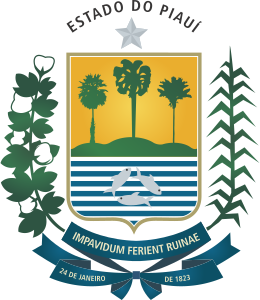
Coat of Arms — Three native palms above three silver piau fish, the species that gives the state its name.
Emblema Mundi does not yet have a coat-of-arms image on file for Piauí (only the state flag); this section is based entirely on the sourced heraldic text below and should be read alongside official reproductions.
The coat of arms of Piauí was designed by Luís Mendes Ribeiro Gonçalves, a writer and intellectual serving as secretary of public works, at the initiative of governor João Luís Ferreira, and established by State Law 1,050 of 24 July 1922. It replaced an older state seal that had been in use since 1894.
The shield is neoclassical, divided into two fields. The upper field (gold) bears three native palm trees side by side — the carnaúba, the buriti and the babaçu — read by the law as representing three successive phases of the state's settlement. The lower field shows seven blue stripes on a white ground, standing for the principal tributaries of the Parnaíba river's right bank, above which swim three silver piau fish arranged in a triangular pattern, representing the state's three largest rivers: the Parnaíba, the Canindé and the Poti. Above the shield rises a five-pointed silver star, and the whole is flanked by branches of cotton and sugar cane tied at the base by a blue ribbon inscribed in gold letters with the Latin motto Impavidum ferient ruinae and the date 24 de janeiro de 1823, marking Piauí's adhesion to Brazilian independence.
A note on accuracy: some descriptions in circulation — including outdated text on this site's own Portuguese page — describe the arms as bearing a Phrygian cap. This is incorrect. No Phrygian cap appears in the 1922 legal text or in the Wikipedia and heraldic reference descriptions consulted for this page; the confusion likely borrows a charge common on other Brazilian Republican-era state arms. The arms have also been reproduced since around 2023 in a modernised state government version with rounded rather than angular branch outlines, without a change to the underlying 1922 heraldic description.
Piauí's colonization followed a different path from the sugar-growing coastal states to its east: it was cattle, not cane, that drew settlers inland. From the mid-seventeenth century, Portuguese and Luso-Brazilian ranchers — many arriving via Bahia and Pernambuco — pushed into the Piauí backlands establishing vast currais (cattle enclosures) and latifundia worked largely by hired and enslaved vaqueiros (cowhands), supplying meat and hides to the wider colony rather than growing an export crop. The Captaincy of São José do Piauí was formally created in December 1718 as an offshoot of the Captaincy of Maranhão, gaining its own resident governor only decades later and full separate administration in 1811; it became a province on 28 February 1821 and a state with the Proclamation of the Republic on 15 November 1889.
The defining episode of the coat of arms' historical dating is the Battle of Jenipapo, fought on 13 March 1823 on the banks of the Jenipapo river at Campo Maior. Over a thousand poorly armed Piauiense civilians — vaqueiros, farmers and Indigenous fighters wielding scythes, machetes and old hunting muskets — joined by some five hundred Ceará volunteers under Captain Luís Rodrigues Chaves, confronted Portuguese royalist troops commanded by Major João José da Cunha Fidié. The five-hour battle left roughly two hundred Brazilians dead against sixteen Portuguese casualties — a tactical defeat, but one that so exhausted Fidié's column that his men were forced to surrender weeks later at Caxias, in neighbouring Maranhão, ending Portugal's last military foothold in Brazil's north. The state's coat of arms commemorates the wider adhesion movement with the date 24 January 1823, while the flag was later updated specifically to mark the Jenipapo anniversary (see Flag, below).
Piauí territory was also touched, at its margins, by the Balaiada (1838–1841), a popular revolt centred in neighbouring Maranhão against the provincial oligarchy; rebel columns under leaders including Raimundo Gomes and Manoel Francisco dos Anjos Ferreira carried the fighting into Piauí in 1839 before the uprising was suppressed. Because the revolt's political and social epicentre lay in Maranhão, it is treated here as a border episode of Piauí's history rather than, as on some other regional pages, a defining one.
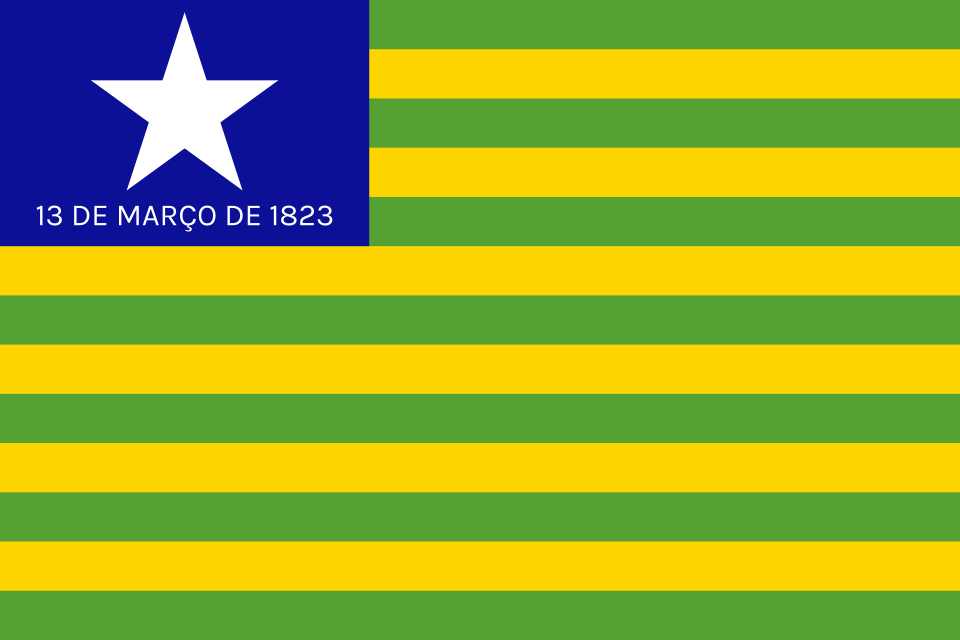
Flag — Thirteen stripes of green and yellow, with a blue canton bearing a white star and the date of the Battle of Jenipapo.
The flag was adopted alongside the coat of arms by the same State Law 1,050 of 24 July 1922, signed by governor João Luís Ferreira, replacing an earlier design. Its text specifies the flag in the archaic orthography of the period: "cores nacionaes verde e amarello alternadas em sete faixas da primeira e seis da segunda" (the national colours green and yellow, alternated in seven stripes of the first and six of the second), with a blue rectangle bearing a white star in the upper-left canton. The design was left otherwise unchanged for over eighty years until State Law 5,507 of 17 November 2005 added a single element: the inscription 13 DE MARÇO DE 1823 beneath the star, commemorating the Battle of Jenipapo (see Coat of Arms, above).
The flag is a field of thirteen horizontal stripes in a 2:3 proportion — seven green and six yellow, alternating from the top — echoing Brazil's national colours. In the upper-left canton sits a blue rectangle bearing a white five-pointed star, with the inscription 13 DE MARÇO DE 1823 in white capitals below it since the 2005 amendment. Official symbolism, per sources consulted, reads yellow as the state's mineral wealth, green as hope, and blue as the sky; the white star is identified with Antares, the star conventionally assigned to Piauí on Brazil's national flag, marking the state's place within the federation.
The flag flies over Piauí's public buildings and presides over official state ceremonies alongside the national flag. It is most prominent each 13 March, the state holiday marking the Battle of Jenipapo, when Teresina and Campo Maior hold civic commemorations for the piauienses who fought in 1823.
The three silver piau fish (the species that gives the state its name) represent Piauí's three principal rivers: the Parnaíba, the Canindé and the Poti. They sit above seven blue stripes symbolising the main tributaries of the Parnaíba's right bank, beneath the shield's upper field of three native palms.
No. This is a common error, including on outdated Portuguese-language descriptions of the arms. The official 1922 design, set by State Law 1,050, has no Phrygian cap: its charges are three native palms, three piau fish, seven river stripes, a silver star and a Latin motto, flanked by cotton and sugar-cane branches. The Phrygian cap belongs to the arms of other Brazilian states, not Piauí.
Fought on 13 March 1823 on the banks of the Jenipapo river near Campo Maior, it pitted over a thousand poorly armed Piauiense civilians and around five hundred Ceará volunteers against Portuguese royalist troops under Major João José da Cunha Fidié. Roughly two hundred Brazilians were killed against sixteen Portuguese losses, but the resistance so exhausted Fidié's column that his men surrendered weeks later at Caxias, Maranhão, securing the independence of Brazil's northern provinces.
The flag was adopted by State Law 1,050 of 24 July 1922, alongside the coat of arms, both designed by Luís Mendes Ribeiro Gonçalves under governor João Luís Ferreira. Its current form, adding the inscription 13 DE MARÇO DE 1823 to the canton, was fixed by State Law 5,507 of 17 November 2005.
Teresina, founded in 1852 to replace the inland town of Oeiras, is generally considered the first planned state capital in Brazil, laid out under Councillor José Antônio Saraiva with streets running in parallel from the Parnaíba to the Poti river. It is also one of the few Brazilian state capitals with no coastline, and it is named after Empress Teresa Cristina, consort of Pedro II.
Last reviewed by the Emblema Mundi editorial team on 2026-07-05.