State
Pernambuco's emblems are a record of a state that has rebelled against distant authority more than once. The coat of arms, fixed by State Law 75 of 1895, shows Recife's own lighthouse and harbour fort with Olinda in the distance, crested by a resting lion and dated with four flashpoints of local defiance: 1710, 1817, 1824 and 1889. The flag began as the banner of the 1817 Pernambuco Revolution — a rainbow, a sun and a red cross on fields of blue and white — and was only made an official state symbol a century later, on the revolution's 1917 centenary.
Flag
Not available
Coat of Arms
Not available
| State | Pernambuco (Brazil, Northeast Region) |
|---|---|
| Capital | Recife (capital in practice from the 1820s; Olinda was the original colonial capital) |
| Coat of arms adopted | State Law 75 of 21 May 1895, under governor Alexandre Barbosa Lima; corrected heraldic rendering fixed in 1997 by researcher Jobson Figueiredo |
| Flag designed | 1817, during the Pernambuco Revolution, attributed to Padre João Ribeiro Pessoa de Melo Montenegro; painted by Antônio Alvares |
| Flag officialised | State Decree 459 of 23 February 1917; current construction specifications by State Law 17,139 of 28 December 2020 |
| Flag colours | Blue, white, red, yellow, green |
| Coat of arms crest | A resting lion, popularly linked to Pernambuco's epithet "the Lion of the North" |
| Dates on the arms | 1710, 1817, 1824, 1889 |
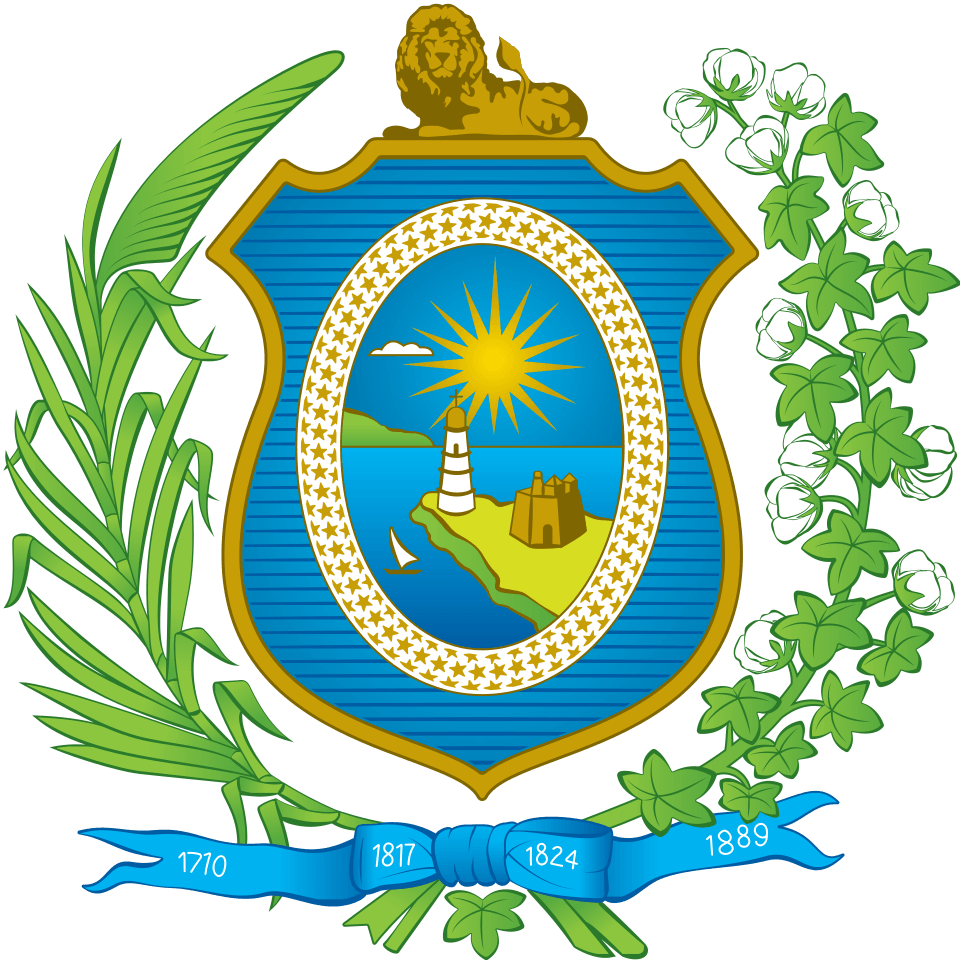
Coat of Arms — Recife's lighthouse and fort beneath a rising sun, crested by a resting lion and framed by sugar cane and cotton.
The coat of arms of Pernambuco was fixed in its official heraldic wording by State Law 75 of 21 May 1895, under governor Alexandre Barbosa Lima. A blue shield is bordered by a narrow elliptical band charged with stars, one for each municipality of the state. Within the ellipse is a view of Recife seen from the north: the city's lighthouse (Farol do Recife) and the fortification at the harbour bar stand in the foreground, with the older city of Olinda visible in the distance, and the sun rising over the ocean to the right. Above the shield, as crest, stands a resting lion. The composition is flanked by sugar cane and a flowering cotton plant, interlaced, and tied at the base by a blue-and-white ribbon bearing four dates: 1710, 1817, 1824 and 1889.
A note on accuracy: some secondary descriptions in circulation — including outdated text on this site's own Portuguese page — describe the crest as a "leão passant" (a walking lion within the shield) and omit the Recife/Olinda cityscape and the four-date ribbon entirely. The 1895 legal wording and the 1997 corrected heraldic rendering both place the lion resting as a crest above the shield, not walking within it, and both include the city view and the ribbon of dates. We follow the legally described and heraldically corrected version here.
The captaincy of Pernambuco was granted to Duarte Coelho Pereira in 1534 and grew rich on sugar, developed around Olinda, its first capital. In 1630 the Dutch West India Company invaded, and from 1637 to 1644 the colony was governed by Johan Maurits van Nassau-Siegen, whose rule brought relative tolerance and urban development to Recife, including the presence of the painters Frans Post and Albert Eckhout. After Nassau's recall, Dutch policy hardened, and Luso-Brazilian planters together with free Black and Indigenous fighters — commanders João Fernandes Vieira, André Vidal de Negreiros, Henrique Dias and Filipe Camarão among them — waged the Insurreição Pernambucana (1645–1654), culminating in the Battles of Guararapes (1648–1649) and the final Dutch surrender in 1654.
The four dates on the arms' ribbon mark later flashpoints of the same combative history: 1710, the Guerra dos Mascates, a conflict between Olinda's sugar planters and Recife's Portuguese merchants over municipal status and trade privileges; 1817, the Pernambuco Revolution, a republican uprising that briefly broke from Portuguese rule (see Flag, below); 1824, the Confederação do Equador, a separatist republican movement led by Manuel de Carvalho Paes de Andrade that spread briefly to Paraíba and Ceará before being crushed; and 1889, the Proclamation of the Republic across Brazil. Recife itself succeeded Olinda as Pernambuco's effective seat of government over the 1820s–30s, formalising a rivalry the 1710 conflict had already exposed.
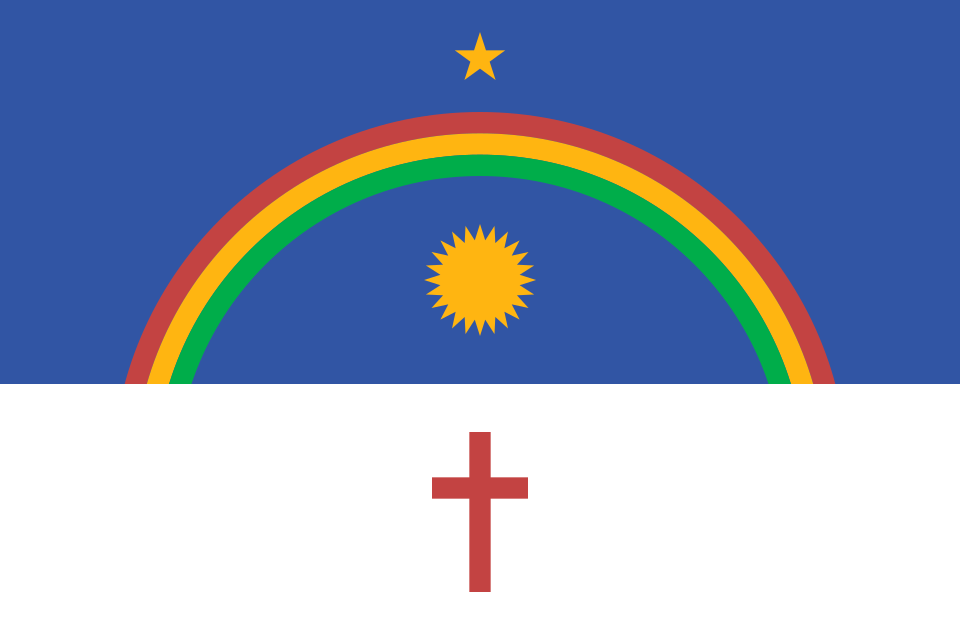
Flag — A rainbow, star and sun over blue, a red cross over white — the banner of the 1817 Pernambuco Revolution.
The flag of Pernambuco was not designed as a state symbol but as the banner of a revolution. When the Pernambuco Revolution broke out on 6 March 1817, the insurgents initially raised a plain white flag signalling peaceful intent; a fuller design, attributed to the priest and revolutionary João Ribeiro Pessoa de Melo Montenegro and executed on canvas by the painter Antônio Alvares, followed within weeks, carrying a white rainbow, a sun, and three stars for Pernambuco, Paraíba and Rio Grande do Norte — the captaincies the rebels hoped would join their short-lived republic. The design was not revived as an official symbol until exactly a century later: State Decree 459 of 23 February 1917, signed by governor Manuel Antônio Pereira Borba on the revolution's centenary, fixed the flag substantially as it appears today, with two of the three stars removed and the rainbow's white band changed to green. Its current technical construction specifications — proportions, module grid and official colour values — were set out by State Law 17,139 of 28 December 2020.
The flag is divided horizontally into two unequal fields: a larger blue field above (24 of 40 vertical units under the 2020 specification) and a smaller white field below (16 units), in an overall 2:3 proportion. Within the blue field, a rainbow of red, yellow and green arcs across the design; a yellow five-pointed star sits above it, and a yellow sun sits within the semicircle it forms. The white field below carries a red cross spanning its width. In official use, blue is read as the grandeur of the Pernambuco sky, white as peace, the rainbow as the union of all Pernambucans, the star as the state's place within the federation, the sun as the state's strength and energy, and the cross as faith in justice and understanding.
The flag flies over Pernambuco's public buildings, schools and barracks alongside the national flag. It is most visible on 6 March, the state holiday marking the anniversary of the 1817 revolution, and it has occasionally drawn national attention for its rainbow motif being mistaken abroad for an LGBTQ+ pride symbol — a coincidence unrelated to the flag's 1817 revolutionary origin.
The blue-and-white ribbon at the base of the shield carries four dates: 1710, the year of the Guerra dos Mascates between Olinda's planters and Recife's merchants; 1817, the Pernambuco Revolution; 1824, the Confederação do Equador; and 1889, the Proclamation of the Republic. Together they mark Pernambuco's recurring history of local uprisings against distant authority.
No. The heraldic description set by State Law 75 of 1895 places a resting lion as the crest above the shield, not a lion passant (walking, three paws on the ground) within it. The lion has long been popularly linked to Pernambuco's nickname "the Lion of the North," a byname for the state's history of rebellion, though the two are not formally the same heraldic tradition.
The flag originated during the 1817 Pernambuco Revolution and was formally made an official state symbol by State Decree 459 of 23 February 1917, signed by governor Manuel Antônio Pereira Borba on the revolution's centenary. Its current technical construction specifications were set by State Law 17,139 of 28 December 2020.
The Dutch West India Company occupied Pernambuco from 1630, with Johan Maurits van Nassau-Siegen governing the colony from 1637 to 1644 and turning Recife into a cosmopolitan capital. After Nassau's recall, Luso-Brazilian planters, free Black and Indigenous fighters waged the Insurreição Pernambucana (1645–1654), culminating in the Battles of Guararapes (1648–1649) and the Dutch surrender in 1654.
A republican and separatist uprising that began on 6 March 1817 after colonial authorities killed a suspect during an arrest, proclaiming a short-lived republican government in Recife. Portuguese forces retook the province by 20 May 1817, roughly seventy-five days later; several leaders were executed for treason, and the movement's ideals resurfaced seven years later in the Confederação do Equador of 1824.
Last reviewed by the Emblema Mundi editorial team on 2026-07-04.