State
Paraná's official emblems have survived an unusually turbulent legal history for Brazilian state heraldry. The coat of arms — a green shield with a sower, a rising sun over three peaks, and a crest of a harpy eagle — was fixed in 1947, revised in 1990, and then restored to its 1947 form in 2002 after the courts struck down the intervening redesign. The state flag, designed by Rodolpho Doubek in the same year as the arms, crosses a green field with a diagonal white band bearing the Southern Cross on a blue celestial sphere. Both emblems flank their central motifs with branches of araucaria (Paraná pine) and erva-mate, the two commodities that shaped the state's economy.
Flag
Not available
Coat of Arms
Not available
| State | Paraná (Brazil, Sul / South Region) |
|---|---|
| Capital | Curitiba |
| Separated from São Paulo | Imperial Law 704, dated 29 August 1853 (now Paraná's official Creation Day); the province's government was physically installed later, on 19 December 1853, when its first president took office in Curitiba |
| Coat of arms adopted | Original design by State Law 904 of 21 March 1910; current form fixed by Decree-Law 2.457 of 31 March 1947; a red-shielded 1990 revision was later ruled unconstitutional and the 1947 arms were restored by Decree 5.713 of 27 May 2002 |
| Flag adopted | Decree-Law 2.457 of 31 March 1947, same instrument as the coat of arms; likewise restored by Decree 5.713 of 27 May 2002 after the 1990 revision |
| Designers | Alfredo Andersen (original 1910 shield composition); Rodolpho Doubek (1947 flag) |
| Shield field colour | Green (sinople) in the 1947/current version — not red, despite this error appearing in some secondary sources describing the superseded 1990 design |
| Flag colours | Green, white, blue, gold/silver |
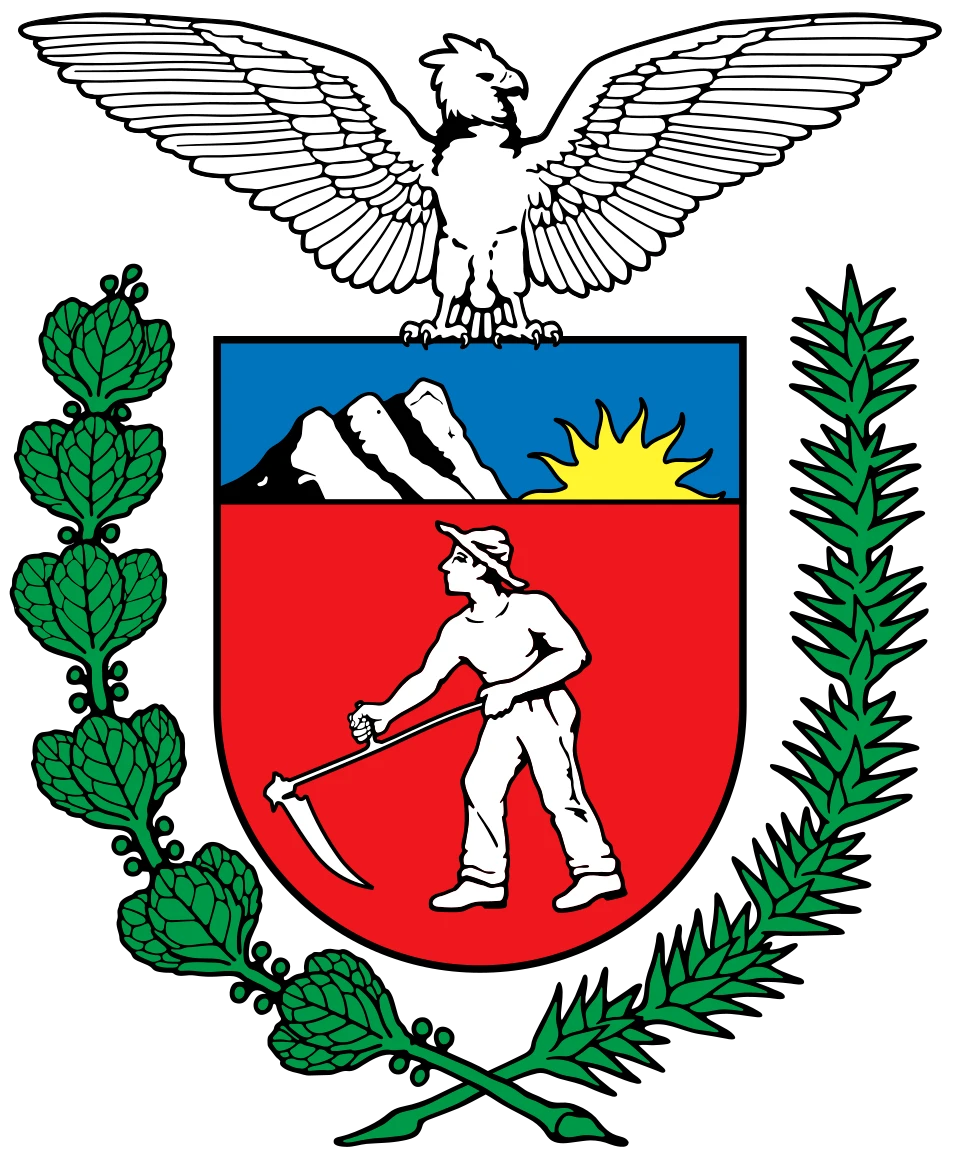
Coat of Arms — A green shield with a sower, a rising sun over three peaks, crested by a harpy eagle, flanked by yerba-mate and araucaria.
The coat of arms of Paraná takes the form of a Portuguese-style shield with a green field (sinople). At its centre stands a sower in silver (argent), shown in working posture, cultivating the soil. Above this, in a separately coloured blue chief, appears a gold rising sun accompanied by three silver peaks. As a crest above the shield stands a harpy eagle in silver (Harpia harpyja), its wings displayed and its head turned to face the viewer. The shield is flanked by two supporting branches, crossed at the base: a branch of erva-mate (Ilex paraguariensis), fruited, and a branch of Paraná pine or araucaria (Araucaria angustifolia).
This green field is the version fixed by Decree-Law 2.457 of 31 March 1947 and, after a legal interruption described below, the version currently in force. A number of tourism and general-interest sources online describe the shield as having a red field; this describes the different, no-longer-valid 1990 revision, not the current 1947/2002 design, and should not be relied on as the official blazon.
The composition originates with the Norwegian-born painter Alfredo Andersen, who had settled in Curitiba and designed the arms as adopted by State Law 904 of 21 March 1910. Like the symbols of most Brazilian states, the arms went out of official use under the centralising 1937 Estado Novo Constitution; when Governor Moysés Lupion restored the state's own symbols after the return to constitutional government, Decree-Law 2.457 of 31 March 1947 re-established the coat of arms, retaining Andersen's central elements — the sower, the sun, the three peaks and the eagle — within a revised overall design.
In 1988 a commission was formed to review perceived heraldic and descriptive inaccuracies in the 1947 symbols; its work led to Complementary Law 52 of 24 September 1990, approved unanimously by the state legislature, which redefined the coat of arms with a red field and adjusted details of the eagle, the branches and the constellation on the accompanying flag. This 1990 version was challenged in the courts on the grounds that changing a state's official symbols required a constitutional amendment rather than an ordinary complementary law; Paraná's Court of Justice agreed and declared Complementary Law 52 unconstitutional. Acting on that ruling, Governor Jaime Lerner issued Decree 5.713 of 27 May 2002, formally restoring the 1947 coat of arms — with its green field — as the state's official arms, the version that remains in force today.
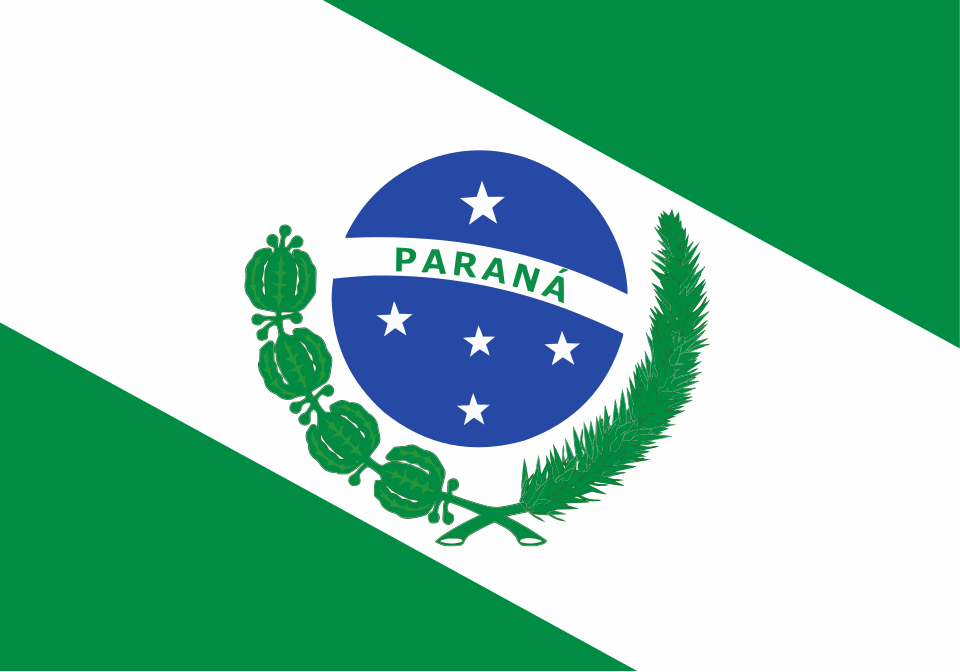
Flag — Green field, diagonal white band, blue celestial sphere with the Southern Cross, flanked by yerba-mate and araucaria.
Paraná's first provincial flag, in use from 1892, carried a celestial sphere inscribed with the positivist motto Ordem e Progresso, echoing the newly adopted national flag of the Republic. A second design, credited to the historian Romário Martins, followed from 1905, replacing the motto with the state's own name on a curved band. Like the coat of arms, the state flag was suppressed between 1937 and 1947 under the Estado Novo Constitution, during which only the national flag could be flown. When Governor Moysés Lupion's government restored the state's symbols, the flag was redesigned by Rodolpho Doubek and adopted, together with the coat of arms, by Decree-Law 2.457 of 31 March 1947.
As with the arms, an adjusted 1990 flag (removing the "PARANÁ" lettering and revising the branches and stars for heraldic accuracy) was adopted by Complementary Law 52 of 24 September 1990, then struck down along with the coat of arms; Decree 5.713 of 27 May 2002 restored the 1947 flag design, including its "PARANÁ" inscription, as the version now in force.
The flag is a green rectangle in 7:10 proportions (20 modules by 14, matching the ratio of the national flag), crossed diagonally from the upper hoist corner to the lower fly corner by a broad white band. Set within this band is a blue celestial sphere charged with the five silver stars of the Southern Cross constellation — identified in state sources as Alpha, Beta, Gamma, Delta and Epsilon Crucis — with the brightest star above the arc of a narrower white fess and the four remaining stars below it. That inner white fess carries the inscription PARANÁ in green capital letters. The sphere is flanked by two curved branches: erva-mate and araucaria (Paraná pine), echoing the supporters of the coat of arms.
State sources describe the green field as recalling the exuberant forests that once covered Paraná's territory, and the white band as a symbol of the peaceful character of its people. The celestial sphere is described as depicting the sky above the state at the moment of its political creation, tying the flag's astronomy to the same 29 August 1853 date commemorated as Paraná's Creation Day.
The flag flies over Paraná's public buildings and official ceremonies alongside the national flag, and is prominently displayed each 29 August for the state's Creation Day commemorations, as well as around 19 December, the anniversary of the province's actual installation under its first president. Its 1947 design — including the "PARANÁ" lettering that heraldists have long criticised as a departure from international heraldic convention, since properly designed arms and flags are not meant to spell out in words what their imagery already conveys — remains a point of debate among Paraná heraldry researchers, some of whom continue to argue for the more heraldically conventional 1990 design that the courts set aside on procedural, not artistic, grounds.
Green. The shield established in 1947 by Decree-Law 2.457 has a green (sinople) field. A red-shielded revision was adopted in 1990 by Complementary Law 52, but Paraná's Court of Justice later declared that law unconstitutional, and Decree 5.713 of 27 May 2002 restored the original 1947 arms with their green field as the version currently in legal force.
The original composition — the sower figure, the rising sun and the three peaks — was created by the Norwegian-born painter Alfredo Andersen, settled in Curitiba, and adopted by State Law 904 of 21 March 1910. Governor Moysés Lupion's Decree-Law 2.457 of 1947 revised the design while keeping Andersen's central elements, and this 1947 version, after a brief interruption, is the one in force today.
The diagonal band carries a blue celestial sphere charged with the five stars of the Southern Cross, echoing the constellation on the national flag of Brazil while giving Paraná its own distinct composition. The flag, designed by Rodolpho Doubek, was adopted by the same Decree-Law 2.457 of 31 March 1947 that fixed the coat of arms.
A harpy eagle (Harpia harpyja), called gavião-real in Portuguese and nhapecani in Guarani, shown as the crest above the shield with its wings displayed. It is the largest eagle in the Americas and is officially described as a symbol of freedom; it is now considered critically endangered within Paraná.
Imperial Law 704, signed by Emperor Pedro II, is dated 29 August 1853 and is the legal act that created the Province of Paraná out of territory previously administered from São Paulo; this date is now Paraná's official Creation Day. The province's government was not physically installed until 19 December 1853, when its first president, Zacarias de Góis e Vasconcellos, arrived in Curitiba and took office — a distinction sometimes blurred in secondary sources.
Last reviewed by the Emblema Mundi editorial team on 2026-07-05.