State
Pará is the second-largest state in Brazil and the giant of the Amazon's mouth — a territory of over 1.2 million km² anchored by Belém, founded in 1616 around the Forte do Presépio as one of Portugal's earliest footholds in the Amazon. Its emblems carry the scars and pride of that long history: the coat of arms, granted in 1903, crests a red-and-white shield with a Guianan eagle and frames it with branches of cacao and rubber, while the flag — red fields split by a white diagonal band and a solitary blue star — recalls both the Equator crossing the state and the bloodshed of the Cabanagem revolt of 1835–1840.
Flag
Not available
Coat of Arms
Not available
| State | Pará (formerly the colonial Grão-Pará, a province from 1824, a state since 15 November 1889) |
|---|---|
| Capital | Belém (founded 1616 as Santa Maria de Belém do Grão-Pará) |
| Region | North (Norte) |
| Coat of arms adopted | 9 November 1903, State Law 912 |
| Flag adopted | Republican-era design (from c. 1889–1890), formalised alongside the 1903 arms |
| Designers | José Castro Figueiredo (architect) and Henrique Santa Rosa (historian and geographer), coat of arms; flag badge attributed to Philadelpho de Oliveira Condurú |
| Motto | Sub Lege Progrediamur (Under the law, let us progress) |
| Historical note | Belém founded 1616; Pará joined Brazilian independence in August 1823; the Cabanagem revolt (1835–1840) killed tens of thousands |
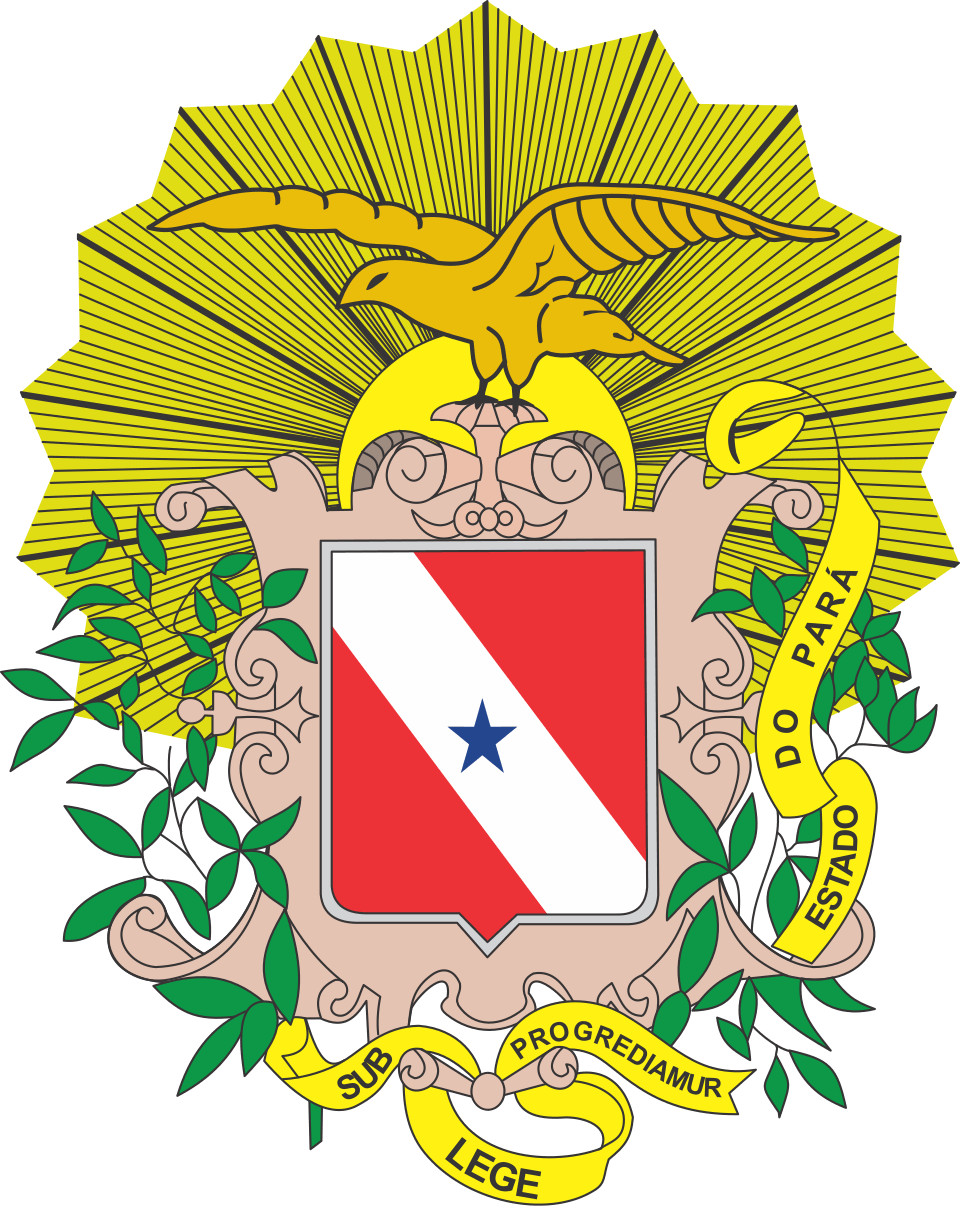
Coat of Arms — A red shield crossed by the white band of the Equator, crested by a Guianan eagle, under the motto Sub Lege Progrediamur.
Pará's coat of arms follows the Republican-era Brazilian convention of a shield crested and flanked rather than built on strict medieval heraldic rules. The shield itself is red, crossed diagonally by a white band that mirrors the design of the state flag, at whose centre sits a solitary five-pointed star. Above the shield, in place of a helm, stands a Guianan eagle displayed, its wings spread in a pose read locally as a mark of pride and sovereignty. Flanking the shield are two plant branches acting as supporters: cacao on the dexter side and rubber tree (Hevea brasiliensis) on the sinister side. Beneath the composition, a ribbon bears the Latin motto SUB LEGE PROGREDIAMUR.
Pará was among the very first areas of the Amazon colonised by Portugal. In 1616, the explorer Francisco Caldeira Castelo Branco built a wooden, straw-roofed fort — the Forte do Presépio — at the confluence of the Rio Guamá and the Baía do Guajará, founding the settlement that grew into Belém. The Captaincy of Grão-Pará that followed became the largest in the colony, encompassing nearly the whole of Portuguese Amazonia and administered separately from the rest of Brazil for much of the colonial period. Pará did not join Brazilian independence immediately: only after fighting in Belém did the province adhere, on 15 August 1823, nearly a year after the Cry of Ipiranga.
Deep social tensions between the Luso-Brazilian elite and the poor — Indigenous people, caboclos, and enslaved and formerly enslaved Africans — erupted in the Cabanagem (1835–1840), one of the deadliest popular revolts in Brazilian history; historians' estimates of the dead range from roughly 30,000 to 40,000, a substantial share of the province's population at the time. Later in the nineteenth century, the Amazon rubber boom briefly made Belém one of the wealthiest cities in Brazil, funding grand public works such as the Theatro da Paz (1878), before the trade's collapse after 1912 left the state in economic decline for decades. The coat of arms, formalised by State Law 912 of 9 November 1903 under a design credited to the architect José Castro Figueiredo and the historian and geographer Henrique Santa Rosa, replaced the earlier informal use of Belém's own 1626 municipal arms as a stand-in for a state emblem.
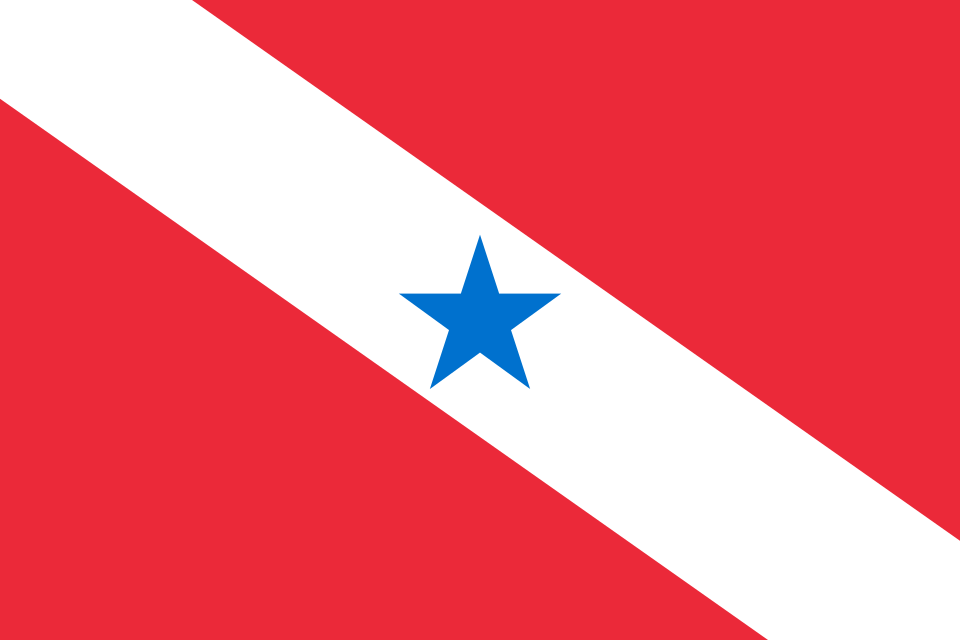
Flag — Red field with a white diagonal stripe and a blue star, recalling the Equator and the Cabanagem revolt.
Pará's flag has its roots in the badge of the Clube Republicano Paraense, a design attributed to Philadelpho de Oliveira Condurú that came into informal use as a state banner in the days following Pará's adherence to the Republic on 16 November 1889. A bill to formally adopt it as the state flag was introduced by the deputy Higino Amanajás and passed the lower house on 3 June 1890, but it was blocked in the state senate at the urging of Governor Augusto Montenegro, who argued that all Brazilians should recognise only the national flag. Despite that setback, the design persisted in civic use and was treated as the de facto state flag through the following decades, becoming the reference design when the coat of arms was formally established in 1903.
The flag is a red rectangle crossed by a white diagonal stripe running from the upper hoist corner to the lower fly corner, dividing the field into two red triangles. At the centre of the white stripe sits a five-pointed blue star.
The flag flies over all state government buildings and presides over official ceremonies, most visibly during the Círio de Nazaré — the largest Catholic procession in Brazil, held in Belém on the second Sunday of October and inscribed by UNESCO as Intangible Cultural Heritage of Humanity in 2013.
The solitary star represents Pará as a single federal unit rather than as a cluster of stars. At the time of the Proclamation of the Republic in 1889, Belém was the only state capital located north of the Equator, so Pará alone was singled out with its own star on the national flag, set apart from the main constellation of states.
Sub Lege Progrediamur is Latin for “Under the law, let us progress.” It appears on the ribbon beneath the shield of Pará's coat of arms, affirming the state's commitment to constitutional order following the upheavals of the Cabanagem revolt and the early Republican period.
The white diagonal stripe is usually explained as a reference to the Equator and to the Amazon River crossing the state, while the red fields either side commemorate the blood shed by the Cabanos during the Cabanagem revolt of 1835–1840 and in the broader struggles for independence and the Republic. A blue five-pointed star sits at the centre of the stripe.
The coat of arms was adopted on 9 November 1903 by State Law 912, with a design credited to the architect José Castro Figueiredo and the historian and geographer Henrique Santa Rosa. It replaced an earlier practice of using the 1626 arms of the city of Belém as a de facto state emblem.
Pará was one of Brazil's oldest colonial territories, founded around the Forte do Presépio at Belém in 1616. It joined Brazilian independence only in August 1823, nearly a year after the Cry of Ipiranga, then endured the bloody Cabanagem revolt (1835–1840) and the boom-and-bust of the Amazon rubber cycle — episodes commemorated in the red of its flag and the agricultural branches of its arms.
Last reviewed by the Emblema Mundi editorial team on 2026-07-04.