State
Minas Gerais wears its history on its emblems more plainly than most Brazilian states. The state seal — legally a selo, not a shield-bearing coat of arms — displays crossed pickaxes and a mining lamp beside branches of coffee and tobacco, tracing the arc from the eighteenth-century gold rush to the agricultural economy that followed it. The flag, made official only in 1963, carries a red triangle traditionally linked to the Inconfidência Mineira of 1789 — the failed independence conspiracy whose martyr, Tiradentes, is said to have proposed the shape himself — and the Latin motto Libertas Quæ Sera Tamen, "Liberty, though late." Much of that founding story, as told below, rests on eighteenth-century trial testimony rather than a surviving flag, and modern vexillologists treat parts of it as informed reconstruction rather than settled fact.
Flag
Not available
Coat of Arms
Not available
| State | Minas Gerais (Brazil, Sudeste / Southeast Region) |
|---|---|
| Capital | Belo Horizonte (inaugurated 12 December 1897 as Cidade de Minas, renamed 1901); the earlier capital was Vila Rica, renamed Ouro Preto in 1823 |
| Capitania created | 12 September 1720, separated from the Capitania de São Paulo e Minas do Ouro following the Vila Rica Revolt; province of the Empire from the 1820s; state of the federation with the Proclamation of the Republic, 15 November 1889 |
| State emblem adopted | Officially a "Selo do Estado" (State Seal), not a heraldic coat of arms; current design instituted by State Decree 6.498 of 5 February 1924, replacing the original seal of State Law 1 of 14 September 1891 (whose date, 15 June 1891, the promulgation of the first state constitution, is still inscribed on the current seal) |
| Flag adopted | State Law 2.793 of 8 January 1963; the design is traditionally associated with the Inconfidência Mineira conspiracy of 1789, though no flag from that year is known to survive or be reliably documented |
| Flag proportions | Rectangle of 20 by 14 modules (7:10, matching Brazil's national flag) |
| Colours | Seal: red, in a black-and-white official line drawing with no legally fixed colour scheme; flag: white field, red triangle |
| Motto | Libertas Quæ Sera Tamen ("Liberty, though late"), adapted from Virgil's First Eclogue |
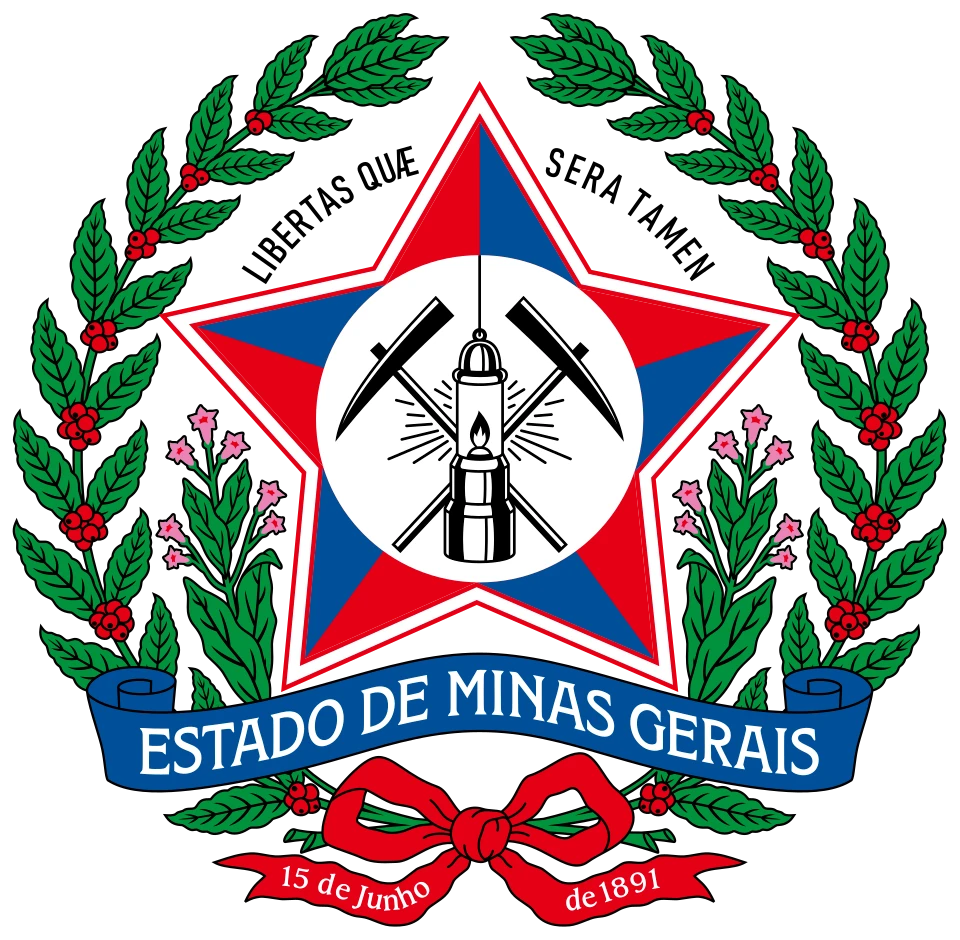
State Seal — A five-pointed star with mining tools at its centre, framed by coffee and tobacco branches.
What is popularly called the "coat of arms" of Minas Gerais is, in the state's own legislation, a Selo do Estado (State Seal). The distinction is not pedantry: the design has no shield, no crest, and does not follow the conventions of European heraldry, so Portuguese-language sources on state symbols generally avoid calling it a brasão in the strict sense, even though the term is used loosely in everyday speech and on this site's own navigation.
The current design was instituted by State Decree 6.498 of 5 February 1924, which replaced an earlier seal created by State Law 1 of 14 September 1891 — itself adopted only weeks after Minas Gerais's first republican state constitution was promulgated on 15 June 1891. The 1924 decree did not set out a written heraldic blazon; it simply annexed a reference drawing, which is why secondary sources describe the design rather than quote an official blazon text.
At the centre stands a five-pointed star outlined in red. In front of the star sit two crossed pickaxes and a mining lamp (candeeiro), tools of the underground gold and diamond workings that first brought settlers to the region. Flanking the star are two large branches of fruited coffee on the outside and, springing from the star's lower points, two smaller flowering tobacco branches in green with red and purplish blossoms. Below the whole device runs a band inscribed ESTADO DE MINAS GERAIS, and beneath that, a ribbon bearing the date 15 DE JUNHO DE 1891 — the date of the first state constitution, carried forward from the 1891 seal even after the 1924 redesign. The motto LIBERTAS QUÆ SERA TAMEN curves around the star's uppermost point.
The 1924 decree specified no official colours, only a black-and-white line drawing. The colour scheme now commonly seen — a star divided in red and blue, a white band, and a ribbon in blue and red — traces to a private reconstruction published in 1933 by Clóvis Ribeiro in his book Brasões e Bandeiras do Brasil, which other publishers and the state's own police and administrative bodies have since followed with some variation (for instance, a red-and-white star with a blue band and bow in some official uses).
Bandeirante prospectors found alluvial gold in the region's rivers in the final years of the seventeenth century, triggering a rush that drew hundreds of thousands of settlers and enslaved Africans into the Serra do Espinhaço and its surrounding valleys. Rivalry between paulista prospectors and newcomers from Portugal erupted into the armed Vila Rica Revolt of 1720; in its aftermath, the Portuguese crown separated the goldfields from the Capitania de São Paulo e Minas do Ouro on 12 September 1720, creating the Capitania de Minas Gerais with its seat at Vila Rica (renamed Ouro Preto in 1823).
By the late eighteenth century, heavy royal taxation on the declining gold output — above all the threatened derrama, a forced collective back-payment of unmet quotas — helped drive a group of colonial elites, poets, clergy and military officers into the conspiracy known as the Inconfidência Mineira, uncovered in 1789. Its most prominent martyr, the militia officer Joaquim José da Silva Xavier, known as Tiradentes, was hanged and quartered in Rio de Janeiro on 21 April 1792; the other condemned conspirators had their death sentences commuted to exile by Queen Maria I. The episode, and Tiradentes's memory in particular, became central to Minas Gerais's civic identity and, later, to Brazilian republican mythology more broadly.
After the Proclamation of the Republic in 1889, Ouro Preto's steep colonial street plan was judged unfit for a modern state capital. A planning commission led by the engineer Aarão Reis laid out an entirely new, geometrically planned city on the site of the former arraial of Curral del-Rei; it was inaugurated on 12 December 1897 under the name Cidade de Minas, and was renamed Belo Horizonte in 1901. The state seal adopted in 1924 — decades after this move — still commemorates the mining and agricultural foundations of the older Minas Gerais rather than the new capital itself.
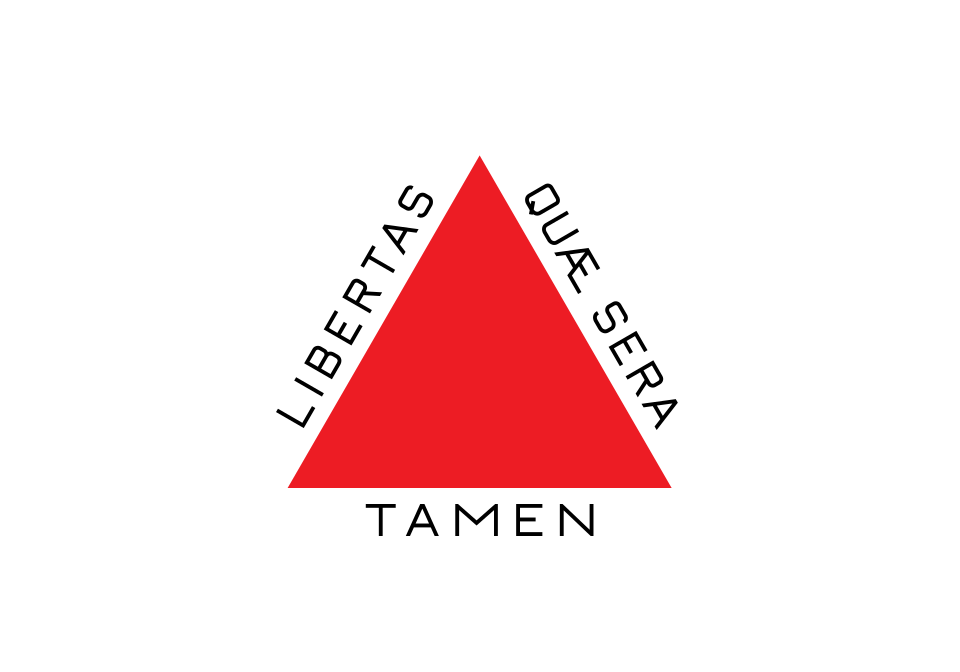
Flag — White field with a red triangle inscribed Libertas Quæ Sera Tamen, associated with the Inconfidência Mineira of 1789.
The flag of Minas Gerais was made official comparatively late, by State Law 2.793 of 8 January 1963, though the triangle design had already circulated informally as a symbol of the state for decades before that. Its origin is traditionally traced to the Inconfidência Mineira conspiracy of 1789. According to the surviving records of the conspirators' trial, Tiradentes testified that he had proposed a triangle for the movement's projected flag, reasoning — in a testimony often paraphrased as comparing it to the five wounds of Christ on Portugal's own arms — that a new republic should instead carry a triangle standing for the three persons of the Holy Trinity. Another conspirator, the poet Inácio José de Alvarenga Peixoto, is credited with proposing the accompanying Latin motto, which the tribunal recorded as having prevailed over Tiradentes's own wording as "something more allusive to liberty."
Historians and vexillologists caution that this traditional account should not be read as proof that a physical Inconfidência flag ever existed. No cloth flag from 1789 is known to survive, and specialist review of the trial testimony (notably by the Flags of the World research project) finds that the conspirators described several different, partly conflicting proposals and never reached firm agreement on a single design before the plot was betrayed. The flag adopted in 1963 is best understood as a twentieth-century state symbol built on a much later reconstruction of that trial testimony, not a direct copy of an eighteenth-century original.
The flag is a white rectangle built on a grid of 20 modules in length by 14 in height — the same 7:10 proportions as Brazil's national flag — charged at the centre with an equilateral red triangle measuring 8 modules to a side. The motto is split across the triangle in three parts: LIBERTAS along the upper-left side, QUÆ SERA along the upper-right side, and TAMEN along the base.
The triangle's colour is itself debated. The modern flag's triangle is red, popularly read as recalling the blood of the executed Inconfidência conspirators, above all Tiradentes. Some historians, however, have argued that the conspirators originally envisioned a green triangle; this claim traces largely to a hypothetical reconstruction published in 1933 by Clóvis Ribeiro. Specialist vexillological review of the same eighteenth-century trial documents has found no solid textual evidence favouring either colour, treating both red and green as informed conjecture rather than an attested historical fact.
The Latin motto Libertas Quæ Sera Tamen ("Liberty, though late," sometimes rendered "Liberty, however tardy") is adapted from a line of Virgil's First Eclogue. Brazilian sources consistently attribute the choice of this specific wording, as opposed to Tiradentes's own more explicitly religious triangle symbolism, to Alvarenga Peixoto.
The flag flies over Minas Gerais's public buildings and official ceremonies alongside the national flag, and is especially prominent each 21 April, the national holiday commemorating Tiradentes's execution. In the historic towns of the old mining district — Ouro Preto, Mariana, São João del-Rei and Diamantina, several of them UNESCO World Heritage sites — the red triangle is a near-ubiquitous visual motif, appearing in museum branding, civic festivals and tourism materials tied to the Inconfidência's memory.
Strictly speaking, no. The state's own legislation calls it a Selo do Estado (State Seal), not a brasão (coat of arms), because it lacks a shield and does not follow the conventions of European heraldry. It takes the form of a five-pointed star bearing mining tools and agricultural branches rather than a shield with a crest. The design is nonetheless commonly referred to, informally, as the state's coat of arms.
Libertas Quæ Sera Tamen is Latin for "Liberty, though late" (or "Liberty, however tardy"). It is adapted from a line in Virgil's First Eclogue and, according to the trial testimony of the 1789 Inconfidência Mineira conspiracy, was proposed as the movement's motto by the poet Inácio José de Alvarenga Peixoto. It appears on both the state seal and the state flag.
The attribution is traditional but not fully certain. Under interrogation after the conspiracy's discovery, Joaquim José da Silva Xavier (Tiradentes) testified that he proposed a triangle representing the Holy Trinity as a symbol for the movement. However, vexillologists note that no physical flag from 1789 survives or is reliably documented, that the conspirators' own testimony describes several competing proposals, and that the modern state flag adopted in 1963 is a twentieth-century reconstruction of a design that may never have been sewn as cloth in the eighteenth century.
This is disputed. The modern flag's triangle is red, but some historians, following a hypothetical reconstruction published in 1933 by Clóvis Ribeiro, have argued the original conspirators envisioned a green triangle. Vexillological researchers who have examined the surviving trial documents have found no solid textual evidence for either colour, concluding that both are informed guesses rather than settled fact.
After the Proclamation of the Republic in 1889, the old colonial capital Vila Rica (Ouro Preto), with its steep terrain and cramped colonial street plan, was judged unsuitable for a modern seat of government. A planning commission led by the engineer Aarão Reis designed a new, geometrically planned capital on the site of the former arraial of Curral del-Rei, inaugurated on 12 December 1897 as Cidade de Minas; it was renamed Belo Horizonte in 1901.
Last reviewed by the Emblema Mundi editorial team on 2026-07-05.