State
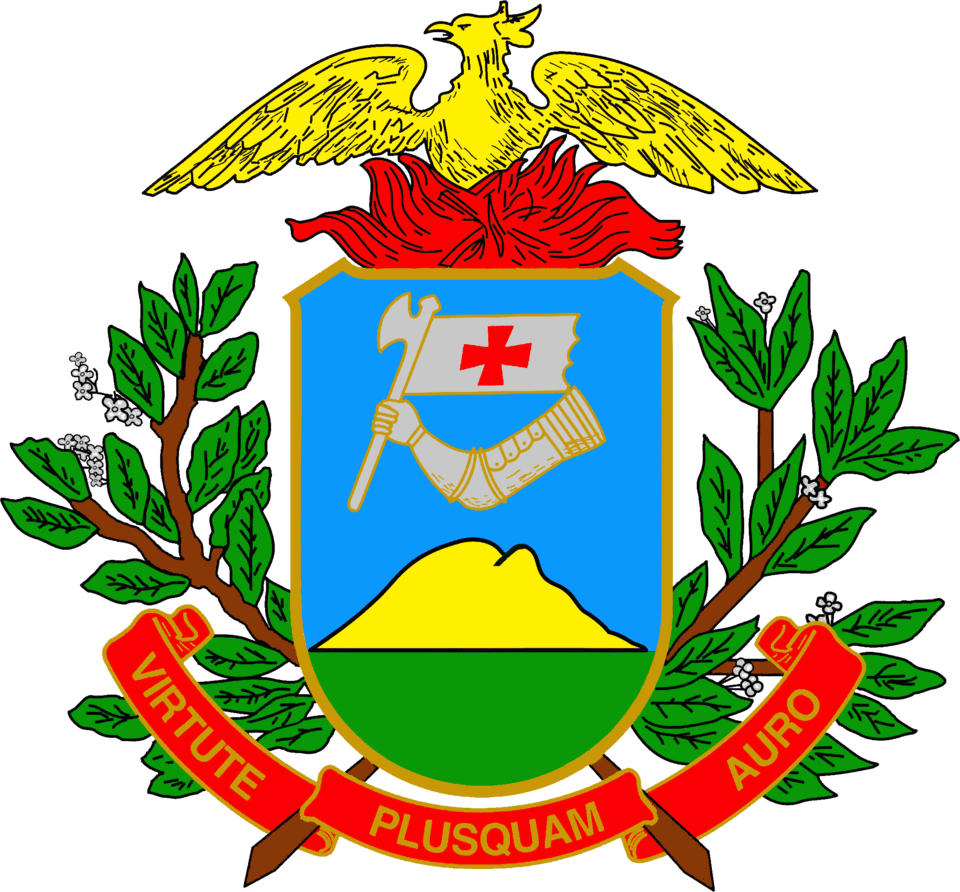
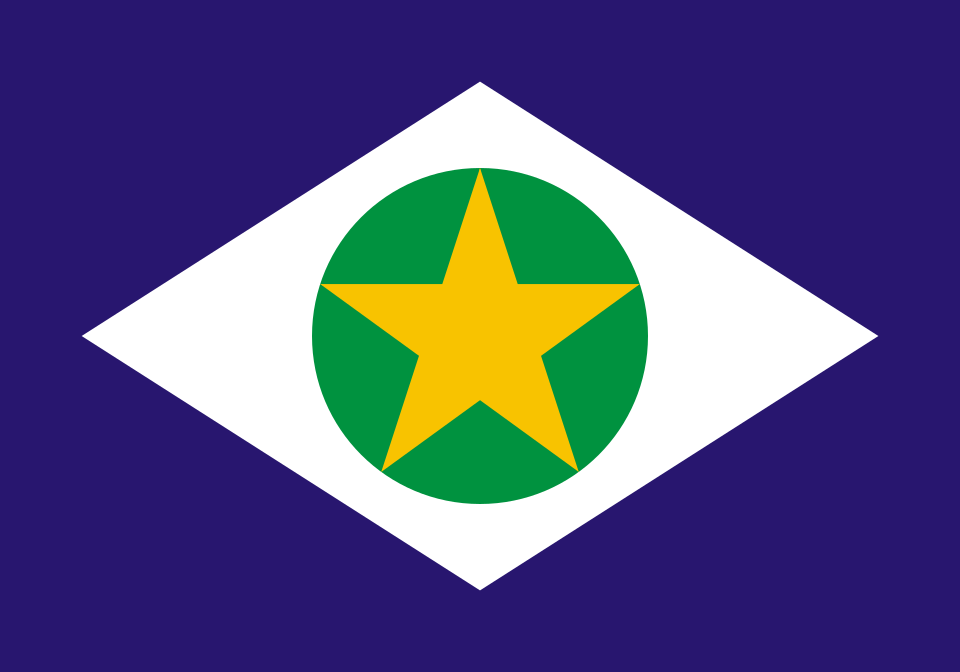
Mato Grosso's emblems trace a single arc from gold rush to reinvention. The coat of arms, a Portuguese-style shield adopted in 1918, is dominated by the heraldic figure of the bandeirante — an armed arm brandishing a banner marked with the Cross of the Order of Christ — recalling the paulista prospectors whose 1719 gold strike on the Coxipó river gave rise to the capital, Cuiabá. Above the shield, a gold phoenix rises from flame, a device read locally as the state's capacity to remake its economy after each boom fades. The flag, one of the oldest in the Brazilian federation, was fixed within weeks of the Republic's proclamation: a blue field bearing a white lozenge, a green globe, and a gold star recalling Sirius, the star that stands for Mato Grosso on the national flag itself.
Flag
Not available
Coat of Arms
Not available
| State | Mato Grosso (Brazil, Centro-Oeste / Central-West Region) |
|---|---|
| Capital | Cuiabá (settlement founded 8 April 1719 by the bandeirante Pascoal Moreira Cabral after a gold strike on the Coxipó river; formally became provincial capital, replacing Vila Bela da Santíssima Trindade, on 28 August 1835) |
| State admitted | Capitania de Mato Grosso created 9 May 1748, separated from the Capitania de São Paulo; province of the Empire from the 1820s; state of the federation with the Proclamation of the Republic, 15 November 1889 |
| Coat of arms adopted | Resolution (Resolução) 799 of 14 August 1918, under governor (Presidente do Estado) Dom Francisco de Aquino Correia; colours and construction details fixed by State Decree 5.003 of 29 August 1994 |
| Flag adopted | State Decree 2 of 31 January 1890, designed by governor Antônio Maria Coelho, Baron of Amambaí; abolished by State Law 1,046 of 8 October 1929; restored by Article 140 of the State Constitution of 11 July 1947 |
| Flag proportions | 7:10 |
| Flag colours | Blue, white, green, gold |
| Motto | Virtute Plusquam Auro ("By virtue more than by gold") |
| Later split | Southern territory detached in 1977 (effective 1979) to form the state of Mato Grosso do Sul |
Coat of Arms — A Portuguese-style shield with the armed bandeirante, a gold hill, and a phoenix rising above.
The coat of arms of Mato Grosso was established by Resolution 799 of 14 August 1918, under the administration of governor Dom Francisco de Aquino Correia; the precise colours and construction of the design were later fixed by State Decree 5.003 of 29 August 1994, without altering the 1918 blazon. The shield follows the Portuguese style, with a rounded point. Its lower field is sinople (green), bearing a gold hill with two peaks — one centred, one lower to the left — representing the state's highland terrain. The upper field is a blue sky (blau), dominated in chief by the shield's principal charge: an armed silver arm brandishing a banner with a four-pointed flammule, itself charged with the Cross of the Order of Christ in red (goles).
Above the shield, as its timbre (crest), a gold phoenix rises with head turned to its right from a fire of red flames. At the base, two flowering branches — a rubber tree (seringueira) on the dexter side and yerba mate (erva-mate) on the sinister side, both in their natural colours — are bound by a red ribbon inscribed in gold letters with the motto VIRTUTE PLUSQUAM AURO.
Gold-seeking bandeirante expeditions from São Paulo reached the future territory of Mato Grosso in the early eighteenth century. In 1719, an expedition led by Pascoal Moreira Cabral discovered gold on the Coxipó river; on 8 April 1719 Cabral signed the founding act of the settlement at a site known as Forquilha, securing the discovery's rights for the Capitania de São Paulo. Further strikes, notably by Miguel Sutil at the Prainha stream in 1722, accelerated the rush of settlers, and the resulting arraial was elevated to a vila — Cuiabá — on 1 January 1727.
The Capitania de Mato Grosso was formally separated from the Capitania de São Paulo on 9 May 1748, with Dom Antônio Rolim de Moura Tavares appointed its first governor and captain-general. Rolim de Moura founded Vila Bela da Santíssima Trindade on the Guaporé river on 19 March 1752 as the new captaincy's seat of government, sited there chiefly to help guard against Spanish incursions from the west. As the alluvial gold deposits around Cuiabá were worked out through the later eighteenth century and Vila Bela's remoteness became a growing liability, the seat of government shifted decisively: Cuiabá, by then the larger and better-connected town, was formally declared the provincial capital by law on 28 August 1835.
The captaincy became a province of the Brazilian Empire in the 1820s and a state of the federation with the Proclamation of the Republic on 15 November 1889. Through the following century, Mato Grosso's economy passed through successive cycles reflected in the coat of arms — rubber, yerba mate, extensive cattle-ranching — before its late-twentieth-century emergence as one of Brazil's leading agribusiness producers. On 11 October 1977, Complementary Law 31, signed by President Ernesto Geisel, detached the state's southern territory to create the new state of Mato Grosso do Sul, with its capital at Campo Grande; the new state's own government was installed only on 1 January 1979.
Note on accuracy: the Portuguese-language description previously published on this site's own Mato Grosso page stated that the coat of arms was adopted by "decreto estadual de 1890." No source consulted for this page supports a 1890 date for the coat of arms — the shield was established by Resolution 799 of 14 August 1918, under governor Francisco de Aquino Correia, with its colours only later specified by Decree 5.003 of 1994. The 1890 date belongs to the flag, not the coat of arms, and appears to have been conflated between the two symbols on the earlier page.
Flag — Blue field with a white lozenge, a green globe, and a gold star touching its circumference.
The flag of Mato Grosso was fixed by State Decree 2 of 31 January 1890, signed at the Palácio do Governo in Cuiabá by Antônio Maria Coelho, Baron of Amambaí, the state's first governor after the Proclamation of the Republic — barely 73 days after Brazil's own national flag had been adopted on 19 November 1889. The decree's Article 2 further specified that the state flag was to be raised on ceremonial days below the national flag. It was subsequently abolished by State Law 1,046 of 8 October 1929 and remained out of use for nearly two decades, until it was restored, with its original design unchanged, by Article 140 of the State Constitution of 11 July 1947.
Article 1 of the 1890 decree describes the flag as "azul, com losango branco, no centro deste uma esfera ou globo verde e uma estrela amarela com os raios tocando a circunferência da esfera" — blue, with a white lozenge, at whose centre sits a green sphere or globe bearing a yellow (gold) star whose rays touch the sphere's circumference. The flag's proportions are 7:10. Secondary sources offer varying readings of the colour symbolism — the blue as the sky or as spiritual aspiration, the white lozenge as peace or, in a Positivist reading, as an emblem of the feminine principle, the green globe as territorial extension or environmental hope — but converge in identifying the gold star with Sirius, the star used to represent Mato Grosso on Brazil's own national flag, and in linking its colour to the gold that drew the region's first colonisers.
The flag flies over Mato Grosso's public buildings and official ceremonies alongside the national flag, and is counted, together with the coat of arms and the state anthem, among the state's three official symbols. As one of the oldest state flags in Brazil's federative history, it is often cited for having been adopted only weeks after the young Republic's own national emblem.
The armed silver arm brandishing a flammule bearing the red Cross of the Order of Christ represents the paulista bandeirantes, the gold-seeking pioneers from São Paulo who pushed into the sertão in the early eighteenth century. Pascoal Moreira Cabral's expedition, which found gold on the Coxipó river and founded the settlement that became Cuiabá on 8 April 1719, is the episode most associated with this device.
The gold phoenix rising from red flames, placed above the shield as its crest, is read as a symbol of rebirth: the state's ability to reinvent its economy after each cycle of decline, from the exhaustion of colonial gold deposits through the rubber and yerba-mate eras to the twentieth-century rise of cattle-ranching and agribusiness.
Virtute Plusquam Auro is Latin for "By virtue more than by gold." Inscribed in gold on the red ribbon binding the coat of arms's rubber-tree and yerba-mate branches, the motto asserts that the state's true worth lies in the character of its people rather than in the mineral wealth that first drew settlers to the region.
The flag, fixed by State Decree 2 of 31 January 1890 under governor Antônio Maria Coelho, is blue with a white lozenge at its centre enclosing a green globe and a gold five-pointed star whose rays touch the globe's edge. The star is conventionally identified with Sirius, the star representing Mato Grosso on Brazil's own national flag; blue, white and green have been explained as the sky, peace, and the state's territorial extension, while the gold star also recalls the mineral wealth that attracted the first colonisers.
Complementary Law 31 of 11 October 1977, signed by President Ernesto Geisel, detached the southern portion of Mato Grosso to create the new state of Mato Grosso do Sul, with its capital at Campo Grande. The new state's government was not actually installed until 1 January 1979.
Last reviewed by the Emblema Mundi editorial team on 2026-07-05.