State
Mato Grosso do Sul is one of Brazil's youngest states, carved out of the much larger Mato Grosso by Complementary Law 31 of 11 October 1977 and formally installed only on 1 January 1979. Its emblems, both adopted on that same first day, are correspondingly recent: a coat of arms whose green field carries a stylised passant jaguar and a ring of 55 stars for the newborn state's founding municipalities, and a flag whose green-white-blue-gold design reached its final form only after the contest's original winning entry was publicly disqualified for plagiarising the flags of North Vietnam and Somalia.
Flag
Not available
Coat of Arms
Not available
| State | Mato Grosso do Sul (Brazil, Centro-Oeste / Central-West Region) |
|---|---|
| Capital | Campo Grande |
| State created | Complementary Law 31 of 11 October 1977, splitting the southern portion off the former state of Mato Grosso; powers formally installed 1 January 1979 under first governor Harry Amorim Costa |
| Coat of arms adopted | State Decree 2 of 1 January 1979, designed by José Luiz de Moura Pereira |
| Flag adopted | State Decree 1 of 1 January 1979 (first raised at 18:04 on 31 December 1978), designed by Mauro Michael Munhoz with fellow architecture students from the University of São Paulo |
| Flag proportions | 7:10 |
| Flag colours | Green, white, blue, gold |
| Stars on the shield | 55, for the state's 55 founding municipalities in 1979 (the state has since grown to 79 municipalities) |
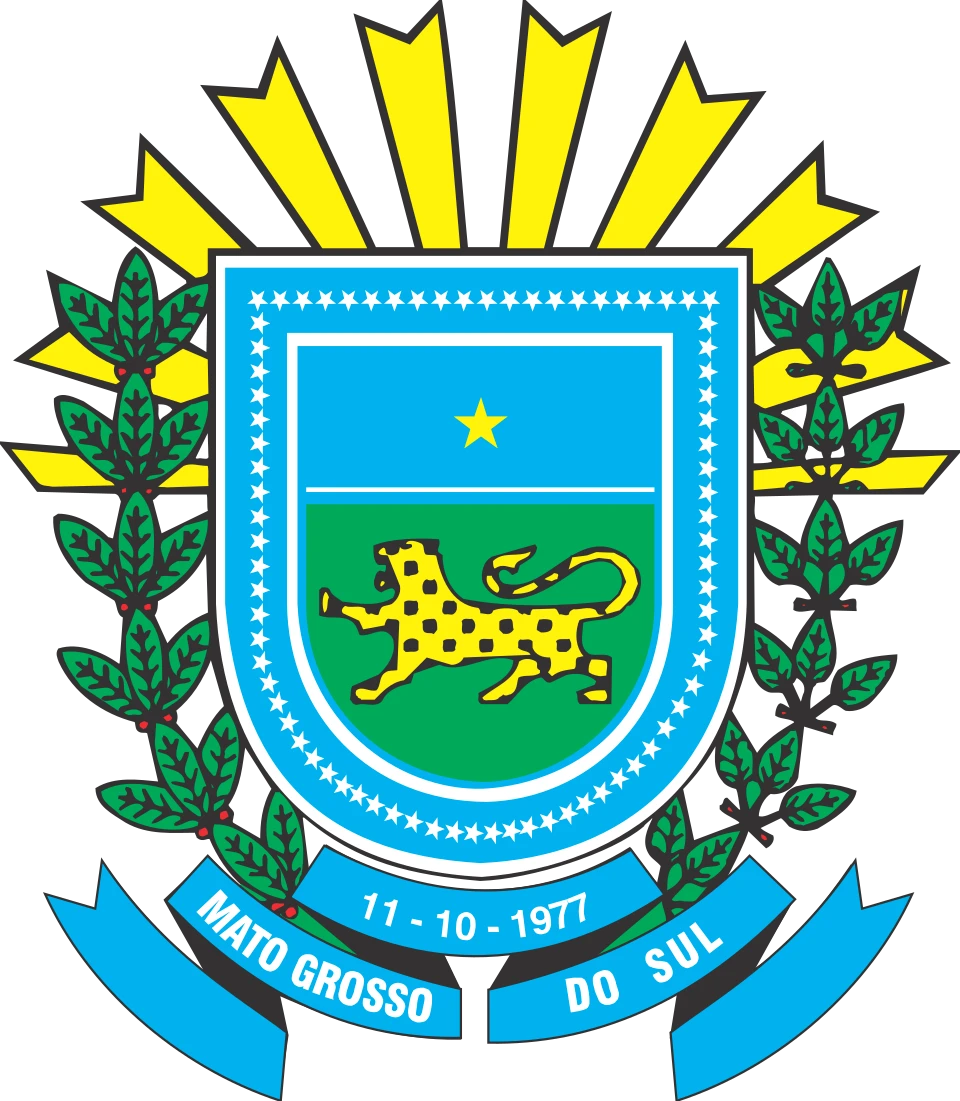
Coat of Arms — A peninsular shield with a gold star above a passant jaguar, bordered by 55 stars for the state's founding municipalities.
The coat of arms of Mato Grosso do Sul was designed by José Luiz de Moura Pereira and adopted by State Decree 2 of 1 January 1979, the same day the new state's powers were installed. The shield is peninsular in outline and divided horizontally into two unequal sections. The upper third (chief) is azure and bears a single gold five-pointed star at its centre. The lower two-thirds are vert (green) and carry a stylised jaguar (onça-pintada) passant, its head turned to the dexter side, rendered with black spots on its coat.
The shield is surrounded by a border in azure edged with silver, charged with fifty-five silver five-pointed stars. It is flanked by a wreath of a fruited coffee branch on the dexter side and a flowering yerba mate sprig on the sinister side, tied at the base. Above the shield, golden rays of sunlight radiate in a semicircle; sources describe either eight full rays plus one half-ray, or eight full rays plus two half-rays, meeting the horizon line — the exact count is not fully consistent across the sources consulted for this page. Below the shield, a ribbon in azure with silver lettering bears the inscription 11-10-1977 (the date Mato Grosso do Sul was created) together with the state's name.
Note on accuracy: the Portuguese-language description previously published on this site's own Mato Grosso do Sul page described the shield as bearing a wavy blue river band and wreaths of soy, cotton and yerba mate, with no mention of a jaguar. Independent cross-checking against Portuguese Wikipedia's article on the coat of arms, a regional news feature enumerating the state's official symbols, and the underlying 1979 decree text found no river band, no soy and no cotton on the coat of arms — the correct central charge on the green field is the stylised passant jaguar described above, flanked by coffee and yerba mate (not soy and cotton). That earlier text has been superseded here by the sourced blazon above; see the report to the site's editorial team for the exact wording to correct on the Portuguese page.
The division of the old state of Mato Grosso had been debated for decades before it happened: elites in the southern half of the territory had long complained of neglect by the distant northern capital, Cuiabá. The divisionist movement gathered decisive momentum in the mid-1970s under the military government of President Ernesto Geisel, who signed Complementary Law 31 of 11 October 1977, creating Mato Grosso do Sul with its capital at Campo Grande. Unusually for a Brazilian state, the law's date of creation and the date its institutions actually began functioning are not the same: state deputies (initially sitting as a constituent assembly) were elected on 15 November 1978, and the new state's powers were formally installed only on 1 January 1979, when Harry Amorim Costa was sworn in as its first governor. Both the coat of arms and the flag were adopted by decree on that same inaugural day, making Mato Grosso do Sul's civic symbols essentially contemporaneous with the state's own birth as a functioning government, rather than products of a later, separate design process as in many older Brazilian states.
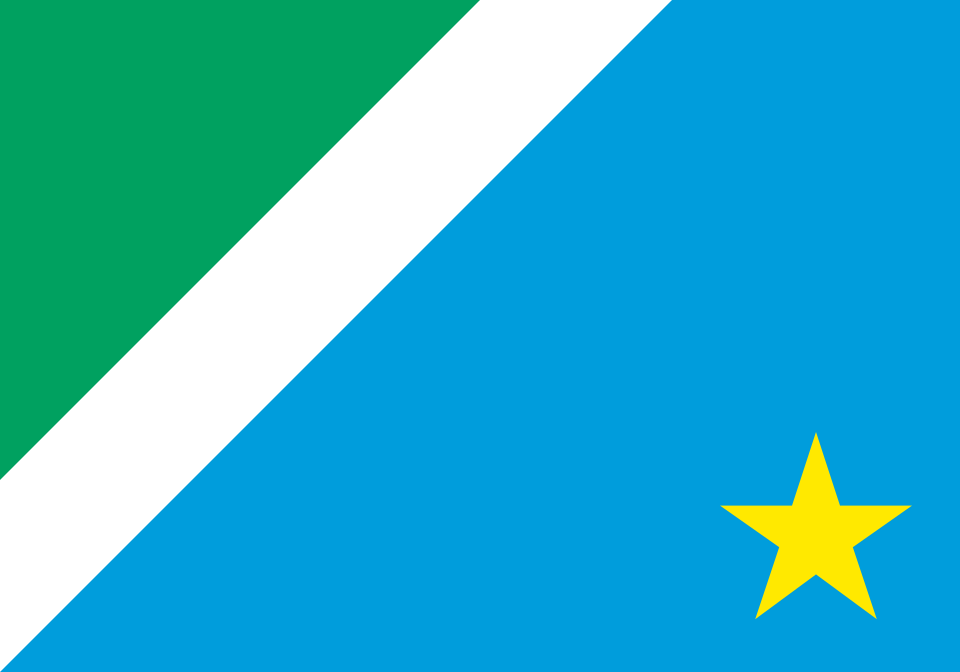
Flag — A white diagonal band between green and blue fields, with a gold star — the surviving design from a contest upended by a plagiarism scandal.
Shortly after the state's creation in October 1977, the new authorities launched a national public contest to choose official symbols for Mato Grosso do Sul, including the flag. Despite logistical delays that pushed back the original 31 October 1978 deadline, the contest drew 816 submitted designs. The entry initially placed first by the judging panel was disqualified on 21 November 1978 after it was identified as, in the panel's own words, plagiarism of the flags of North Vietnam and Somalia, altered only in its colours.
The design that was actually adopted had placed second in the contest. It was created by Mauro Michael Munhoz, then a second-year architecture student at the University of São Paulo's Faculty of Architecture and Urbanism (FAU-USP), together with fellow students including Vera Domschke and Alex Flemming, who worked on the submission from a shared studio in São Paulo's Bexiga neighbourhood. The flag was formally instituted by State Decree 1 of 1 January 1979 and was first hoisted at 18:04 on 31 December 1978, ahead of the state's official installation.
The flag is a rectangle in 7:10 proportion. A white diagonal band, two units wide, rises at a 45-degree angle from the lower hoist corner, dividing the field into a green upper triangle and a blue lower triangle. A gold five-pointed star sits in the lower fly corner. According to the symbolism the designer himself attached to the flag, green stands for "the richness of the forests and fields" and manifests a conscience for the preservation of natural wealth; white represents peace and serene friendship among peoples; blue evokes the sky and the hope of the population; and the gold star stands for "the wealth of our labour," expressing balance, firmness and serenity — the qualities Munhoz said he intended the whole composition to convey.
The design as adopted was not, however, exactly the one the students first submitted. Their original entry used an ochre band in the lower field rather than blue, intended to evoke the reddish terra roxa soil prized by the region's agriculture. Before the flag's formal adoption, the authorities of the day replaced the ochre with blue — a change Munhoz and his collaborators publicly protested at the time, without success, and which also altered the accompanying official memorial description of the flag's symbolism from what the students had originally written.
Before the 1979 flag, the future state had already flown two unofficial banners during its brief transitional period as a not-yet-installed federative unit: a green flag with a white horizontal stripe reading "Estado de Mato Grosso do Sul," and a light-blue flag with a white central stripe and five stars representing the Southern Cross, inscribed "Estado de Campo Grande" — an alternative name once floated for the new state. The 1979 flag that ultimately prevailed now flies over Mato Grosso do Sul's public buildings and is displayed at official ceremonies alongside the national flag, including the annual civic commemorations of 11 October, the date the state was created.
Mato Grosso do Sul was created by Complementary Law 31 of 11 October 1977, signed by President Ernesto Geisel, splitting the southern portion off the much larger state of Mato Grosso. The new state's powers were formally installed only on 1 January 1979, when its first governor, Harry Amorim Costa, took office in Campo Grande.
The stylised passant jaguar (onça-pintada), shown on a green field with its head turned to the dexter side, represents the native wildlife of the state's wetlands, above all the Pantanal, the world's largest tropical wetland, which lies largely within Mato Grosso do Sul.
The 55 silver stars on the shield's border represented the 55 municipalities that made up Mato Grosso do Sul at the time the coat of arms was designed in 1979. The state has since grown to 79 municipalities through further subdivision, but the coat of arms, adopted by State Decree 2 of 1 January 1979, has not been redesigned to reflect the change.
Yes. In the 1978 public contest to choose the new state's flag, the design initially ranked first by the jury was found to be a near-copy of the flags of North Vietnam and Somalia with only the colours altered, and was disqualified. The design actually adopted, by State Decree 1 of 1 January 1979, was the second-place entry, submitted by a group of University of São Paulo architecture students led by Mauro Michael Munhoz.
The winning student design used an ochre band in the lower field, meant to evoke the reddish local soil. Before the flag's official adoption, the authorities of the day substituted blue for ochre. Munhoz and his collaborators protested the change, but the blue version, not their original design, was the one enacted by decree.
Last reviewed by the Emblema Mundi editorial team on 2026-07-05.