State
Maranhão's emblems tell the story of a state colonised twice — briefly by France, then definitively by Portugal. Its coat of arms, granted in 1905, is a Republican-era design of green, gold and blue quarters framing the state flag and an emblem of instruction. Its flag, adopted in 1889 by the Maranhense poet Sousândrade, is one of Brazil's most distinctive: nine horizontal stripes of white, red and black — a design often compared to the French Tricolore, though its resemblance to São Luís's French founders of 1612 is a coincidence rather than a deliberate homage.
Flag
Not available
Coat of Arms
Not available
| State | Maranhão (state since 15 November 1889; formerly a separate Portuguese colonial territory) |
|---|---|
| Capital | São Luís, founded by French colonists in 1612 |
| Coat of arms adopted | Decree No. 58 of 30 December 1905; confirmed by Law No. 416 of 27 August 1906 |
| Flag adopted | Decree No. 6 of 21 December 1889; restored by State Law No. 3,210 of 19 November 1971 after suppression under the Estado Novo |
| Designer (flag) | Joaquim de Sousa Andrade, known by his pen name Sousândrade |
| Flag colours | White, red, black (stripes); blue and white (canton and star) |
| Number of stripes | Nine (four white, three red, two black) |
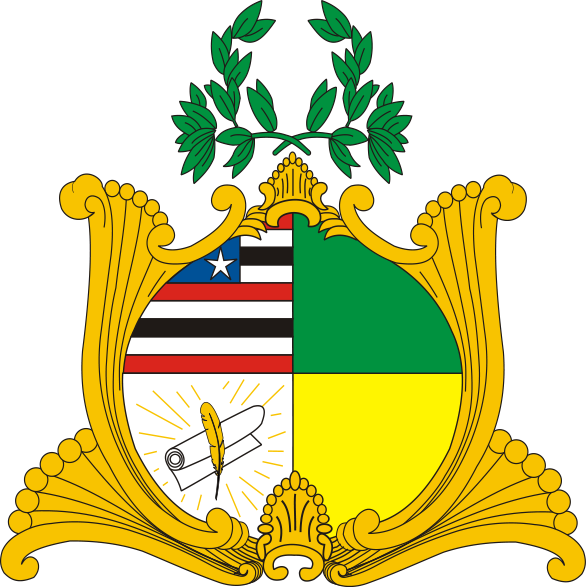
Coat of Arms — A quartered shield framing the state flag, with a quill and parchment symbolising instruction.
The coat of arms of Maranhão follows an outline described by Brazilian heraldic sources as modelled on the shield of the Swiss Confederation, bordered by a baroque-style gold frame and surmounted by a laurel wreath, also in gold. The field is divided into four quarters: the upper-right quarter is green, the lower-right is gold/yellow, the lower-left is blue, and the upper-left quarter reproduces the state flag itself in miniature. At the centre of the shield sit a quill and a parchment, an emblem of instruction and letters.
According to the sources consulted, the green quarter stands for Maranhão's abundant nature, the gold quarter for the state's wealth, and the blue quarter for its sky and sea. The quill-and-parchment device at the centre is consistently described as representing education and culture — some sources add that the feather is that of a heron (garça), a bird associated with the state's wetlands, though this specific detail could not be independently confirmed against an official decree text and should be treated as a secondary tradition rather than a settled fact.
The present arms were established by Decree No. 58 of 30 December 1905, issued by First Vice-Governor Alexandre Colares Moreira Júnior, and subsequently confirmed by Law No. 416 of 27 August 1906 under Governor Benedito Pereira Leite. Brazilian heraldic sources credit the original design to a draughtsman identified as Lucílio. Some sources also mention an earlier, largely symbolic armorial tradition attributed to the short French colonial episode of 1612–1615 — a sun flanked by three gold fleurs-de-lis with the Latin motto Indis sol splendet, splendescunt lilia Gallis — but this predates any continuous state heraldic tradition and is not the basis of the arms in current use; it should be read as a historical curiosity rather than a documented antecedent of the 1905 design.
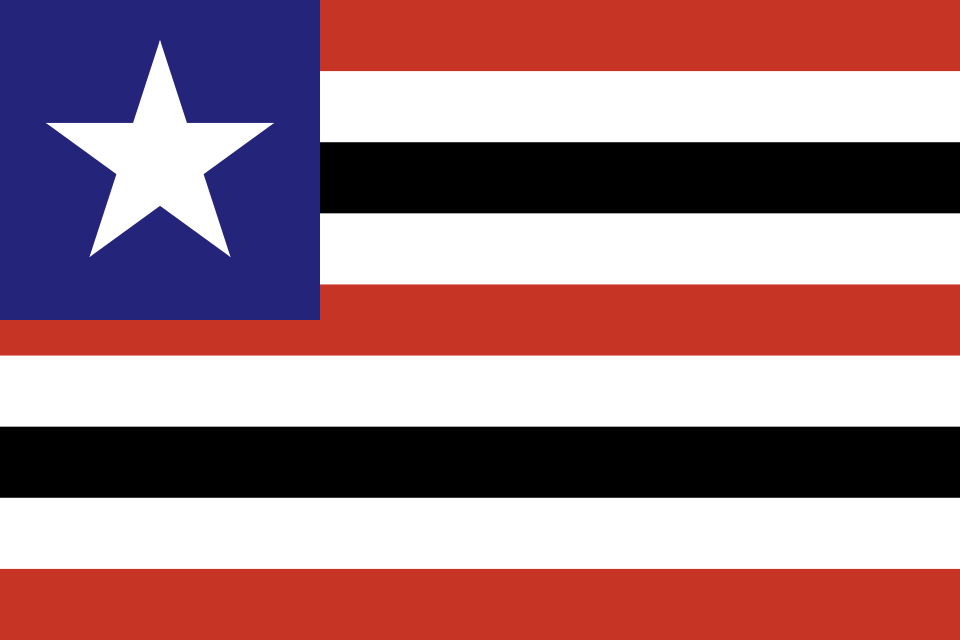
Flag — Nine stripes of white, red and black, with a blue canton and a single white star.
Maranhão's flag was adopted by Decree No. 6 of 21 December 1889, a little over a month after the Proclamation of the Brazilian Republic, during the state's provisional Republican government. It is credited to Joaquim de Sousa Andrade, a Maranhense poet and politician far better known by his literary pen name Sousândrade, who held a post in the provisional state government at the time. Like most state flags created in the enthusiastic first months of the Republic, it was abolished nationwide during the centralising Estado Novo dictatorship (1937–1945), when Getúlio Vargas suppressed regional symbols in favour of the national flag alone. Maranhão's flag was formally restored, unchanged, by State Law No. 3,210 of 19 November 1971.
Brazilian vexillological sources state that Sousândrade likely drew inspiration from the flag of the United States for the general concept of a striped field with a canton — not, as is sometimes assumed from the visual resemblance, from the French Tricolore. Given that no primary decree text or biographical source consulted for this page cites France as a design influence, the apparent echo of the 1612–1615 French colonial episode at São Luís should be treated as coincidental rather than intentional, unless a documented source states otherwise.
The flag is a rectangle in 2:3 proportions composed of nine horizontal stripes, alternating four white, three red, and two black, beginning and ending with a white stripe. In the upper hoist corner sits a blue square canton, occupying one third of the flag's length and half its width, charged with a single five-pointed white star.
According to the state's own published description, the three stripe colours represent the mixture of peoples that formed the Maranhense population: white for the Portuguese, red for Indigenous peoples, and black for Africans. The blue canton represents the sky, and the white star stands for Maranhão as one state within the Brazilian federation; several sources specifically identify the star as corresponding to the star assigned to Maranhão on the national flag's celestial sphere — commonly cited as the star Acrab (Beta Scorpii) — though this specific stellar identification is repeated across secondary sources without a primary decree citation, and is presented here as widely reported rather than independently verified against Decree No. 6's text.
The flag flies over state government buildings and appears at official ceremonies throughout Maranhão. Its distinctive black-white-red striping makes it one of the most visually recognisable of Brazil's 27 state flags, and it is frequently displayed during Bumba meu boi, the state's signature festive tradition (inscribed by UNESCO as Intangible Cultural Heritage of Humanity in 2019), as well as during June festival season in São Luís.
Not directly. The flag was designed in 1889 by the poet Sousândrade, and Brazilian vexillological sources attribute his inspiration to the flag of the United States rather than to France. The visual echo of the French tricolour is coincidental: the stripe colours were chosen to represent Maranhão's Indigenous, Portuguese and African population, not the brief French colonial presence of 1612–1615.
By Decree No. 6 of 21 December 1889. It was suppressed nationwide during the Estado Novo (1937–1945) and formally restored by State Law No. 3,210 of 19 November 1971.
The four white, three red and two black stripes represent, according to the state's official description, the three peoples whose mixing formed the Maranhense population: white for the Portuguese, red for Indigenous peoples, and black for Africans. The blue canton stands for the sky, and its white star for Maranhão among the states of the federation.
In 1612 the French nobleman Daniel de La Touche, Seigneur de La Ravardière, landed on the Maranhão coast and founded São Luís as the capital of France Équinoxiale, a short-lived colonial venture named for its proximity to the Equator. Portuguese forces expelled the French and took the fort in 1615; Maranhão was afterward administered as a separate Portuguese possession — later the State of Maranhão e Grão-Pará — only unified administratively with the rest of Portuguese America in 1774.
A shield outlined in the manner of the Swiss coat of arms, quartered into green (nature), gold (wealth), and blue (sky and sea) fields, with one quarter reproducing the state flag, and a quill and parchment at the centre symbolising instruction. It was established by decree in 1905 and confirmed by state law in 1906.
Last reviewed by the Emblema Mundi editorial team on 2026-07-04.