State
Goiás's emblems, both fixed by a single 1919 law, tell the story of a gold-rush captaincy turned cattle country at the geographic centre of Brazil. The coat of arms, its shield distinctively shaped like a heart, carries a landscape of grazing cattle, sheaves of rice, coffee and sugar cane, the forked Araguaia river figured as a comet, and a flaming dish recalling the frontier legend of the bandeirante Anhanguera. The flag, striped green and yellow with a starred blue canton, echoes the national colours while marking Goiás's place in the federation — a state whose own capital was later moved wholesale, from the colonial hill town of Vila Boa to the planned modernist city of Goiânia.
Flag
Not available
Coat of Arms
Not available
| State | Goiás (Brazil, Centro-Oeste / Central-West Region) |
|---|---|
| Capital | Goiânia (foundation stone laid 24 October 1933; capital status transferred by State Decree 1,816 of 23 March 1937; officially inaugurated 5 July 1942); previously Vila Boa de Goiás, today Cidade de Goiás |
| State admitted | Captaincy created 1748–49, separated from São Paulo; province of the Empire from 1821–22; state of the federation with the Proclamation of the Republic, 15 November 1889 |
| Coat of arms adopted | State Law 650 of 30 July 1919, designed by Luiz Gaudie Fleuri, under governor João Alves de Castro |
| Flag adopted | State Law 650 of 30 July 1919 (same law as the coat of arms), designed by Joaquim Bonifácio de Siqueira |
| Flag colours | Green, yellow, blue, white |
| Shield shape | Heart-shaped — read as a reference to Goiás's position near the geographic centre of Brazil |
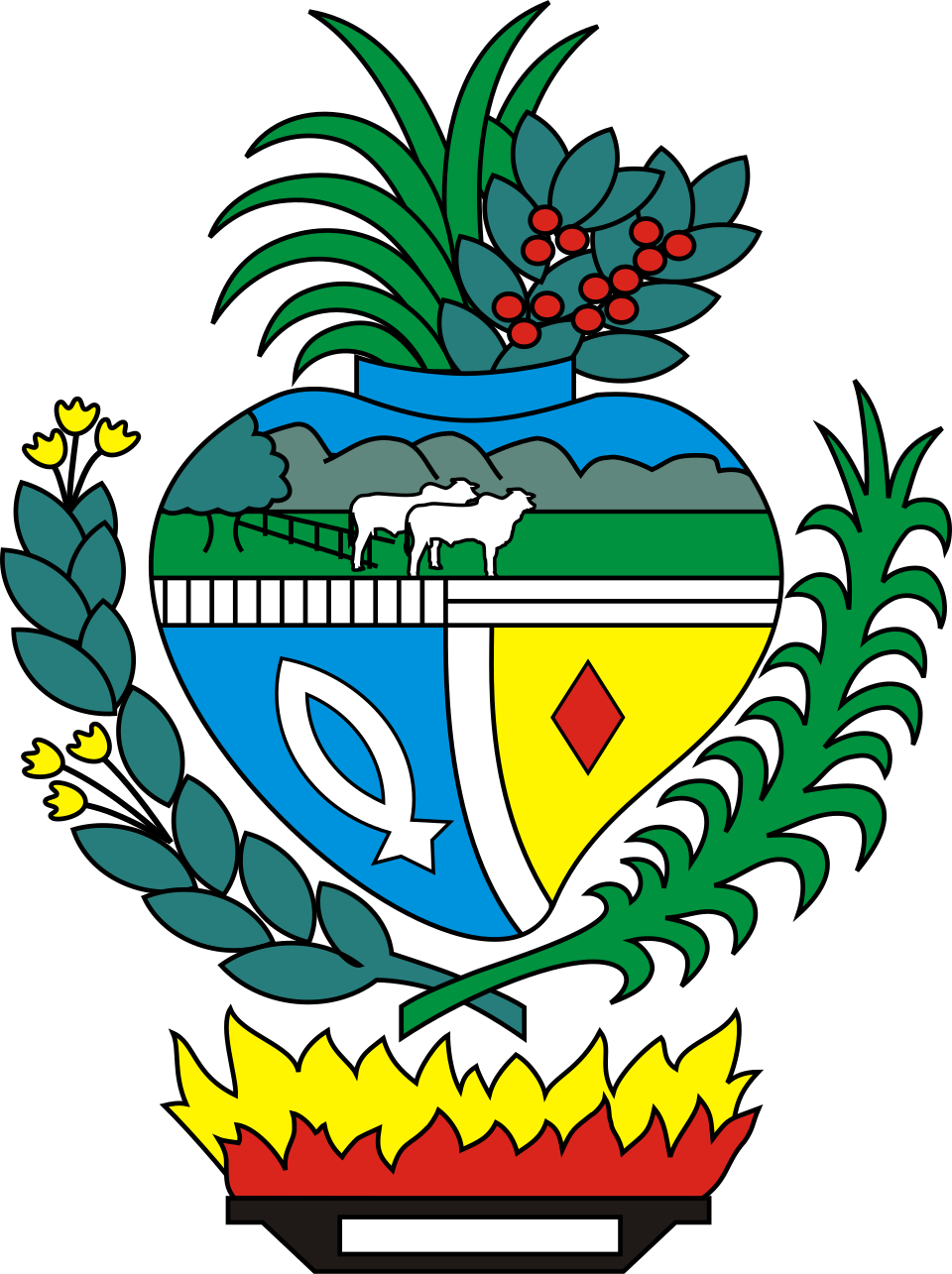
Coat of Arms — A heart-shaped shield with a cattle landscape, the Araguaia river as the Biela comet, and the flames of the Anhanguera legend.
The coat of arms of Goiás was designed by Luiz Gaudie Fleuri and adopted, together with the state flag, by State Law 650 of 30 July 1919, during the administration of governor João Alves de Castro. Its shield is unusual among Brazilian state arms for its outline: a heart shape, read as an allusion to Goiás's position near the geographic centre of the country.
The upper field of the heart shows a rural landscape with grazing cattle, representing the state's chief agricultural activity. Framing the heart above and around its edges are a sheaf of rice, a coffee branch, tobacco sprigs and sugar-cane stalks, attesting to the state's other major crops. Below the landscape, the shield splits into two lower fields: on one side, a blue field bearing the "Biela comet" — a forked charge representing the point where the Araguaia river divides to form Ilha do Bananal; on the other, a yellow field with a red lozenge, standing for the state's mineral wealth. At the base of the shield, a small plate bearing flames recalls a celebrated frontier legend (see below).
Note on accuracy: the Portuguese-language description previously published on this site's own Goiás page listed the Latin motto "Pro Brasilia Fiant Eximia" as belonging to this coat of arms. That motto in fact belongs to the coat of arms of the state of São Paulo, adopted in 1932 and designed by José Wasth Rodrigues — it is not part of the Goiás arms and has been omitted here as a factual error to be corrected on the Portuguese page.
Gold-seeking bandeirante expeditions from São Paulo reached the future territory of Goiás in the last years of the seventeenth century, but organised settlement began with the 1722–1725 expedition of Bartolomeu Bueno da Silva (the son, distinguished from his father of the same name), who searched the region his father was said to have explored decades earlier. According to a widely repeated tradition, the younger Bueno intimidated the Goiá people during this expedition by setting fire to a plate of aguardente (cane spirit) and threatening to set the rivers themselves alight unless he was shown the region's gold; the episode, whose precise historicity cannot be independently confirmed, earned him the Tupi nickname Anhanguera ("old devil"). His son later returned to the region, founding an arraial on the Vermelho river in 1726, named Sant'Ana; the settlement was elevated to a vila in 1739 under the name Vila Boa de Goiás — the town today known as Cidade de Goiás, a UNESCO World Heritage Site.
The Capitania de Goiás was formally separated from the Capitania de São Paulo around 1748–1749, becoming a province of the Brazilian Empire in the early 1820s and a state of the federation with the Proclamation of the Republic on 15 November 1889. As the alluvial gold deposits were exhausted through the later eighteenth century, the regional economy shifted decisively toward extensive cattle-ranching and agriculture — the same activities depicted on the 1919 coat of arms.
In the twentieth century, federal interventor and later governor Pedro Ludovico Teixeira, who took power in Goiás following the 1930 Revolution, championed the relocation of the state capital from the remote hill town of Vila Boa to a newly planned city on the central plateau. The foundation stone of Goiânia, designed by the urban planner Attílio Corrêa Lima, was laid on 24 October 1933; the seat of state government was formally transferred there by State Decree 1,816 of 23 March 1937, though the city's ceremonial inauguration as capital was celebrated only on 5 July 1942. Decades later, the northern portion of Goiás was detached to form the new state of Tocantins, created by Article 13 of the Transitional Constitutional Provisions of the 1988 Federal Constitution, promulgated 5 October 1988. Goiás's own territory also gave up land for a different purpose in the twentieth century: the plateau selected in 1956 for the new national capital, Brasília, inaugurated in 1960, was carved out to form the separate Federal District.
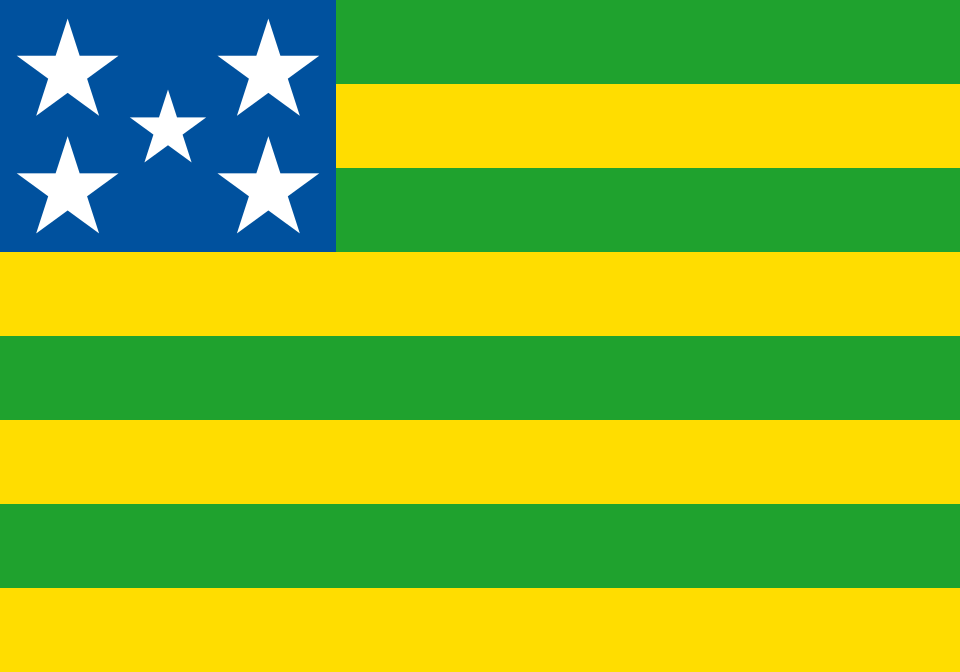
Flag — Green and yellow stripes with a blue canton bearing the five stars of the Southern Cross.
The flag of Goiás was designed by Joaquim Bonifácio de Siqueira and adopted, in the same act as the coat of arms, by State Law 650 of 30 July 1919, under governor João Alves de Castro. Like most Brazilian state flags of the period, its design was intended to combine the national colour scheme with a distinctive regional device. Both the flag and the coat of arms have remained unchanged in their essential design since 1919, a continuity the Legislative Assembly of Goiás itself marked with a formal centenary commemoration in 2019.
The flag consists of eight alternating horizontal stripes, four green and four yellow, beginning with green. In one upper corner of the flag sits a blue rectangular canton bearing five white five-pointed stars arranged to represent the Southern Cross (Cruzeiro do Sul) — the same constellation referenced on Brazil's national flag, and one that gave the newly discovered land its earliest Portuguese names, Vera Cruz and Santa Cruz. As on the national flag, green is explained as standing for the state's forests and fields, and yellow for its mineral wealth, chiefly the gold that drew the first bandeirante settlers.
The flag flies over Goiás's public buildings and presides over official state ceremonies alongside the national flag. It appears at civic and cultural events across the state, including the historic cavalhadas of Pirenópolis, a colonial-era pageant re-enacting the battles between Moors and Christians, held each year around Pentecost in the former colonial capital region.
The heart-shaped shield is read as a reference to Goiás's position near the geographic centre of Brazil, popularly called the country's heart. It was designed by Luiz Gaudie Fleuri and adopted with the flag by State Law 650 of 30 July 1919.
It recalls the legend of the bandeirante Bartolomeu Bueno da Silva, nicknamed Anhanguera ("old devil" in Tupi), who is said to have set fire to a dish of cachaça in front of the Goiá people during his 1722–1725 expedition, threatening to set the rivers alight unless shown the gold deposits. The tale is widely repeated in Goiás historiography, though its precise historicity cannot be independently confirmed here.
It is the heraldic device, on the shield's blue field, representing the Araguaia river at the point where it forks to form Ilha do Bananal, one of the world's largest river islands. Biela's Comet, a real nineteenth-century comet known for splitting into two visible fragments, lent its name to this forked charge.
The flag was designed by Joaquim Bonifácio de Siqueira and adopted, together with the coat of arms designed by Luiz Gaudie Fleuri, by State Law 650 of 30 July 1919, during the administration of governor João Alves de Castro.
Vila Boa (now Cidade de Goiás), the colonial-era capital founded in the 1720s–30s, was remote and difficult to access. Under federal interventor and later governor Pedro Ludovico Teixeira, a new planned capital, Goiânia, had its foundation stone laid on 24 October 1933; the seat of government was formally transferred by State Decree 1,816 of 23 March 1937, though the city's official inauguration was celebrated only on 5 July 1942.
Last reviewed by the Emblema Mundi editorial team on 2026-07-05.