State
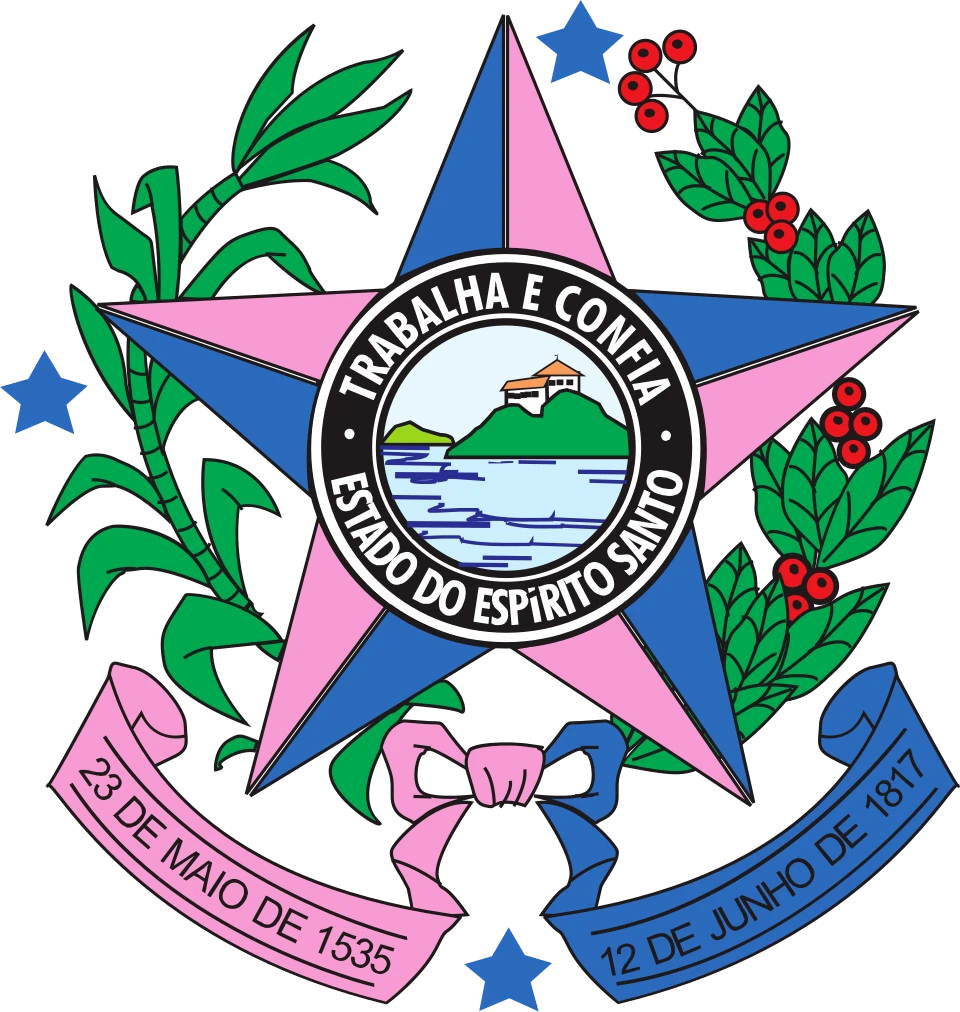
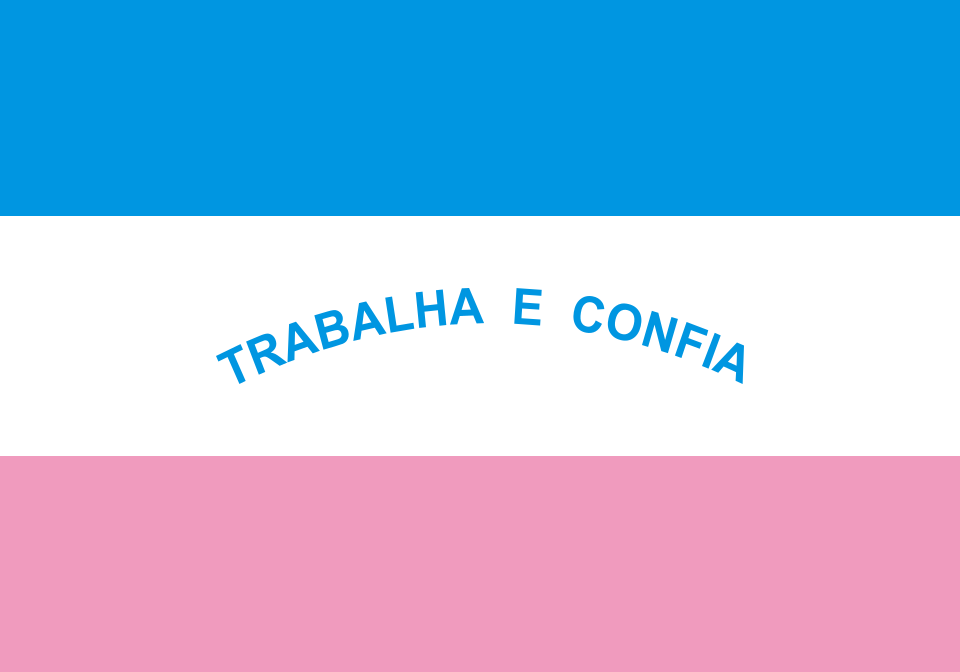
Espírito Santo's emblems centre on a single view: the entrance to Vitória's bay, framed by the Moreno and Penha hills and the Convent of Nossa Senhora da Penha, set within a large five-pointed star that alternates the state's own colours, blue and pink. The coat of arms, whose design dates to 1909 and was fixed in its current form in 1947, is flanked by branches of sugarcane and coffee — the two crops that carried the state's economy across four centuries — and bears the motto Trabalha e Confia ("Work and Trust"). The flag, designed the year before by governor Jerônimo Monteiro, repeats the same unusual palette in three plain stripes of blue, white and pink.
Flag
Not available
Coat of Arms
Not available
| State | Espírito Santo (Brazil, Sudeste / Southeast Region) |
|---|---|
| Capital | Vitória (settlement on the bay island founded 1549; named Vila da Vitória after September 1551) |
| State admitted | Hereditary captaincy granted 1 June 1534; province of the Empire from the 1820s; state of the federation with the Proclamation of the Republic, 15 November 1889 |
| Coat of arms adopted | Design established by State Decree 456 of 7 September 1909, under governor (Presidente do Estado) Jerônimo de Souza Monteiro; current form fixed by Decree-Law of 24 July 1947. An earlier, different seal had been adopted by State Law 2 of 11 June 1892. |
| Flag adopted | Designed in 1908 by Jerônimo Monteiro; blue and pink fixed as official state colours on 7 September 1909; officially adopted by Decree-Law 16.618 of 24 July 1947 |
| Flag proportions | Same as the national flag (2:3), per Decree-Law 16.618 |
| Flag colours | Blue, white, pink |
| Motto | Trabalha e Confia ("Work and Trust") |
Coat of Arms — A blue-and-pink star framing the view of Vitória's bay, flanked by coffee and sugarcane branches.
The coat of arms of Espírito Santo in its present design was established by State Decree 456 of 7 September 1909, signed by governor Jerônimo de Souza Monteiro and his secretary Ubaldo Ramalhete Maia; the version now in official use was fixed without altering the essential blazon by a Decree-Law of 24 July 1947. At the centre is a large five-pointed star alternating blue and pink — the state's own official colours. Within the star is set a naturalistic scene: the entrance to Vitória's bay, flanked by the Moreno and Penha hills, with the Convent of Nossa Senhora da Penha visible in the background.
Around the star run two concentric rings, in whose intermediate space appear the words "Trabalha e Confia" and "Estado do Espirito Santo." The shield is flanked by two branches in their natural colours: a coffee branch bearing fruit on the dexter side (the viewer's right), and a sugarcane stem on the sinister side (the viewer's left). At the base, a ribbon, half blue and half pink, bears two dates: 23 May 1535 and 12 June 1817. Three small five-pointed stars complete the composition, positioned to represent the three neighbouring states of Bahia, Rio de Janeiro and Minas Gerais.
The Portuguese crown granted the hereditary captaincy of Espírito Santo to the fidalgo Vasco Fernandes Coutinho on 1 June 1534, its territory running roughly from the mouth of the Mucuri river to that of the Itapemirim. Coutinho landed on 23 May 1535 at a cove below the Penha hill, in what is today Vila Velha, accompanied by some sixty settlers; because the day was a Pentecost Sunday, he named the captaincy Espírito Santo (Holy Spirit). Early settlement relied on the sesmaria land-grant system and was marked by prolonged conflict with the Tupi and other indigenous peoples of the region. Seeking greater security, Coutinho moved the administrative centre in 1549 to a mountainous island in the bay; after a Portuguese victory there over indigenous forces in September 1551, the new settlement was named Vila da Vitória — the nucleus of the present-day capital.
Sugar-mill agriculture, established under Coutinho, remained the backbone of the captaincy's economy for roughly three centuries. The territory became a province of the Brazilian Empire following independence and a state of the federation with the Proclamation of the Republic on 15 November 1889. From around 1850, coffee displaced sugar as the leading export crop, a transition accelerated in the following decades by organised waves of Italian immigration (from 1874 onward, chiefly from Veneto, Trentino and other northern Italian regions) together with German and Pomeranian settlement, which repopulated much of the mountainous interior and left a lasting cultural imprint still visible in the state today.
An earlier and quite different seal for the state had been adopted by State Law 2 of 11 June 1892, centred on the Southern Cross constellation rather than the bay-and-star device; this was superseded by the 1909 design. The 1909 arms were themselves suspended for roughly a decade following the centralising Constitution of 1937, before being restored, with a revised ribbon, by the 1947 Decree-Law: where the 1909 version's ribbon read "23 May 1535" and "2 May 1892" (the date of the state's first republican constitution), the current ribbon instead pairs 23 May 1535 with 12 June 1817, the date of Domingos José Martins's execution.
Note on accuracy: the Portuguese-language description previously published on this site's own Espírito Santo page states that the shield itself is "carregado de uma paisagem naturalista" with a mountain, sea and coffee tree directly on the field, flanked by "ramos de café e cana-de-açúcar." Primary and reference sources consulted for this page (the 1909 decree text, Wikipédia's Brasão do Espírito Santo article, and the Tribunal de Justiça do Espírito Santo's own explainer) instead describe the landscape scene as set within a large blue-and-pink star at the shield's centre, and additionally document three small stars for neighbouring states and a bicolour ribbon bearing the dates 23 May 1535 and 12 June 1817 — details the earlier Portuguese-language page omits. That page also gives the flag's adoption decree as "Decreto-Lei n.º 972 de 1947"; every source found for this page instead gives the number as Decreto-Lei 16.618, dated 24 July 1947.
Flag — Blue, white and pink stripes, with the motto Trabalha e Confia on the white band.
The flag of Espírito Santo was designed in 1908 by governor Jerônimo Monteiro, who the following year, on 7 September 1909, fixed blue and pink as the state's official colours in the same decree that established the coat of arms. The flag itself, however, remained without formal legal status for decades: it was only officially adopted by Decree-Law 16.618 of 24 July 1947, which set its proportions to match those of the national flag and specified its design in detail. In 1989 a proposal by Paulo Fundão to replace the pink stripe with red, on the grounds that heraldic convention frowns on placing two "tinctures" (colours) side by side without a metal between them, was rejected by governor Max Mauro after public and political opposition; the original design has remained unchanged.
The flag consists of three equal horizontal stripes — blue, white and pink — running the full length of the flag. On the central white stripe, an arc of blue letters spells out the motto "Trabalha e Confia." Blue and pink are described by state sources as recalling the colours of the vestments of Nossa Senhora da Penha, the patroness of Espírito Santo venerated at the Convent of Penha in Vila Velha (some secondary sources instead associate the colours with Nossa Senhora da Vitória, patroness of the capital; this project follows the Penha attribution as the one most consistently repeated in state and reference sources, while noting the discrepancy). The pairing of blue and pink is unusual among Brazilian state flags, where pink rarely appears at all.
The flag is flown over Espírito Santo's public buildings and official ceremonies alongside the national flag, and is counted, together with the coat of arms, among the state's official symbols. Its blue-and-pink palette, shared with the coat of arms, is often cited as the most visually distinctive feature of Espírito Santo's state heraldry within the Brazilian federation.
The large five-pointed star, alternating blue and pink, is not a celestial device but a frame: within it sits a landscape scene showing the entrance to Vitória's bay, flanked by the Moreno and Penha hills, with the Convent of Nossa Senhora da Penha visible in the background. The star's own blue-and-pink colouring echoes the state's official colours, fixed in 1909.
Trabalha e Confia is Portuguese for "Work and Trust." The motto, credited to governor Jerônimo Monteiro and commonly traced to a maxim attributed to Saint Ignatius of Loyola — work as though everything depended on you, trust as though everything depended on God — appears on both the coat of arms and, in blue letters on the white stripe, on the state flag.
Pink (rosa), alongside blue, was fixed as an official state colour on 7 September 1909, the same day Decree 456 established the coat of arms. Sources describe the blue and pink as recalling the vestments of Nossa Senhora da Penha, the state's patroness venerated at the Convent of Penha in Vila Velha; pink is otherwise rare in Brazilian state vexillology, and a 1989 proposal to replace it with red was rejected by the state government.
The Portuguese crown granted the hereditary captaincy to Vasco Fernandes Coutinho on 1 June 1534. Coutinho landed at a cove below the Penha hill, in what is now Vila Velha, on 23 May 1535 — a Pentecost Sunday, which gave the territory its name, Espírito Santo (Holy Spirit). The administrative seat moved to an island in the bay in 1549, and after a victory over indigenous forces in September 1551 that settlement was named Vila da Vitória, the nucleus of today's capital.
The sugarcane stem, on the shield's left, recalls the sugar-mill economy that sustained the captaincy from the sixteenth century until around 1850. The coffee branch, on the right, marks the crop that took over as the state's leading product from the mid-nineteenth century, a shift reinforced later in the century by waves of Italian, German and Pomeranian immigration into the Espírito Santo highlands.
Last reviewed by the Emblema Mundi editorial team on 2026-07-05.