State
The emblems of Brazil's Federal District belong to no historical dynasty or colonial captaincy — they were invented from scratch for a city that did not yet exist. Both the coat of arms (1960) and the flag (1969) were designed by the São Paulo poet Guilherme de Almeida around a single device of his own creation, the Cruz de Brasília (Cross of Brasília): four gold arrows radiating from the centre toward the cardinal points, a deliberate break from traditional heraldry meant to echo the modernist architecture of Oscar Niemeyer and the Plano Piloto of Lúcio Costa — the same audacity that built Brasília itself on empty savanna at the order of President Juscelino Kubitschek.

Flag
Not available
Coat of Arms
Not available
| Federal unit | Federal District (Distrito Federal) — the only Brazilian federal unit with no municipalities, divided instead into administrative regions; seat of Brasília, the national capital |
|---|---|
| Created | 21 April 1960, the day Brasília was inaugurated as Brazil's capital, under Law 3,273 of 1 October 1957 |
| Region | Centro-Oeste (Central-West), on the Central Plateau (Planalto Central) |
| Coat of arms adopted | Decree 11 of 12 September 1960, designed by Guilherme de Almeida |
| Flag adopted | Decree 1,090 of 25 August 1969, designed by Guilherme de Almeida |
| Flag proportions | 7:10 |
| Colours | White, green, gold |
| Motto | Venturis Ventis ("To the winds that are to come") |
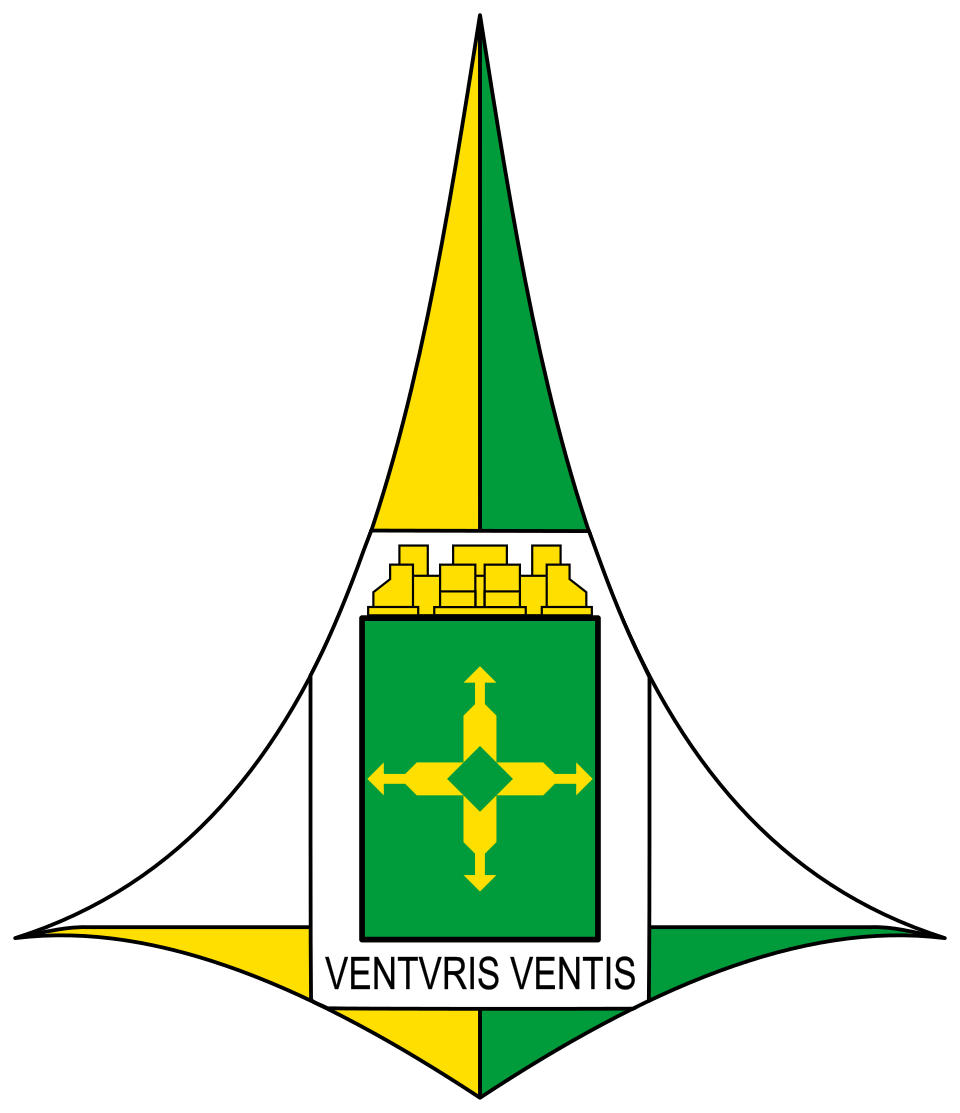
Coat of Arms — The Cross of Brasília: four gold arrows radiating from the centre of a green shield, beneath a mural crown.
The coat of arms of the Federal District was adopted by Decree 11 of 12 September 1960, barely five months after Brasília's inauguration, and was designed by the poet and self-taught heraldist Guilherme de Almeida (1890–1969). The decree's own wording describes a quadrangular shield of sinople (heraldic green) bearing "uma caderna de setas de ouro em cruz" — a group of four gold arrows arranged in a cross, barbed and feathered, radiating outward from the centre of the shield. Almeida named this device the Cruz de Brasília (Cross of Brasília).
Above the shield sits a gold mural crown of four towers, each with its own gateway, as specified in the decree. Below the shield, a cartouche — explicitly modelled on one of the pilotis (supporting columns) of the Palácio da Alvorada, the presidential residence designed by Niemeyer — carries the Latin motto VENTURIS VENTIS, incised in gold. The shield's own quadrangular, pilotis-inspired outline was itself a deliberate departure from the ovals and classical cartouches of most nineteenth-century Brazilian state arms.
The idea of moving Brazil's capital inland predates Brasília by nearly seventy years. Article 3 of the Constitution of 1891 already reserved a 14,400 km² zone on the Central Plateau for a future federal capital. Between 1892 and 1893, the Cruls Mission, an expedition of 21 members led by the Belgian astronomer Luiz Cruls, surveyed the region over seven months and roughly 4,000 kilometres, producing a detailed report on its topography, climate, geology and resources and formally demarcating the area that became known as the Quadrilátero Cruls. The project remained dormant for over sixty years.
It was Juscelino Kubitschek, elected president in 1955 on a platform that included building the new capital, who acted on it. Law 3,273 of 1 October 1957 set 21 April 1960 as the date the federal capital would move to the already-delimited Federal District. A national competition held in 1956–1957 for the Pilot Plan (Plano Piloto) was won on 16 March 1957 by urban planner Lúcio Costa, chosen among some 26 submitted proposals; his plan, whose crossing axes are often likened to a cross, an aeroplane, or a bird in flight, was built out with the presidential palace, government ministries and monumental public buildings designed by architect Oscar Niemeyer. At midnight on 21 April 1960, following a solemn Mass, Kubitschek formally inaugurated Brasília as the country's new capital; Rio de Janeiro, which had served as capital since 1763, became the state of Guanabara. In 1987, UNESCO inscribed Brasília on the World Heritage List — the first modern city to be so recognised — citing the Pilot Plan's urban design and Niemeyer's public buildings as an outstanding realisation of Modern Movement planning and architecture.
Note on accuracy: the Portuguese-language description previously published on this site's own Distrito Federal page attributed the shield's central device to a "cruz de Caravais" evoking the bandeirante Bartolomeu Bueno da Silva, and described wheat ears and coffee branches flanking the shield. Neither element could be verified against the original 1960 decree, the Portuguese or English Wikipedia articles, or the heraldry references consulted for this page. The shield's cross is officially named the Cruz de Brasília, composed of arrows (not a "cruz de Caravais"), and no wheat or coffee motif appears in the sourced descriptions. That earlier text has been superseded here by the sourced blazon above.
Flag — A white field bearing the green shield and gold Cross of Brasília at its centre.
The Federal District's flag came nearly a decade after its coat of arms, adopted by Decree 1,090 of 25 August 1969 — the same year its designer, Guilherme de Almeida, died. Before 1969, the Federal District had flown a different, less heraldically rigorous flag combining blue and white fields with a pilotis motif recalling the Palácio da Alvorada; the 1969 decree replaced it with a design built directly from the 1960 coat of arms, extending the same Cruz de Brasília device onto a simple rectangular field.
The flag is a rectangle in 7:10 proportion: a white field, described in the decree as symbolising peace, charged at the centre with the green quadrangular shield of the coat of arms, on which the four gold arrows of the Cruz de Brasília radiate outward toward the cardinal points. The decree's explanatory text repeats the same symbolism given for the coat of arms: the arrows' cruciform arrangement recalling the Southern Cross constellation, the cross of the caravels' sails, and the cross of the first Mass, while honouring an Indigenous heritage through the arrow as heraldic device. White, green and gold together were chosen to align the Federal District's flag with Brazil's own national colours without directly reproducing the national flag's blue-and-yellow globe.
The flag flies over the Palácio do Buriti (seat of the Federal District government), the Praça dos Três Poderes, and the district's administrative regions, appearing alongside the national flag at official ceremonies, including presidential inaugurations held in Brasília.
The Cruz de Brasília (Cross of Brasília) is a cross formed by four gold arrows, barbed and feathered, radiating outward from the centre of the shield toward the four cardinal points. Its designer, the poet and heraldist Guilherme de Almeida, described it as symbolising the centrifugal action of power spreading out from the new capital, while also evoking the arrow as a heraldic emblem of Brazil's Indigenous peoples.
Venturis Ventis is Latin for "to the winds that are to come" (or "to the coming winds"). It appears in gold on a cartouche below the shield of the coat of arms, modelled on a pilotis of the Palácio da Alvorada, and expresses the new capital's openness to the future.
Both were designed by Guilherme de Almeida (1890–1969), a prominent São Paulo poet, journalist and self-taught heraldist. He designed the coat of arms, adopted by Decree 11 of 12 September 1960, days before Brasília's first anniversary, and the flag, adopted nearly a decade later by Decree 1,090 of 25 August 1969, the same year Almeida died.
The Federal District came into being on 21 April 1960, the day President Juscelino Kubitschek formally inaugurated Brasília as Brazil's new capital, replacing Rio de Janeiro (which became the state of Guanabara). The transfer had been mandated by Law 3,273 of 1 October 1957, fulfilling a relocation-of-the-capital idea traceable to Brazil's 1891 Constitution and the 1892–1893 Cruls Mission that first surveyed the Central Plateau site.
Brasília was inscribed on the UNESCO World Heritage List in 1987, only 27 years after its inauguration, as the first modern city to be so recognised. UNESCO honoured urban planner Lúcio Costa's Plano Piloto (the winning design in the 1957 national competition) and Oscar Niemeyer's monumental public buildings for their outstanding realisation of modernist urban planning and architecture.
Last reviewed by the Emblema Mundi editorial team on 2026-07-05.