State
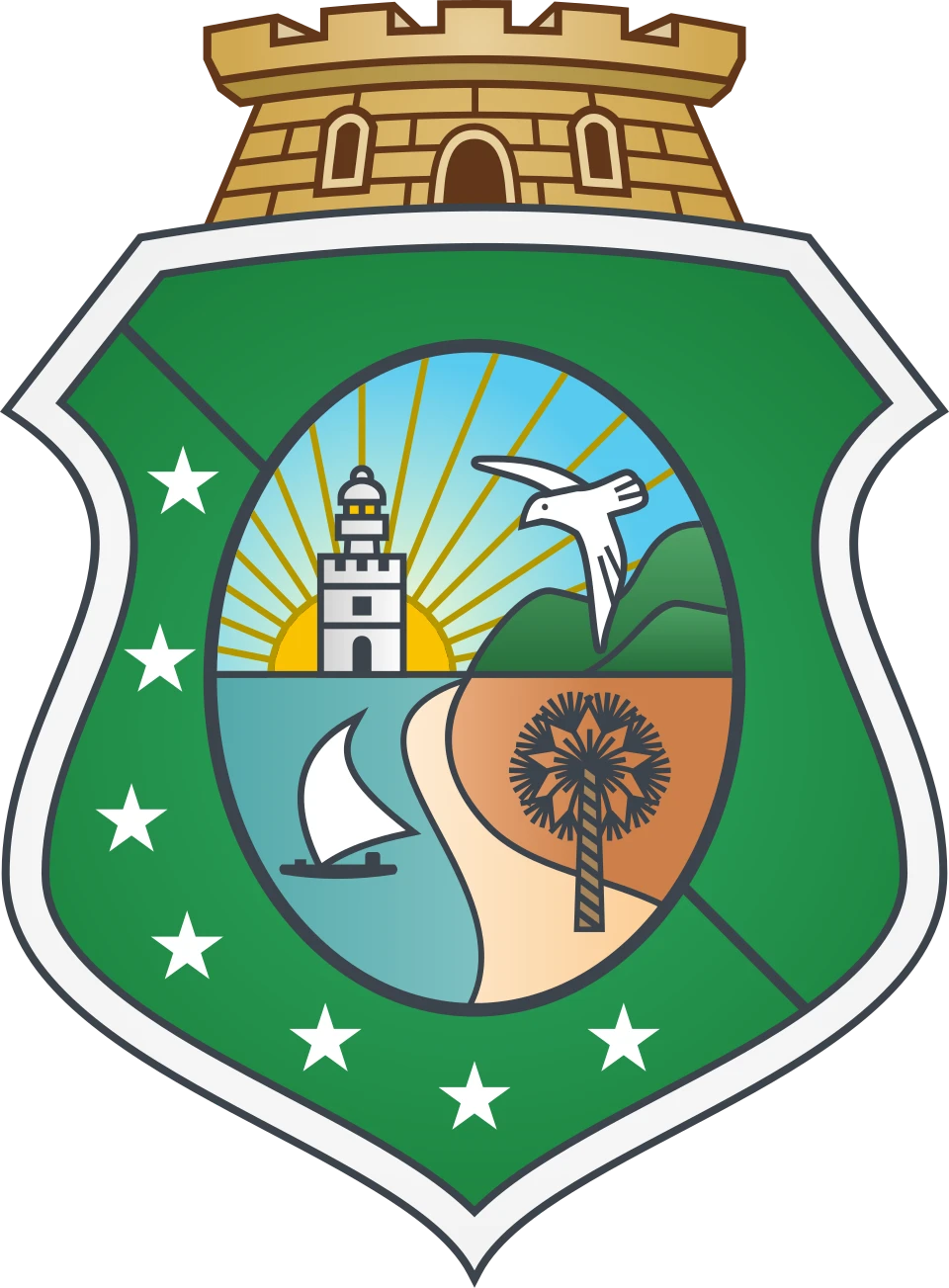
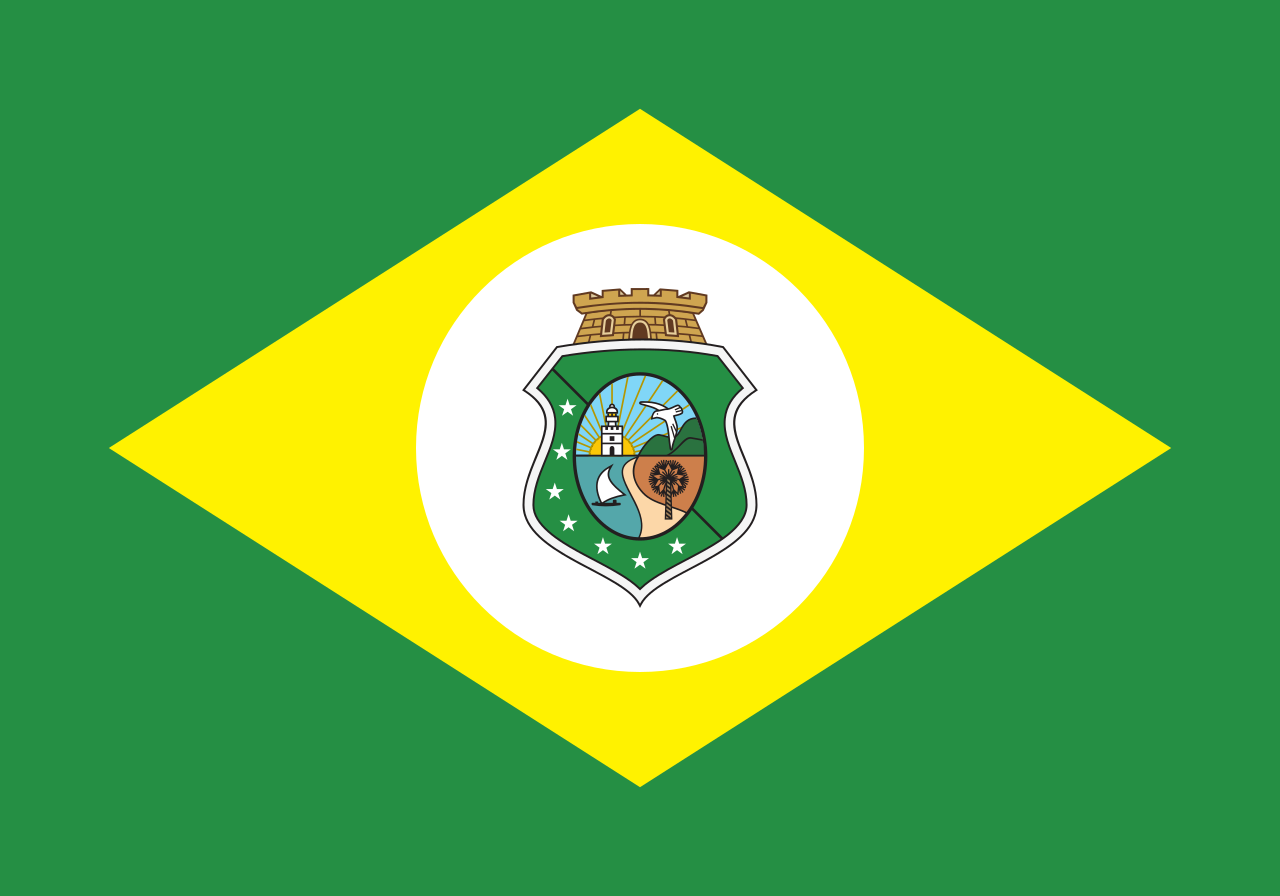
Ceará's emblems weave together fire, air, water and earth into a single shield. The coat of arms, a rounded polonaise shield on a split green field, gathers a rising sun and the Mucuripe lighthouse, a mountain range and a bird, the sea and a jangada raft, and the semi-arid sertão with its carnaúba palm — four quadrants for the four classical elements, crowned by a gold fortress recalling the fort that gave Fortaleza its name. The flag, adopted in 1922, borrows Brazil's own green-and-yellow layout and sets the state arms inside a white disc. Ceará is also remembered as the Terra da Luz — the "Land of Light" — for abolishing slavery in 1884, four years ahead of the rest of the country.
Flag
Not available
Coat of Arms
Not available
| State | Ceará (separated from Pernambuco as an autonomous captaincy in 1799; province from 1824; state since the Proclamation of the Republic, 15 November 1889) |
|---|---|
| Capital | Fortaleza (raised to town status in 1726, city status in 1823) |
| Coat of arms adopted | Original arms by State Law 393 of 22 September 1897; current standardised design by State Law 13,878 of 23 February 2007, amended by Law 13,897 of 21 June 2007 |
| Flag adopted | 25 August 1922 (State Decree 1,971); current specification by Law 13,878/2007 |
| Shield shape | Polonaise (rounded-base), split green field |
| Crest | Gold fortress with five merlons, recalling the Fortaleza de Nossa Senhora da Assunção |
| Stars | Seven white stars — the state's seven mesoregions |
| Nickname | Terra da Luz ("Land of Light"), after the 1884 abolition of slavery |
Coat of Arms — A polonaise shield with seven stars and a four-element central ellipse, crested by a gold fortress.
The coat of arms of Ceará is built on a polonaise shield — a rounded-base form uncommon in Brazilian state heraldry — set on a green, split field. On the sinister side (the viewer's left) stand seven white stars. Over the whole shield lies a central ellipse, cut by a horizon line into four quadrants, each pairing a natural feature of the state with one of the four classical elements. As a crest above the shield stands a fortress of ancient construction, in gold, with five merlons.
Ceará's coat of arms was first established by State Law 393 of 22 September 1897, under governor Antônio Pinto Nogueira Accioli. It was later amended — a 1967 revision under governor Plácido Aderaldo Castelo altered elements of the central composition — before the state government undertook a full revitalisation of the design and its construction specifications in 2007, through Law 13,878 (23 February) and Law 13,897 (21 June), which preserved the traditional elements while standardising proportions, colours and line work.
The fortress crest refers to the origins of Fortaleza, the state capital. A fort named Schoonenborch was built on the site in 1649 by the Dutch captain Matias Beck during the Dutch occupation of the Brazilian northeast; the Portuguese retook the position in 1654 and rededicated it as the Fortaleza de Nossa Senhora da Assunção, from which the city takes its name. The settlement around the fort was raised to the status of vila (town) in 1726 and to city status in 1823. Ceará itself was separated from the captaincy of Pernambuco by royal charter in 1799, becoming an autonomous captaincy and later a province of the Empire.
Flag — Green field, yellow diamond, and a white disc enclosing the state coat of arms.
The flag of Ceará was instituted on 25 August 1922, during the administration of governor Justiniano de Serpa, by State Decree 1,971. It is credited to the merchant João Tibúrcio Albano, son of the Baron of Aratanha, who adapted the layout of the national flag of Brazil to carry the state's own emblem. The coat of arms at its centre was altered by a 1967 law under governor Plácido Aderaldo Castelo, and the flag's full construction specifications — module grid, proportions, and colour placement — were formally set out by State Law 13,878 of 23 February 2007, amended by Law 13,897 of 21 June 2007.
The flag is a green rectangle bearing a yellow diamond, in the same layout as the flag of Brazil, with a white circle at the centre enclosing the state coat of arms. According to the 2007 law, the field's width is divided into 28 equal modules, the flag's length runs to 40 modules, and the central white circle has a radius of 7 modules. Green is generally read as standing for the state's vegetation and natural wealth, and yellow for its mineral resources and characteristic sunlight; the white circle frames the coat of arms in the manner of a seal.
The flag flies over state and municipal public buildings and presides over official ceremonies. It is a fixture of Cearense cultural life, from Carnival celebrations in Fortaleza to the traditional jangada regattas off Mucuripe beach, and it appears in stadiums during matches of the state's two major football clubs, Fortaleza Esporte Clube and Ceará Sporting Club.
The seven white stars on the sinister side of the shield represent the state's seven mesoregions: Noroeste Cearense, Norte Cearense, Metropolitana de Fortaleza, Sertões Cearenses, Jaguaribe, Centro-Sul Cearense and Sul Cearense.
The gold fortress with five merlons recalls the Fortaleza de Nossa Senhora da Assunção, the fort that gave its name to the state capital, Fortaleza. A Dutch fort (Schoonenborch) was built on the site in 1649 by captain Matias Beck; the Portuguese retook it in 1654 and renamed it, and the settlement was raised to town status in 1726.
A horizon line divides the ellipse into four quadrants symbolising the classical elements: sun and the Mucuripe lighthouse (fire), mountain range and a bird (air), sea and a jangada raft (water), and the sertão backlands with a carnaúba palm (earth).
The flag was instituted on 25 August 1922, under governor Justiniano de Serpa, by State Decree 1,971, reportedly designed by the merchant João Tibúrcio Albano. The current specifications were set out by State Law 13,878 of 23 February 2007, amended by Law 13,897 of 21 June 2007.
The nickname commemorates 25 March 1884, when Ceará became the first province of the Brazilian Empire to abolish slavery — four years before the national Lei Áurea of 1888. The abolitionist movement was driven in part by the jangadeiro Francisco José do Nascimento, known as the Dragão do Mar, who organised fellow fishermen to refuse to ferry enslaved people to outbound slave ships; the epithet "Terra da Luz" is generally credited to the abolitionist journalist José do Patrocínio.
Last reviewed by the Emblema Mundi editorial team on 2026-07-04.