State
Bahia was the first Brazilian soil sighted by Portuguese ships, and its emblems still carry that colonial memory alongside a distinctly Republican one. The coat of arms, in official use since 1891, shows a sailing vessel making landfall beneath the star that named the state's capital, flanked by allegorical figures of labour and liberty. The flag, designed in 1889 by the physician Diocleciano Ramos, sets a white Masonic triangle inside a blue canton over red-and-white stripes — a design that predates the Republic itself and still flies each 2 July, the anniversary of Bahia's own war of independence.
Flag
Not available
Coat of Arms
Not available
| State | Bahia (Brazil, Northeast Region) |
|---|---|
| Capital | Salvador (Brazil's first colonial capital, 1549–1763) |
| Coat of arms | In official use since at least 1891, following the 1891 Federal Constitution; redesigned in the mid-20th century |
| Flag designed | 25–26 May 1889, by Diocleciano Ramos, for the Republican Party of Bahia; formally regulated by State Decree 17,628 of 11 June 1960 |
| Flag colours | Red, white, blue |
| Motto (arms) | Per ardua surgo (I rise through difficulty) |
| Civic holiday | 2 July — Dois de Julho, Bahia's Independence Day (1823) |
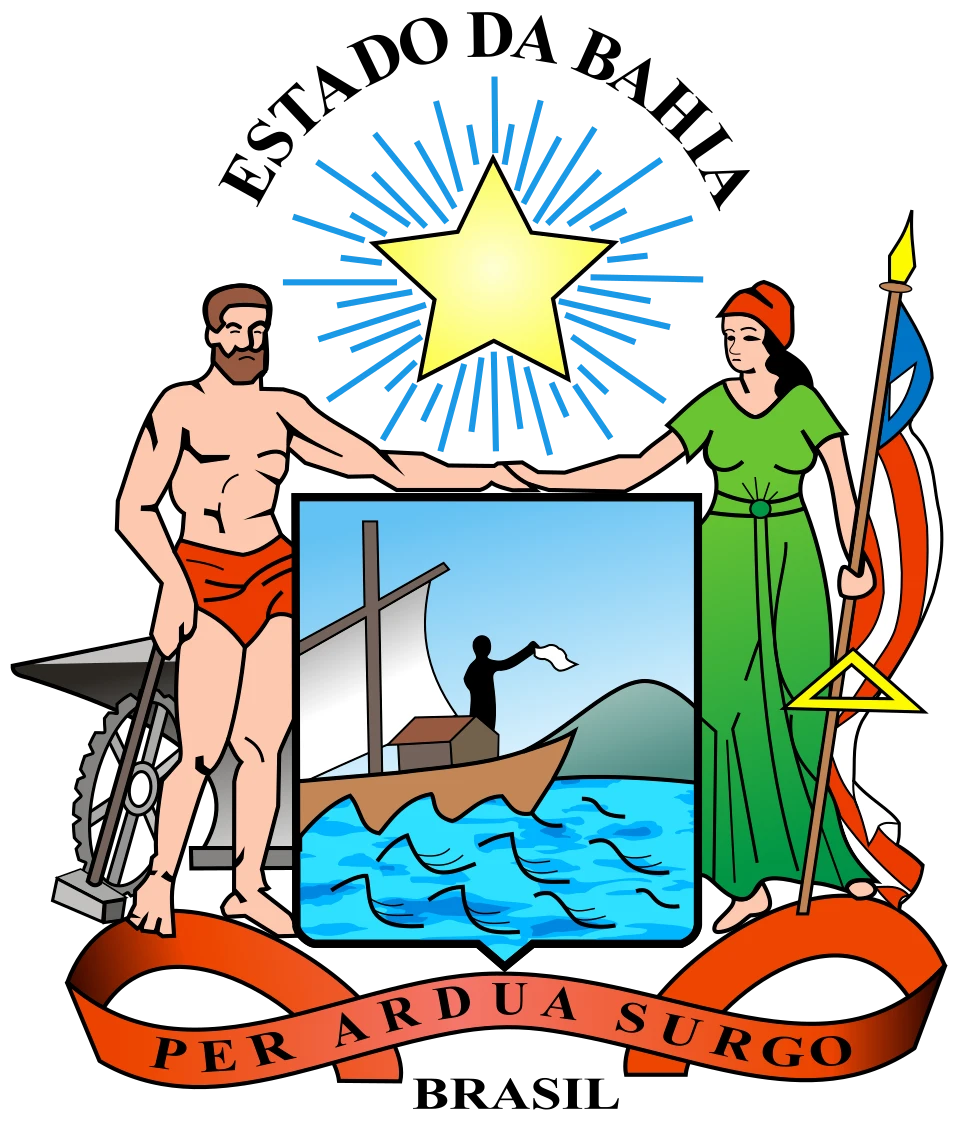
Coat of Arms — A sailing vessel making landfall, flanked by allegorical figures of labour and republican liberty, beneath a radiant star.
Bahia's coat of arms has been in official use since at least 1891, shortly after the Republic's first Constitution allowed each new state to adopt its own emblem. At the centre, a blue shield shows a saveiro — a traditional Bahian sailing vessel — under full sail on the sea; at the bow a sailor waves a white cloth toward the shore, where Monte Pascoal is depicted, the coastal landmark recorded as the first sight of land by Pedro Álvares Cabral's fleet in 1500. The shield is crested by a radiant five-pointed star inscribed ESTADO DA BAHIA, and carries the motto Per ardua surgo (Latin, "I rise through difficulty").
The design available to us does not identify a specific individual designer or the exact decree number under which the current version was fixed; sources agree only that the arms were revised in the mid-twentieth century to reach their present form. This should be treated as an open question rather than a settled fact.
The shield is flanked by two supporting figures (tenentes), a convention common to Brazilian Republican-era state arms:
Note: earlier drafts of this page (and some secondary sources) have described both supporting figures as female. Independent sourcing consistently describes one male figure (labour/industry) and one female figure (republic/liberty); we follow that description here and flag the discrepancy rather than silently repeat it.
Bahia was the stage of Portugal's first documented contact with what became Brazil: Cabral's fleet sighted land near Monte Pascoal in April 1500. Half a century later, in 1549, Tomé de Sousa founded Salvador, which served as the colony's capital until 1763, when the seat of government moved to Rio de Janeiro. The city's harbour anchored the sugar economy of the surrounding Recôncavo Baiano, the wealthiest agricultural region of early colonial Brazil — and, as elsewhere in the plantation economy, a region built substantially on enslaved African labour, a history the coat of arms' Eurocentric imagery has been criticised for omitting.
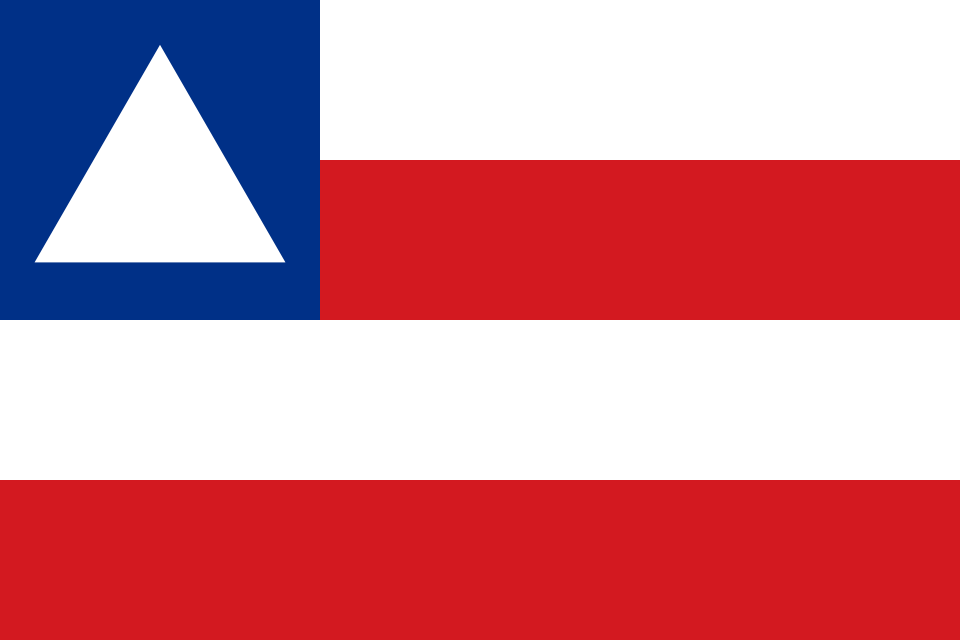
Flag — Red-and-white stripes with a blue canton bearing a white Masonic triangle, designed by Diocleciano Ramos in 1889.
The flag was designed by Diocleciano Ramos, a physician and professor at Bahia's Faculty of Medicine, and presented at a meeting of the Republican Party of Bahia in Salvador on 25 May 1889; the design was approved the following day and adopted as the party's banner. When the Republic was proclaimed and recognised in Bahia in November 1889, the flag was raised locally by Colonel Durval Vieira de Aguiar, commander of the state police. Despite this early adoption, the flag had no formal legal standing for decades: it was banned during the Estado Novo dictatorship (1937–1945), when all subnational symbols were suppressed in favour of national unity, and only received state regulation through Decree 17,628 of 11 June 1960, signed by governor Juracy Magalhães. It was recognised as an official state symbol by Bahia's 1989 Constitution, and further ceremonial rules were set by Decree 13,487 of 2 December 2011.
The flag consists of four horizontal stripes alternating white and red (white outermost), with a blue canton in the upper hoist bearing a centred white triangle. The red-white-blue palette and the stripe arrangement are usually said to echo the flags of the United States and revolutionary France — both invoked as "libertarian colours" by Brazilian Republicans of the period — while the same three colours had already appeared in emblems associated with the 1798 Bahian conspiracy known as the Revolta dos Alfaiates (Tailors' Revolt). The white triangle is a Masonic symbol, echoing the emblem associated with the plotters of the Inconfidência Mineira (1789) and standing for the revolutionary ideal of liberdade, igualdade, fraternidade (liberty, equality, fraternity).
The flag is flown alongside the national flag on Bahia's public buildings and is displayed at official ceremonies and school assemblies. It is most visible during the 2 July celebrations in Salvador, when civic parades mark the anniversary of Bahia's own war of independence from Portuguese forces, distinct from Brazil's national 7 September date.
The white triangle inside the blue canton is a Masonic symbol, echoing the emblem used by the plotters of the Inconfidência Mineira and standing for the republican ideal of liberty, equality and fraternity. It sits on a field of red-and-white stripes inspired by the flags of the United States and revolutionary France.
The flag was designed by Diocleciano Ramos, a Bahian physician and republican, who presented it at a Republican Party meeting in Salvador on 25 May 1889; it was approved the next day. It was banned during the Estado Novo dictatorship (1937–1945) and only received formal state regulation decades later, by Decree 17,628 of 11 June 1960.
A blue shield shows a saveiro under sail with a sailor waving a cloth toward Monte Pascoal, recalling the Portuguese landfall of 1500. It is flanked by two supporters: a semi-nude man with a hammer, anvil and wheel representing labour, and a woman in a Phrygian cap carrying the state flag behind a Masonic triangle, representing the republic and liberty, beneath a radiant star crest and the motto Per ardua surgo.
2 July 1823, Dois de Julho, marks the final expulsion of Portuguese royalist forces from Salvador after roughly a year and a half of fighting that followed Brazil's national declaration of independence on 7 September 1822. It is Bahia's principal civic holiday, commemorated with popular parades in Salvador that locally outweigh the national 7 September date.
Founded in 1549 by Tomé de Sousa, Salvador was Brazil's first colonial capital until 1763, when the seat of government moved to Rio de Janeiro. Its harbour served the sugar economy of the surrounding Recôncavo Baiano, the wealthiest agricultural region of the early colony.
Last reviewed by the Emblema Mundi editorial team on 2026-07-04.