State
Amazonas is the largest state in Brazil by area — a territory of rainforest and rivers larger than most countries in the world — and its emblems are built around water rather than land. The coat of arms, instituted in 1897, is centred on the Encontro das Águas, the famous confluence of the Rio Negro and the Solimões River, watched over by a rising sun and a spread-winged Amazonian eagle. The flag, of the same era but formally confirmed only in 1982, sets a red stripe of remembrance between two white bands of hope, with 25 stars for the municípios of 1897 gathered in a blue canton.
Flag
Not available
Coat of Arms
Not available
| State | Amazonas (AM), North Region of Brazil |
|---|---|
| Capital | Manaus |
| Area | Approx. 1,559,000 km² — the largest of Brazil's 27 federal units |
| Population | Approx. 3.9 million (2022 census) |
| Coat of arms adopted | Decree 204 of 21 November 1897 (regulated further by Decree 10,534 of 1987) |
| Flag adopted | Design used informally from 1897; current pattern confirmed by State Law 1,513 of 14 January 1982 |
| Designer(s) | Not securely documented; the arms were decreed under governor José Cardoso Ramalho Júnior |
| Motto | None official |
| Historical note | Manaus was the capital of Brazil's rubber boom (c. 1880–1912), commemorated indirectly by the state's emblems |
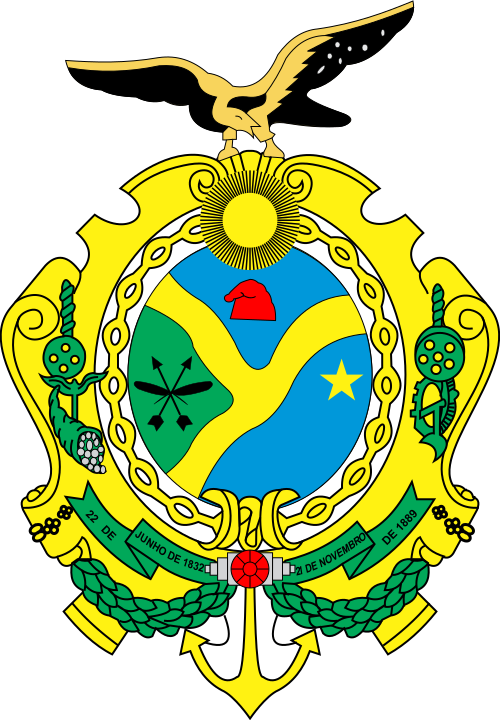
Coat of Arms — An oval shield centred on the confluence of the Rio Negro and the Solimões, beneath a sun, an eagle, and a Phrygian cap.
The coat of arms of Amazonas is built around an oval shield rather than the more common circular medallion used by many Brazilian states. At its centre lies a stylised depiction of the Encontro das Águas (Meeting of Waters) — the point where the dark Rio Negro and the pale, silt-laden Solimões River run side by side before merging into the Amazon proper. Above the rivers a rising sun and a spread-winged Amazonian eagle dominate the upper field, while a red Phrygian cap sits at the river junction itself. A five-pointed star appears above the composition, and a green field beneath carries crossed feathers and arrows. Two historical dates are inscribed on the design: 22 June 1832 and 21 November 1889.
The two dates on the shield refer to distinct, and easily confused, episodes. 22 June 1832 marks a short-lived local declaration of autonomy for the Rio Negro district (the future Amazonas), proclaimed by a handful of local notables dissatisfied with rule from Pará; it was suppressed by imperial troops within weeks and never amounted to genuine independence, though it is remembered locally as an early assertion of regional identity. 21 November 1889 — just days after the Proclamation of the Republic on 15 November — is the date the province formally adhered to the new Republican order; by coincidence, this is also the same day that year on which, eight years later, the coat of arms itself would be decreed, in 1897.
The Province of Amazonas had been carved out of the vast Grão-Pará in 1850 and became a state with the fall of the Empire in 1889. The coat of arms was instituted by Decree 204 of 21 November 1897, signed by governor José Cardoso Ramalho Júnior, though variants of the design are attested in official use as early as 1892. No individual heraldic artist is reliably credited in surviving records; the arms were later re-regulated, without substantive change, by Decree 10,534 of 16 September 1987.
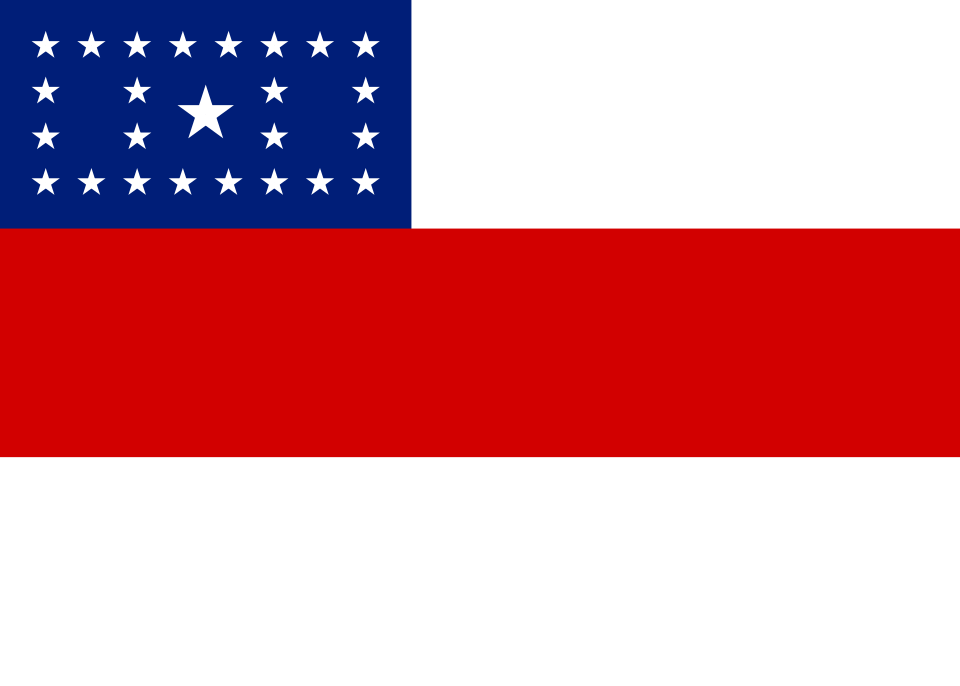
Flag — White-red-white stripes with a blue canton of 25 stars, adopted from an 1897 war banner.
The flag's origins lie in 1897, when a battalion of Amazonas state troops was dispatched to the Northeast to join federal forces in the War of Canudos. A locally devised banner — white and blue with a red stripe added specifically so the unit would carry the colour of blood shed in combat — accompanied the battalion. This war flag was subsequently adapted into the state's civil ensign, though the design that flies today was only given firm legal footing nearly a century later, by State Law 1,513 of 14 January 1982. Some regional sources credit the original 1897 banner to the state's first governor after the fall of the Empire, Marechal Antônio Maria Coelho, though this attribution is not universally confirmed and should be treated with some caution.
The flag consists of three equal horizontal stripes — white, red, white — in a 5:7 proportion. A blue canton occupies the upper hoist-side corner, overlaying the first white stripe, and carries twenty-five white five-pointed stars arranged in rows, with a single larger star at the centre of the group. The white bands are read as a symbol of hope; the red stripe commemorates the hardships endured by Amazonas's soldiers at Canudos; the blue of the canton stands for the sky.
The 25 stars correspond to the 25 municípios that made up the state of Amazonas on 4 August 1897, among them Manaus, Borba, Barcelos, Tefé, Parintins, Itacoatiara, Coari, Manicoré, Humaitá and others — a list that, notably, still included what later became Boa Vista, capital of the future state of Roraima. Unlike the ever-growing star count of the national flag, the number on the Amazonas flag has never been revised to reflect the state's subsequent, much larger, roster of municipalities: it remains fixed as a historical marker of 1897, with the single larger central star standing for the capital, Manaus.
The flag flies over public buildings, schools and civic ceremonies throughout the state and appears alongside the national flag at official events. It is a familiar sight during the state's best-known cultural showcase, the Festival de Parintins, and its white-red-blue palette has become closely associated with Amazonense regional identity on official documents, institutional branding and locally made products.
An oval shield shows the Meeting of Waters — the confluence of the dark Rio Negro and the pale, silty Solimões that together form the Amazon River — beneath a rising sun and a spread-winged Amazonian eagle. A Phrygian cap at the river junction signals loyalty to the Republic, a star above stands for peace and progress, and crossed feathers and arrows on a green field evoke the region's Indigenous roots. Two dates appear on the design: 22 June 1832, when the Rio Negro district briefly declared its own autonomy, and 21 November 1889, when the province formally adhered to the new Republic.
The design dates to 1897, when a red-white-and-blue banner was carried into battle by the Amazonas military battalion sent to the War of Canudos. The coat of arms was formally instituted by Decree 204 of 21 November 1897, and the flag pattern still flown today was confirmed by State Law 1,513 of 14 January 1982.
The 25 white stars in the blue canton represent the 25 municípios that made up the state on 4 August 1897. One larger star at the centre of the group stands for the capital, Manaus. Unlike the national flag's stars, they are a fixed historical count and have not been increased as new municipalities were created.
The Encontro das Águas is the point near Manaus where the dark, warm Rio Negro and the pale, sediment-rich Solimões River run side by side for several kilometres without fully mixing, owing to differences in temperature, density and speed, before merging into the Amazon proper. It is one of the state's best-known natural landmarks and has featured on its arms since the nineteenth century.
Between roughly 1880 and 1912, Amazonas was the world's leading source of natural latex, and Manaus grew into one of Brazil's wealthiest cities on rubber-export fortunes. The opulent Teatro Amazonas opera house, completed in 1896, became the emblem of that boom. The trade collapsed after rubber-tree seeds were smuggled to British and Dutch colonies in Southeast Asia, whose plantations undercut Amazonian production by the 1910s.
Last reviewed by the Emblema Mundi editorial team on 4 July 2026.