State
Brazil's northernmost state wears its geography on its emblems. Amapá — carved out of Pará as a federal territory in 1943 and raised to full statehood only by the 1988 Constitution — adopted both its coat of arms and its tricolour flag in a single stroke on 23 April 1984, the winning entries of a public design competition won by the artist Herivelto Brito Maciel. The arms centre on a gold map of the state bearing the amapazeiro tree that gave the territory its name, crowned by a scroll proclaiming Aqui Começa o Brasil — "Here Brazil Begins." The flag's blue-green-yellow bands, edged in black and white, carry a stylised silhouette of the Fortaleza de São José de Macapá, the eighteenth-century fort that anchored Portuguese control of a frontier once bitterly disputed with French Guiana.
Flag
Not available
Coat of Arms
Not available
| State | Amapá (AP) — North Region |
|---|---|
| Capital | Macapá (the only Brazilian state capital bisected by the Equator) |
| Population | ≈ 730,000–800,000 (2022 census, second-least populous Brazilian state) |
| Coat of arms adopted | 23 April 1984 (Decree 8, Federal Territory of Amapá) |
| Flag adopted | 23 April 1984 (Decree 8); retained unchanged at statehood in 1988 |
| Designer | Herivelto Brito Maciel, winner of the 1983–84 state symbols competition |
| Motto | Aqui Começa o Brasil (Here Brazil Begins) |
| Historical note | Federal territory from 1943 (split from Pará); state since the 1988 Constitution, with legislators seated in 1991 |
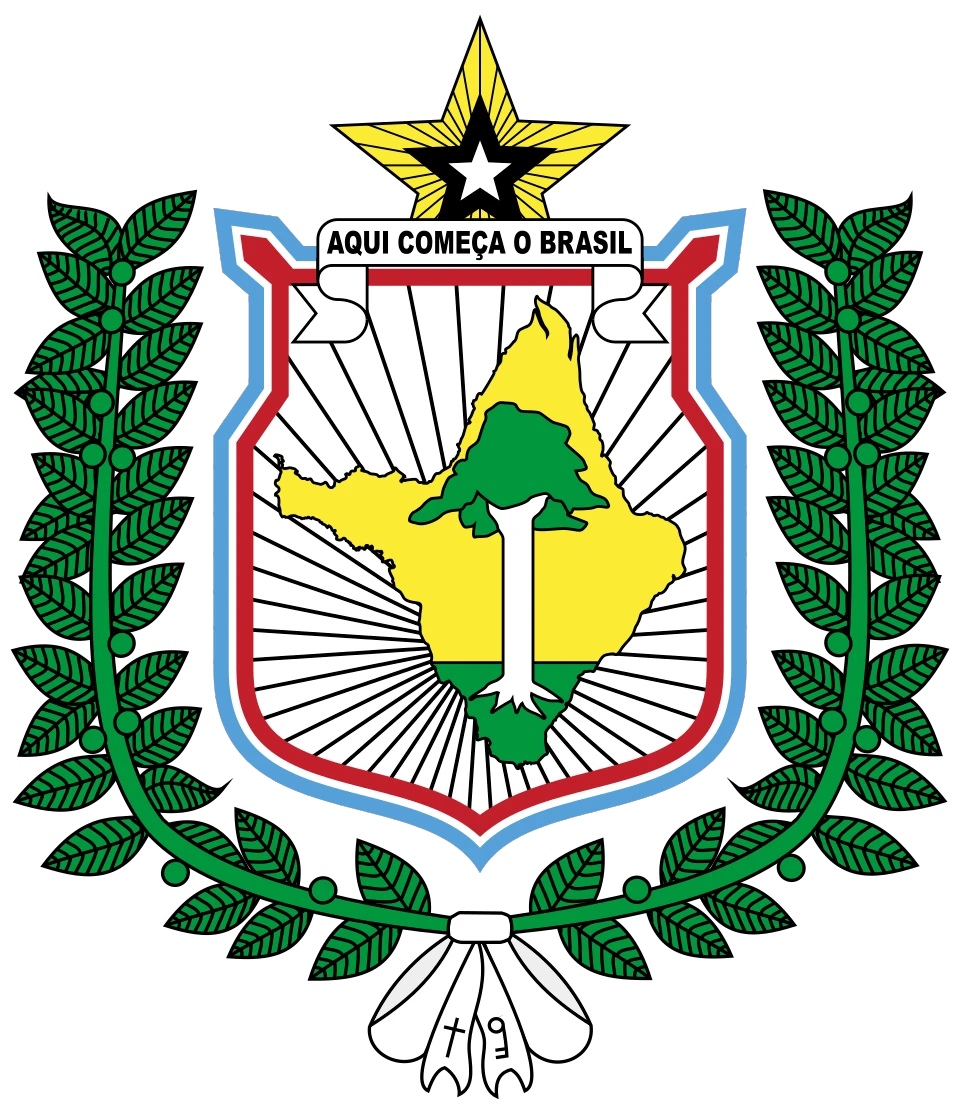
Coat of Arms — A gold map of Amapá bearing the amapazeiro tree, beneath a scroll reading Aqui Começa o Brasil.
The arms of Amapá are borne on a shield outlined in blue and red, its upper corners echoing the outline of the historic Fortaleza de São José de Macapá. The central charge is a gold silhouette map of the state, below a horizontal line marking the Equator (0°0′0″, passing through Macapá) and radiated beneath by twenty-five black rays converging toward the map. Standing on the map is the amapazeiro (Amapa tree) — one of a few competing origins proposed for the territory's name, alongside Tupi and Arawak etymologies — rendered with a silver trunk and a green crown. Above the shield, a small white five-pointed star with yellow rays surmounts a white scroll inscribed in black capitals: AQUI COMEÇA O BRASIL — "Here Brazil Begins." The whole is flanked by two branches of the amapazeiro tree, in the manner of the wreaths common to Brazilian Republican-era state arms.
The coat of arms was not an inheritance from the colonial or imperial period, as with older Brazilian states, but a deliberate act of nation-building for a young federal unit. The Federal Territory of Amapá, created on 13 September 1943 by decree of the Getúlio Vargas government and detached from Pará, spent four decades without arms of its own. In September 1983 the territorial government opened a public competition to design official state symbols; the winning coat-of-arms design, submitted by the artist Herivelto Brito Maciel, was formally adopted together with the flag by Decree 8 of 23 April 1984, under territorial governor Aníbal Barcellos.
The choice of the amapazeiro and the motto reflected a territory still asserting its distinct identity within Brazil, a legacy of the long Amapá Question — the nineteenth-century border dispute with French Guiana that had left the region contested and thinly administered for decades before Brazil's sovereignty was confirmed. When the 1988 Constitution converted the territory into a full state, with the first elected state legislature seated in 1991, the arms adopted in 1984 were carried over unchanged.
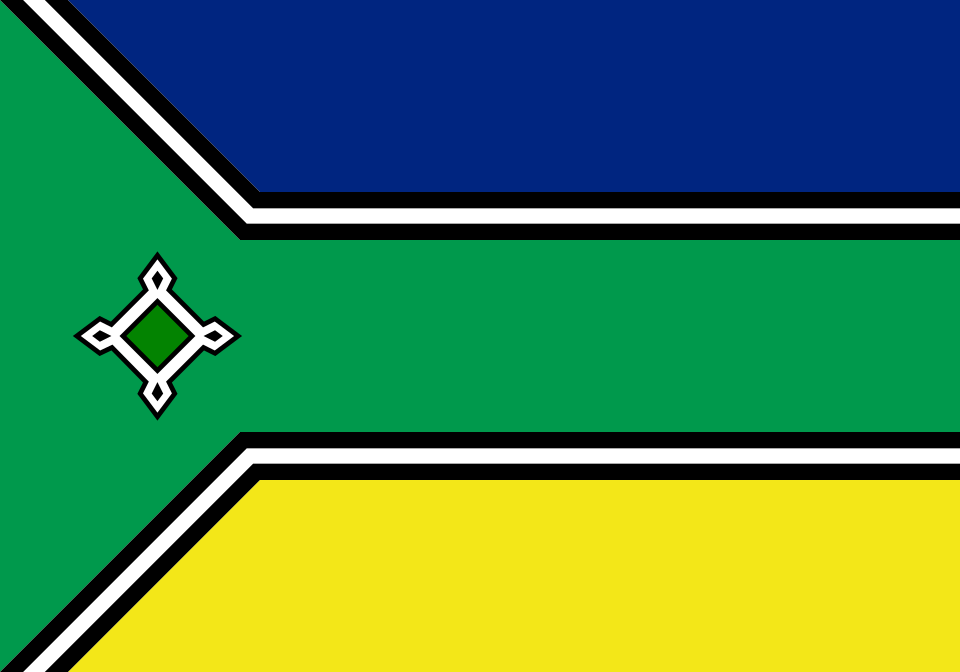
Flag — Blue, green and yellow bands edged in black and white, with a stylised emblem of the Fortaleza de São José at the hoist.
Like the coat of arms, the flag of Amapá has no colonial or imperial pedigree: before 1984 the territory had informally flown a modified version of Pará's own flag, adapted to show the Fortaleza de São José. That stopgap ended when the same 1983 symbols competition that produced the arms also settled the flag's design. The territorial government, under Governor Aníbal Barcellos, formally adopted the new flag alongside the coat of arms by Decree 8 of 23 April 1984 (a preparatory commission had been established shortly before, by Decree 4 of 30 January 1984). The design was carried forward unchanged when Amapá became a state under the 1988 Constitution, formally seating its first state government in 1991.
The flag is a horizontal tricolour in a 7:10 proportion: a dark blue band at the top, a green band in the centre (widening into a triangle at the hoist), and a yellow band at the bottom, each pair of stripes separated by a black-edged white line. Set within the green triangle near the hoist is a stylised black-and-white outline of the Fortaleza de São José de Macapá, echoing the same fortress motif that shapes the upper outline of the coat of arms' shield.
The flag flies over state government buildings, schools and courts throughout Amapá and is displayed at civic ceremonies alongside the national flag. Its fortress emblem and tricolour bands have become a recognisable shorthand for Amapaense identity, appearing on official documents, road signage and in local cultural production, and the flag is a fixture of celebrations tied to Macapá's Free Trade Zone and to state Foundation Day observances.
A shield charged with a gold map of the state bearing the amapazeiro tree, one proposed origin of the name Amapá, crowned by a star and a scroll reading Aqui Começa o Brasil ("Here Brazil Begins"). The design, by the artist Herivelto Brito Maciel, won a public competition held by the Federal Territory of Amapá in 1983 and was adopted by Decree 8 of 23 April 1984.
The current flag was instituted by Decree 8 of 23 April 1984, while Amapá was still a federal territory, following the same 1983–84 symbols competition that produced the coat of arms. It remained the state flag when Amapá achieved statehood under the 1988 Constitution.
Green stands for the Amazon forest that covers most of the state; yellow for mineral wealth and the federal union; blue for justice and the sky; white for peace; and the black outlining the bands commemorates those who died in the region's historical struggles, including the nineteenth-century border conflict with French Guiana.
The capital is Macapá, the only Brazilian state capital bisected by the Equator, and the site of the eighteenth-century Fortaleza de São José de Macapá referenced in the state's emblems.
Amapá was carved out of Pará and made a federal territory in 1943, partly for strategic and administrative reasons tied to its remote, sparsely settled position on the disputed frontier with French Guiana — a border dispute known as the Amapá Question, resolved in Brazil's favour by Swiss arbitration in 1900. It remained a territory administered directly by the federal government until the 1988 Constitution elevated it to full statehood, with elected state legislators seated in 1991.
Last reviewed by the Emblema Mundi editorial team on 4 July 2026.