State
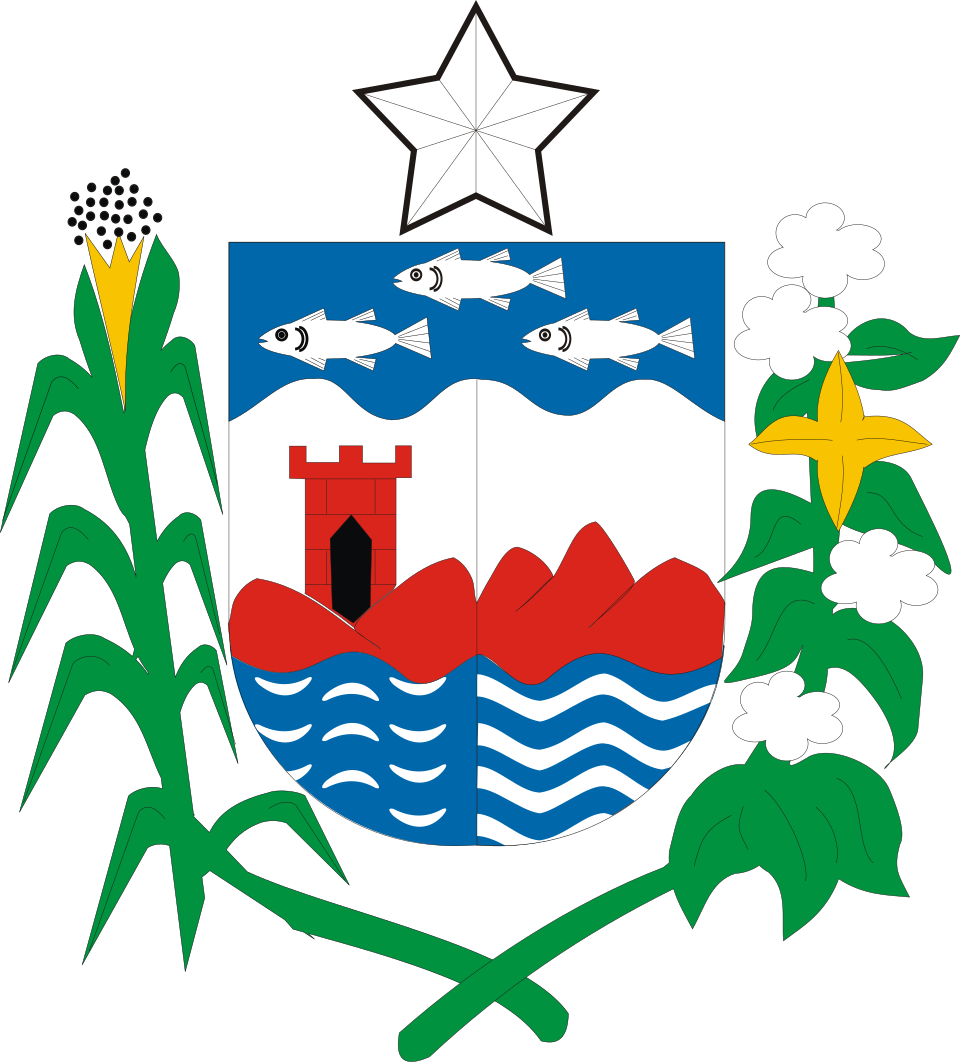
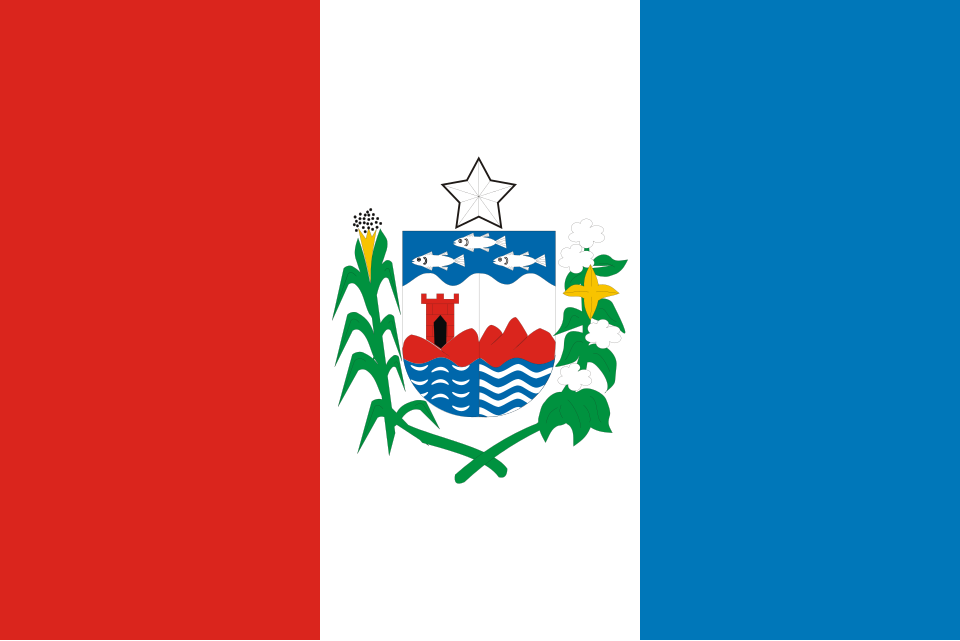
Alagoas packs an unusually literal civic history into its emblems. The coat of arms, designed by the Maceió physician and folklorist Théo Brandão, is really a shield of three towns at once: Penedo's riverside tower, the twin hills of Porto Calvo, and three silver fish for the lagoons — Mundaú, Manguaba, and Jequiá — that gave the old settlement of Alagoas, and eventually the whole state, its name. The flag, adopted the same year, breaks from the usual tricolour format by running its red, white, and blue bands vertically rather than in horizontal stripes, deliberately set apart from the French Tricolore.
Flag
Not available
Coat of Arms
Not available
| State | Alagoas (captaincy separated from Pernambuco in 1817; province from 1822; state since 1889) |
|---|---|
| Capital | Maceió (capital since 1839; the earlier capital, Alagoa do Sul, is today Marechal Deodoro) |
| Coat of arms & flag adopted | 23 September 1963, State Law 2,628 |
| Designer | Théo Brandão (Theotônio Vilela Brandão, 1907–1981), physician and folklorist |
| Flag layout | Three equal vertical bands: red (hoist), white (centre), blue (fly) |
| Motto | Ad Bonum et Prosperitatem (Latin, “For the good and for prosperity”) |
| Region | Northeast Brazil (Nordeste) |
Coat of Arms — A shield combining the emblems of Penedo, Porto Calvo, and old Alagoas, flanked by sugarcane and cotton and topped by a silver star.
The coat of arms of Alagoas is a Portuguese-style shield divided into three fields, each standing for one of the towns that founded the state. On the dexter side (the viewer's left), a red rocky outcrop rising from a wavy blue sea supports a red tower — the arms of Penedo, the old riverside town on the São Francisco. On the sinister side, three united red hills, the middle one taller, rise over a base of eight alternating wavy bands of blue and silver — the arms of Porto Calvo. Across the chief (the upper third of the shield), on a wavy blue field, swim three silver mullets (tainhas) arranged one above another — the arms of the original settlement of Alagoas, today the municipality of Marechal Deodoro.
The shield is flanked by two branches tied at the base: a sugarcane stalk on one side and a cotton branch on the other, the state's two historic staple crops. Above the shield rises a five-pointed silver star. Below, a green ribbon bordered in gold carries the Latin motto AD BONUM ET PROSPERITATEM.
Present-day Alagoas was administered from Pernambuco from the early colonial period until 16 September 1817, when the Portuguese Crown separated it into its own captaincy — a measure taken in the unsettled aftermath of the Pernambucan Revolution of that year, which had briefly established a rebel government in Recife. The territory became a province after Brazilian independence in 1822, and one of the few to recognise Emperor Pedro I's authority quickly. In 1824, Alagoas was invited to join the short-lived Confederação do Equador, the republican secession centred on Pernambuco, but the province did not adhere to the movement and instead served as a base for the imperial forces sent to suppress it. The provincial capital moved from the old town of Alagoa do Sul to Maceió in December 1839, ratified by a resolution of the provincial assembly. Alagoas became a state with the Proclamation of the Republic in 1889.
The territory's most storied episode predates all of this: the Quilombo dos Palmares, centred on the Serra da Barriga in what is now the municipality of União dos Palmares, was the largest and most durable community of self-liberated Africans in colonial Brazil. Its principal settlement fell to a colonial expedition on 6 February 1694; its last leader, Zumbi, survived the assault but was killed over a year later, on 20 November 1695 — the date since adopted nationally as Black Consciousness Day. The current coat of arms replaced an earlier republican design (Decree 53 of 25 May 1894) that was discontinued in 1937; both the 1894 arms and the current one drew on a colonial-era shield that already featured the three silver fish.
Flag — Three vertical bands of red, white, and blue, with the coat of arms, minus its motto ribbon, on the white band.
The flag now in use was established alongside the coat of arms by State Law 2,628 of 23 September 1963, both designed by Théo Brandão. It replaced an unofficial provincial flag and the coat-of-arms-only banner that had served, with interruptions, since the 1890s.
The law describes the flag as bandeira terciada em pala, de vermelho, branco e azul — a rectangular flag divided into three equal vertical bands: red at the hoist, white in the centre, and blue at the fly. The state coat of arms, without its motto ribbon, is centred on the white band. Alagoan sources describe the choice of a vertical tricolour, in this particular colour order, as a deliberate departure from the French Tricolore, with white read as a note of neutrality between the state's regional traditions. (English-language sources sometimes describe the colours as echoing the French Revolutionary motto of liberty, equality, and fraternity; Portuguese-language sources describing the law's intent say the opposite — that the arrangement was chosen to distinguish the flag from France's — so this claim should be treated with caution.)
The flag flies over Alagoas's state government buildings and at official ceremonies alongside the national flag of Brazil. It is flown with particular prominence each 20 November, the national Black Consciousness Day marking Zumbi's death, especially at the Serra da Barriga memorial site of the former Quilombo dos Palmares.
Vertical. State Law 2,628 of 23 September 1963 describes the flag as bandeira terciada em pala — three equal vertical bands of red at the hoist, white in the centre, and blue at the fly, with the coat of arms centred on the white band.
Both were conceived by Théo Brandão (Theotônio Vilela Brandão, 1907–1981), a Maceió-born physician and the state's most celebrated folklorist, and formally adopted by State Law 2,628 of 23 September 1963.
Three silver mullets (tainhas) stacked on a blue field represent the region's three principal lagoons — Mundaú (or do Norte), Manguaba (or do Sul), and Jequiá — and the fishing economy long associated with them.
It is Latin for “For the good and for prosperity,” echoing the opening words of the 1817 decree that created the Captaincy of Alagoas, separate from Pernambuco.
The Quilombo dos Palmares, the largest and longest-lived community of self-liberated Africans in colonial Brazil, was centred on the Serra da Barriga in what is now the Alagoas municipality of União dos Palmares. Its main settlement fell to colonial forces on 6 February 1694, and its last leader, Zumbi, was killed on 20 November 1695 — the date now marked nationally as Black Consciousness Day.
Last reviewed by the Emblema Mundi editorial team on 2026-07-04.