State
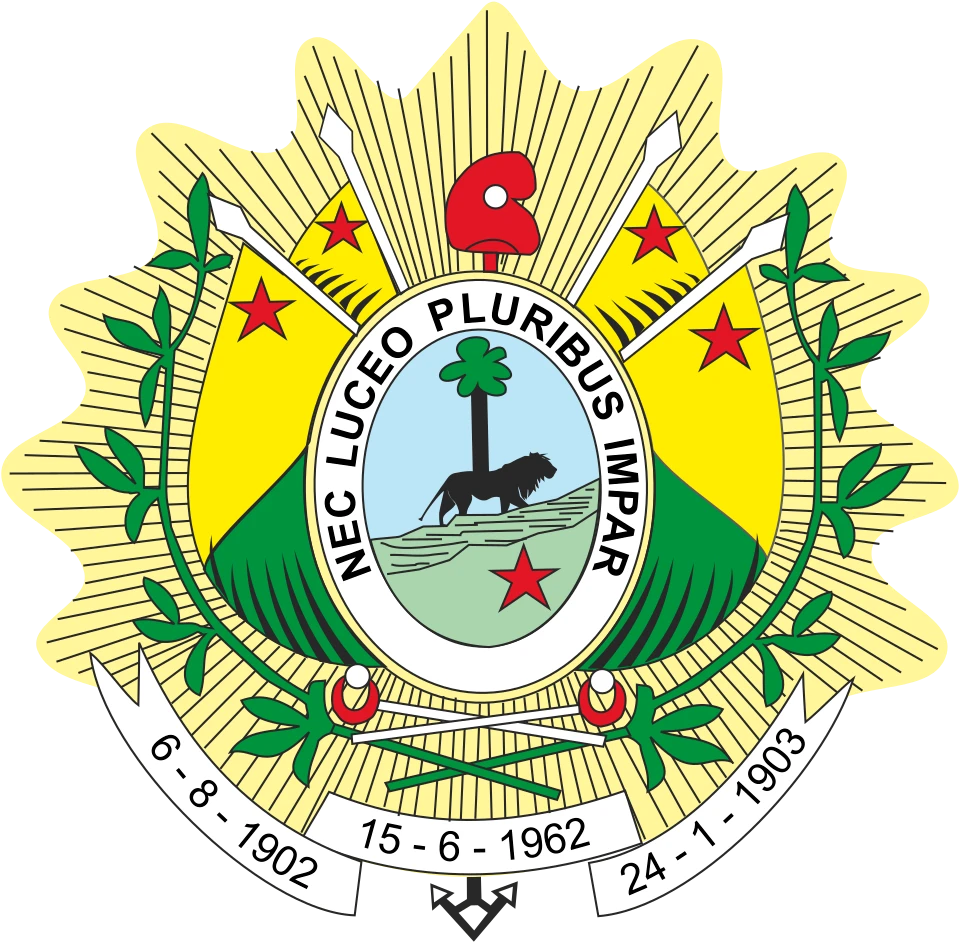
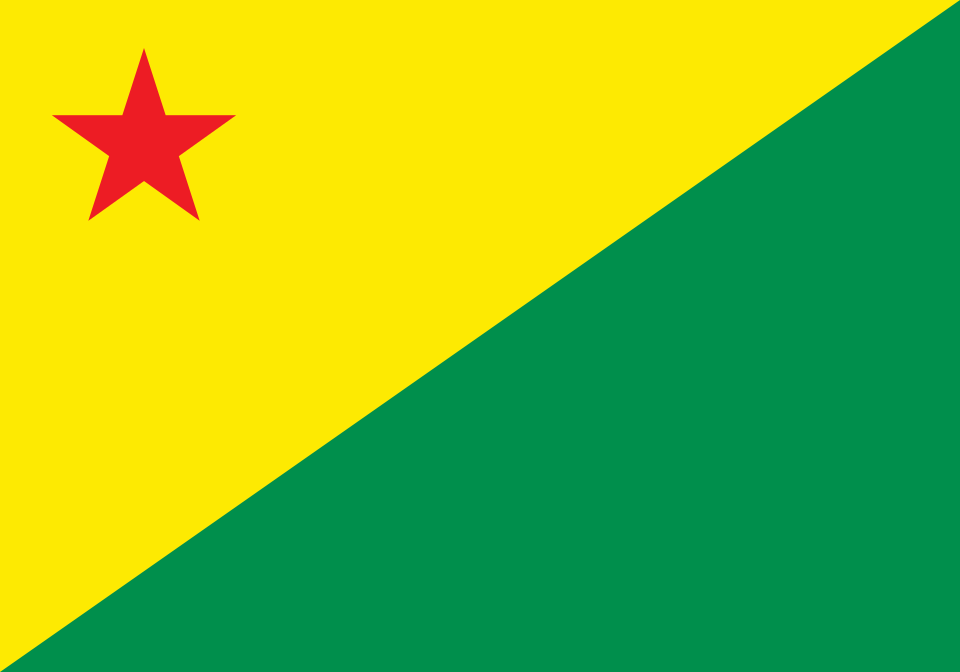
Acre is the Brazilian state with the most unusual origin story in the federation: a territory disputed with Bolivia, won by rubber tappers in the Acrean Revolution (1899–1903), and annexed to Brazil only by the Treaty of Petrópolis (1903) — nearly a century after most of the rest of the country. Its coat of arms carries a red Phrygian cap, symbol of the liberty its rebels claimed, above a shield with a leopard, a rubber tree, and the Latin motto Nec Luceo Pluribus Impar. Its flag, split diagonally into yellow and green, bears a single red star said to recall the blood spilled in that fight for annexation.
Flag
Not available
Coat of Arms
Not available
| State | Acre (AC) — North Region of Brazil |
|---|---|
| Capital | Rio Branco (founded 1882) |
| Population | ≈ 900,000 (2020s estimates) |
| Coat of arms | Elements devised during the Acrean Revolution (1902–1903); revised repeatedly through the twentieth century; current form fixed by State Law No. 1,173 of 22 December 1995 |
| Flag adopted | Design fixed by Resolution No. 5 of 24 January 1921; current legal force from State Law No. 1,170 of 22 December 1995 |
| Key figures | José Plácido de Castro (revolutionary leader); Epaminondas Jácome (first governor of the Federal Territory, credited with the motto) |
| Motto | Nec Luceo Pluribus Impar (“Not inferior to many stars”) |
| Historical note | Former Bolivian territory; independent for brief periods (1899, 1900, 1902–1903); ceded to Brazil by the Treaty of Petrópolis (17 November 1903); federal territory from 1904; statehood only on 15 June 1962 |
Coat of Arms — An oval shield crowned by a Phrygian cap, with a leopard, a rubber tree, and the motto Nec Luceo Pluribus Impar.
The arms of Acre are built around an oval shield (an “escutcheon shape” common to several Brazilian Republican-era states) edged in silver and bearing, along that border, the Latin motto NEC LUCEO PLURIBUS IMPAR. The shield is surmounted by a red Phrygian cap, the classic republican and revolutionary symbol of liberty. Within the field stands a leopard before a rubber tree (seringueira) and a river, flanked by crossed branches of coffee and tobacco and two crossed swords, with an anchor beneath. Framing elements have varied across the several redesigns of the arms, but the Phrygian cap, the lone star, and the Latin motto have remained constant since the early twentieth century.
Unlike almost every other Brazilian state, Acre's emblems commemorate an annexation, not an inheritance from the colonial or Imperial order. The region was recognised as Bolivian territory through the nineteenth century, but its rubber wealth drew a large population of Brazilian migrants. A short-lived independent “Republic of Acre” was declared in July 1899 under Luiz Gálvez Rodrigues de Arias, put down by Bolivian forces in 1900; a second uprising later that year met the same fate. A third, more organised revolt broke out in August 1902 under the Rio Grande do Sul-born rancher José Plácido de Castro, who by early 1903 had secured most of the territory. With the diplomatic backing of the Brazilian government under Baron Rio Branco, the dispute was settled by the Treaty of Petrópolis of 17 November 1903: Bolivia ceded the territory to Brazil in exchange for compensation and land elsewhere. Acre became a Brazilian federal territory in 1904 and was elevated to full statehood only on 15 June 1962 — sixty years after annexation. Elements of the arms first appeared during the revolutionary period itself and were revised more than once over the following decades; the version in use today was given formal legal standing by State Law No. 1,173 of 22 December 1995.
Flag — Diagonal yellow and green field with a lone red star, born from the Acrean Revolution.
The flag's lineage runs directly through Acre's revolutionary period. The short-lived independent state proclaimed in 1899 flew a plain diagonal bicolour, without a star. During the third and decisive uprising of 1902–1903, the forces led by José Plácido de Castro added a lone red star to the design — a change some accounts trace to an earlier, second uprising in late 1900. The flag was formally fixed by Resolution No. 5 of 24 January 1921, signed by Governor Epaminondas Jácome of the then Federal Territory of Acre, and its use as the state flag was given renewed legal force by State Law No. 1,170 of 22 December 1995, after statehood.
The flag is a rectangle in 7:10 proportion, divided by a diagonal line running from the lower hoist to the upper fly. The upper-left triangle is yellow, bearing a single five-pointed red star near the hoist; the lower-right triangle is green. Sources consistently associate the yellow with peace or the land's riches and the green with hope, echoing the colours of the national flag of Brazil and signalling the territory's integration into the federation. The lone star — known locally as the estrela solitária or estrela altaneira — is widely explained as recalling the blood of the rebels who fought and died to bring Acre into Brazil rather than remain under Bolivian administration.
The flag flies alongside the Brazilian national flag on public buildings, schools, and at civic ceremonies throughout Acre. The lone red star, in particular, has become a widely recognised emblem of Acrean regional identity, appearing on official documents, sports jerseys, and in local popular culture as a mark of the state's distinct and hard-won path into the Brazilian federation.
The star was added to an older green-and-yellow banner by the forces of José Plácido de Castro during the Acrean Revolution of 1902–1903. Known as the estrela solitária or estrela altaneira, it recalls the blood of the rebels who fought to bring the territory into Brazil rather than remain under Bolivian rule.
Acre was Bolivian territory until Brazilian rubber tappers, led by José Plácido de Castro, rose up in a series of uprisings between 1899 and 1903 known as the Acrean Revolution. Brazil's government backed the rebels, and the Treaty of Petrópolis of 17 November 1903 transferred the region to Brazil in exchange for compensation and territory elsewhere. Acre became a federal territory in 1904 and a full state only on 15 June 1962.
It translates roughly as “not inferior to many stars” or “no less bright among many.” It is a deliberate adaptation of the French Sun King Louis XIV's motto Nec Pluribus Impar, credited to Epaminondas Jácome, the first governor of the Federal Territory of Acre, asserting the new territory's worth despite its late and contested entry into the Brazilian federation.
The leopard stands for the strength, agility, and ferocity associated with the forest and its peoples, while the rubber tree (seringueira) refers directly to the rubber-boom economy that drew settlers to Acre and financed the revolt against Bolivian rule. Coffee and tobacco branches and an anchor complete the shield, echoing motifs used across Brazilian state heraldry.
Versions of both symbols circulated from the Acrean Revolution onward, but the flag's design was fixed by Resolution No. 5 of 24 January 1921 under Governor Epaminondas Jácome, and the coat of arms went through several revisions before both were given their current legal form by State Laws No. 1,170 and 1,173 of 22 December 1995.
Last reviewed by the Emblema Mundi editorial team on 2026-07-04.