Country
Argentina's national emblems were forged in the upheaval of the May Revolution. The celeste-and-white flag was first raised by General Manuel Belgrano on the banks of the Paraná at Rosario on 27 February 1812, six years before independence was secured. The coat of arms, adopted a year later by the Assembly of the Year XIII, replaced the Spanish royal seal with two clasped hands, a pike topped with a Phrygian cap of liberty, and the rising Sun of May — the same sun that, in 1818, would be added to the flag itself in memory of the Cabildo Abierto of 25 May 1810.
Click on a country to learn more
| Country | Argentine Republic (República Argentina) |
|---|---|
| Coat of arms adopted | 12 March 1813, by the Assembly of the Year XIII |
| Flag first raised | 27 February 1812, at Rosario by Manuel Belgrano |
| Flag adopted nationally | 25 July 1816, by the Congress of Tucumán |
| Sun of May added | 25 February 1818 |
| Modern standardisation | Decree 10,302 of 24 April 1944 |
| Flag colours | Celeste (light blue), white, gold (sun) |
| Motto | En unión y libertad (In union and liberty) |
| Federal units | 23 provinces + 1 autonomous city (Ciudad Autónoma de Buenos Aires) |
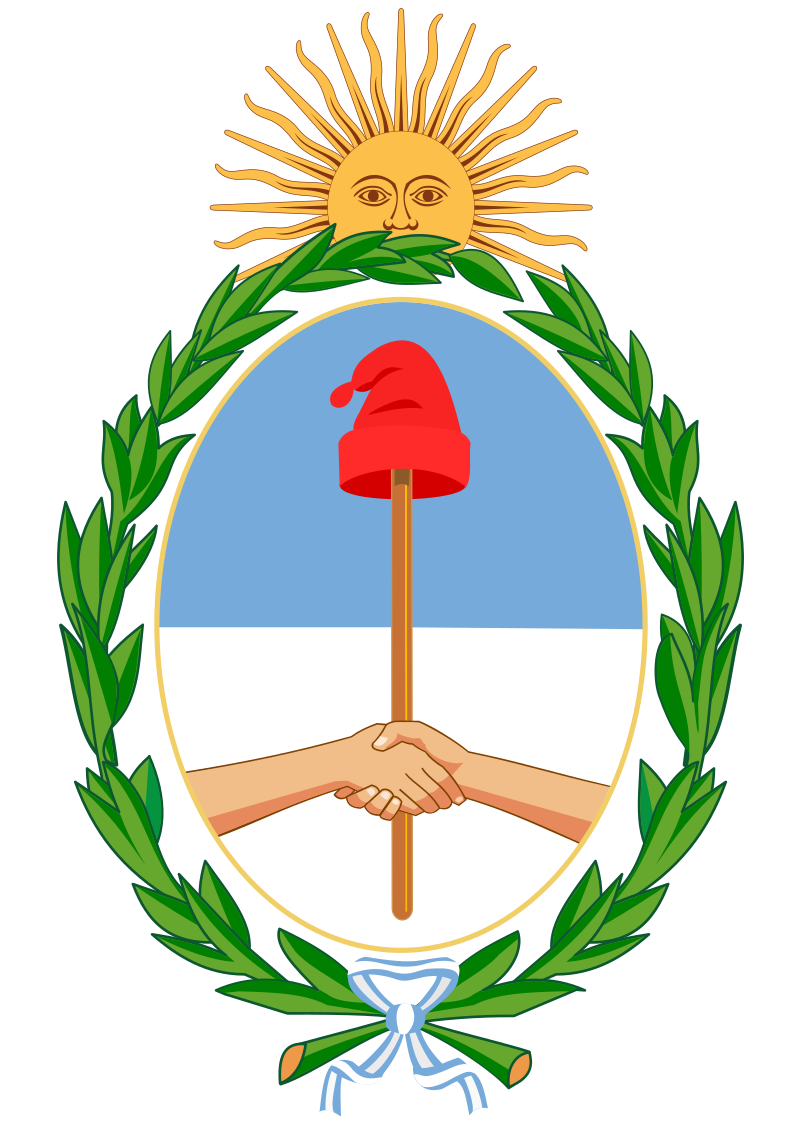
Coat of Arms — An oval party per fess argent and azure, two dexters clasped supporting a pike topped with a Phrygian cap, the Sun of May in chief, within a laurel wreath tied celeste and white.
An oval shield party per fess, the chief argent and the base azure; in the base two dexter hands clasped, issuing from the partition line and supporting a pike argent surmounted by a Phrygian cap gules; in chief, the Sun of May in splendour or; the whole within a laurel wreath vert, tied at the base with a ribbon celeste and argent.
The composition is read from bottom to top as a layered allegory of the Revolution. The two clasped right hands rising from the partition line stand for the union of the provinces against the Spanish Crown; the pike they support is the weapon of the citizen-soldier; the Phrygian cap at its tip is the bonnet of the freed Roman slave, adopted by the French Revolution as the universal emblem of liberty and inherited by every Spanish-American republic. Above them all rises the Sun of May, the founding symbol of the Argentine Republic.
The arms were instituted by the Asamblea General Constituyente — known to Argentines as the Assembly of the Year XIII — on 12 March 1813, fifteen months after Belgrano had first improvised a national flag at Rosario. The Assembly's first practical task was to find a seal to replace the Spanish royal arms on its decrees. Deputy Agustín Donado commissioned two engraved dies — one for the Assembly itself, one for the Executive — from the Peruvian silversmith Juan de Dios Rivera, working in Buenos Aires. Rivera delivered the silver-and-bronze die that became, by simple use, the National Coat of Arms.
The intellectual authorship of the design is less certain. Tradition long credited Rivera himself; modern scholarship more often points to the engraver and political agent Isidro Antonio de Castro, another Peruvian then active in the Río de la Plata. No founding decree describes or prescribes the image — it entered Argentine constitutional life simply by being used.
The Sun of May (Sol de Mayo) is the emblematic core of Argentine iconography. A golden disc bearing a human face, surrounded by 32 alternating rays — 16 straight and 16 flaming (wavy) — it commemorates the events of 25 May 1810, when, according to a tenacious revolutionary legend, the sun broke through the clouds above the Buenos Aires Cabildo just as the deposition of the Viceroy was being proclaimed. The anthropomorphic face and the alternating rays are widely understood as a Republican re-reading of Inti, the solar deity of the Inca empire that had once held the Andean half of the future Republic.
1813 — Foundational seal. Adopted by the Assembly of the Year XIII to authenticate official acts in place of the Spanish royal arms.
1820–1860 — Provincial period. During the long civil war between Unitarians and Federalists, the arms appeared in many local variants, with regional ribbons and motti. No central authority enforced a single version.
1860 — Federal Constitution. The post-Pavón consolidation of the federal Republic restored the 1813 form as the canonical reference.
24 April 1944 — Decree 10,302. The first modern legal standardisation of all national symbols. The decree fixed the precise drawing, proportions and colour values still in use today, ending more than a century of regional drift.
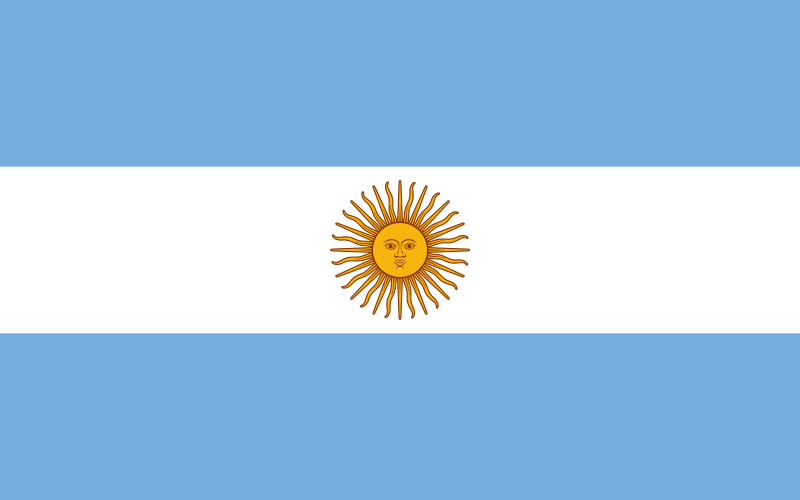
Flag — Three equal horizontal bands, celeste, white and celeste; the central white band charged with the golden Sun of May.
The flag's origin lies in a small administrative request. In February 1812, Manuel Belgrano — Buenos Aires lawyer, economist, and now a creole general charged with fortifying the riverbank at Rosario against Spanish gunboats from Montevideo — asked the First Junta in Buenos Aires for permission to issue a national cockade to distinguish his troops from royalist forces, both still nominally fighting under the flag of Spain. On 18 February 1812, the Junta approved a celeste-and-white cockade (Escarapela Nacional), still commemorated each 18 May as the national Day of the Cockade.
Nine days later, on 27 February 1812, Belgrano went beyond his orders. At a battery he had named Independencia on the banks of the Paraná, he raised a banner in the colours of the new cockade and had his troops swear allegiance to it. The First Junta, embarrassed, ordered the banner withdrawn — but it was already too late. The flag had been seen, and the Army of the North carried versions of it across the Andes and into Upper Peru.
The origin of the colours is debated rather than documented. Three theories circulate in the scholarly literature:
Belgrano himself, in his autobiographical writings, simply records that the colours were "those of the cockade", offering no further justification.
The flag was given national legal status not in Buenos Aires but in the interior. On 9 July 1816, the Congress of Tucumán declared the independence of the United Provinces of the Río de la Plata; on 25 July 1816 the same congress, then sitting under Belgrano's direct influence, formally adopted the celeste-and-white flag as the national pavilion.
The Sun of May was added later, by a decree of the same congress on 25 February 1818, after it had reconvened at Buenos Aires. The sun was modelled directly on the obverse of the first Argentine coin, struck at Potosí in 1813 under the same Assembly that had created the coat of arms — a deliberate visual citation linking flag, currency and arms.
For more than a century Argentine flags varied in shade, proportion and the design of the sun. Decree 10,302 of 24 April 1944 ended that drift. It fixed colours, proportions and the precise drawing of the Sun of May, and it formalised the long-standing customary distinction between two coexisting versions of the same flag:
Argentine heraldry is, like that of every Spanish-American republic, the heraldry of a rupture. Where European nations built their arms outward from medieval feudal shields, the founders of 1810–1816 had to invent symbols capable of replacing the Spanish royal arms without conceding any continuity with monarchy. They drew from three sources:
The arms and the flag together form the visual core of the national pantheon, completed by the cockade and the anthem. Decree 10,302/1944 names all four — flag, arms, anthem, cockade — as the indivisible Símbolos Nacionales.
The Argentine federation is composed of 23 provinces and one autonomous city, each with its own coat of arms and most with its own flag. The majority of provincial arms were designed in the second half of the nineteenth century during the consolidation of the federal state; provincial flags are a more recent phenomenon, with most current designs adopted after the return to democracy in 1983.
The full alphabetical list of all 24 federal units follows below.
The flag was created by General Manuel Belgrano, who first raised it on the banks of the Paraná at Rosario on 27 February 1812, nine days after the First Junta had approved a celeste-and-white national cockade in the same colours. Belgrano acted beyond his formal orders, and the Junta initially asked him to withdraw the banner — but the flag was already in use.
The Sol de Mayo is a golden sun with a human face and 32 rays (16 straight, 16 wavy) commemorating the events of 25 May 1810, when the deposition of the Spanish viceroy was proclaimed in Buenos Aires. By tradition, the sun broke through the clouds at the moment of the proclamation. The anthropomorphic face is also widely read as a tribute to Inti, the solar deity of the Inca empire.
The origin is debated. The colours were already those of the cockade approved by the First Junta on 18 February 1812, themselves inherited either from the Order of Charles III (a Bourbon royal order) or from the cockades worn during the May Revolution of 1810. Later traditions read them as the sky over the Río de la Plata, or as the colours of Nuestra Señora de Luján, the national patroness.
The Bandera Oficial de Ceremonia bears the Sun of May and is reserved for state, military and official use. The Bandera de Ornato is plain celeste and white, used for civilian display. Both are equally the national flag, but the ornamental version must always be hoisted below the ceremonial one when the two are displayed together. The distinction was formalised by Decree 10,302 of 1944.
The two right hands clasped represent the union of the provinces, the pike they support is the weapon of the citizen-soldier, and the Phrygian cap is the classical emblem of liberty inherited through the French Revolution. Together they declared that the new state was a Republic of free and united provinces, replacing the Spanish royal arms on the seals of government from 12 March 1813.
Last reviewed by the Emblema Mundi editorial team on 21 June 2026.