US City
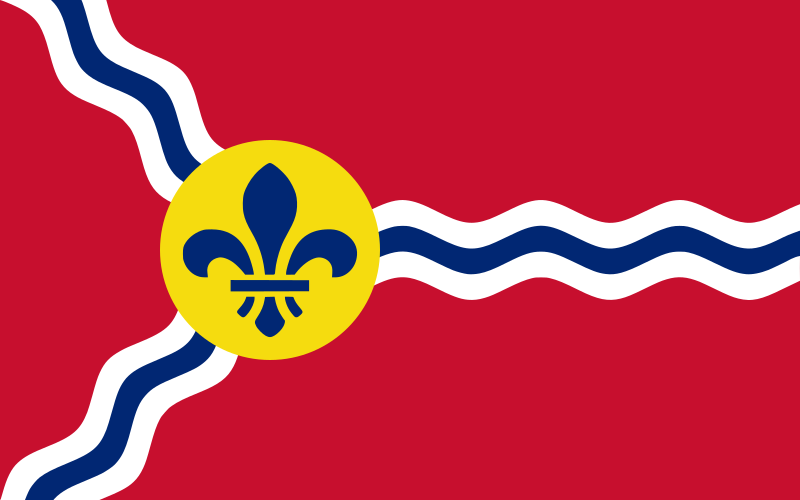
St. Louis has one of the best-loved flags in America and a seal almost nobody notices. The flag, designed in 1964 by the Yale art historian Theodore Sizer, is a red field crossed by wavy blue-and-white bands that meet at a gold disc bearing a blue fleur-de-lis — the two great rivers joining at the city, and the French king for whom it is named. It was voted the fifth-best city flag in the United States. The seal is a quieter thing: a steamboat under the Stars and Stripes, a memory of the river port St. Louis once was. Here is what each of them means.

Click on a country to learn more
| City | St. Louis, Missouri; founded 14 February 1764 by Pierre Laclède and Auguste Chouteau |
|---|---|
| Named for | King Louis IX of France — Saint Louis |
| Flag adopted | 1964 (replacing an earlier flag of 1946) |
| Flag designer | Theodore Sizer (1892–1967), art historian, Yale University |
| Flag design | Red field; wavy blue-and-white bands meeting at a gold disc bearing a blue fleur-de-lis |
| Symbolism | The bands, the confluence of the Missouri and Mississippi; the gold disc, the city and the Louisiana Purchase; the fleur-de-lis, French heritage and Louis IX |
| NAVA 2004 survey | Voted 5th-best of 150 United States city flags |
| Seal | A circular device: a steamboat flying the United States flag, with a scroll |
| Incorporated as a city | 1822 |
Flag of St. Louis — wavy blue-and-white bands on red meeting at a gold disc with a blue fleur-de-lis: the two rivers, the city, and the French king it is named for. Designed by Theodore Sizer, 1964.
The flag was designed by Theodore Sizer, an art historian at Yale University, and adopted by the city in 1964, the bicentennial year of its founding. It replaced an earlier civic flag designed by Edward Krondl and adopted in 1946. Sizer’s design is spare and legible, and it has aged far better than most: a single red field with three broad wavy bands running in to a point.
Every element is doing work. The wavy blue-and-white bands stand for the confluence of the Missouri and Mississippi, the meeting of the two great rivers just above the city. Where they meet sits a gold disc — heraldically a bezant, a gold roundel standing for a Byzantine coin and, by old convention, for a purchase: here it marks the city itself and the Louisiana Purchase of 1803. On the disc is a blue fleur-de-lis, for the French who founded St. Louis and for Saint Louis of France, King Louis IX, whose name the city carries.
The design is one the profession holds up as a model. In the North American Vexillological Association’s 2004 survey of 150 United States city flags, St. Louis was voted the fifth-best in the country — a rare flag that a resident can draw from memory, and that says something true about the place in three or four shapes.
The flag’s colours are chosen to carry more history than the eye first catches. Red and gold are the colours of Spain; white and gold, of Bourbon France; blue, white and red, of Republican France; red, white and blue, of the United States. Between them they name every power that has ruled the city, and in the order it changed hands.
St. Louis was founded as a French fur-trading post on 14 February 1764 — yet the land west of the Mississippi had, only months before, been ceded to Spain, and Spanish officials would govern the town for a generation. In 1800 it passed briefly back to France, until Napoleon sold the whole of Louisiana to the United States in 1803. So the city was French by birth, Spanish by treaty, French again for a moment, and finally American — four sovereignties in forty years, folded quietly into the palette of a flag designed a century and a half later.
Seal of St. Louis — a steamboat flying the United States flag, with a scroll: a memory of the city’s age as a great river port.
If the flag is celebrated, the seal is all but invisible — a plain, official thing. The city code describes a small circular device, an inch and a half across, engraved with a steamboat carrying a United States flag and surmounted by a scroll. There is no allegory and no Latin: just the boat.
The choice is not idle. St. Louis, incorporated as a city in 1822, grew rich in the nineteenth century as one of the great steamboat ports of the Mississippi, the hinge between the settled East and the opening West — the role later cast in steel as the Gateway Arch. The seal keeps the older image: the paddle-wheeler that made the city, running under the flag of the country that bought it.
On a red field, wavy blue-and-white bands meet at a gold disc bearing a blue fleur-de-lis. The bands are the confluence of the Missouri and Mississippi; the gold disc stands for the city and the Louisiana Purchase; and the fleur-de-lis is for the French founding and for Louis IX of France, the city’s namesake.
A bezant — a heraldic gold roundel representing a Byzantine coin, used to signify a purchase. Here it stands for the city and for the Louisiana Purchase of 1803, by which the United States bought the territory from France.
Because St. Louis was founded by the French in 1764 and named for King Louis IX, Saint Louis. The fleur-de-lis, emblem of the French crown, marks both the city’s origin and its royal namesake.
Theodore Sizer, an art historian at Yale, designed the flag adopted in 1964; it replaced an earlier flag by Edward Krondl adopted in 1946.
In the North American Vexillological Association’s 2004 survey of 150 United States city flags, St. Louis was voted the fifth-best design in the country.
A circular seal showing a steamboat flying the United States flag, with a scroll — a memory of the city’s era as a great Mississippi river port. St. Louis was incorporated as a city in 1822.
Last reviewed by the Emblema Mundi editorial team on 16 September 2026.