US City
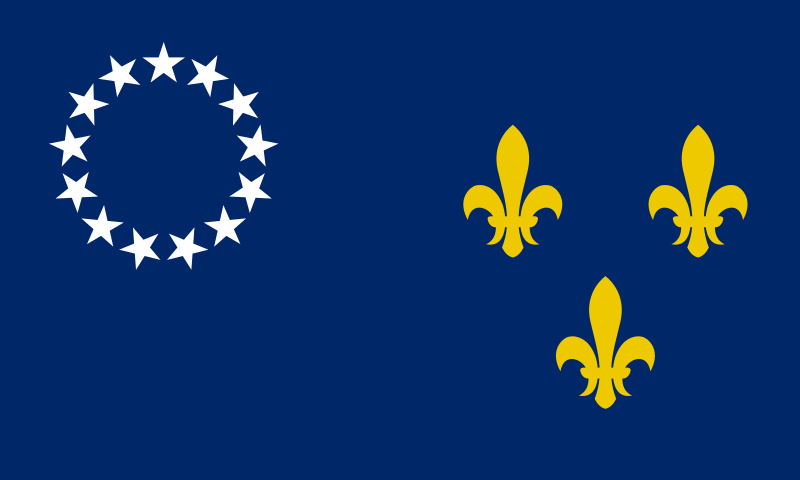
For seventy years Louisville flew a flag that put a republic and a monarchy on the same cloth: thirteen white stars for the United States as they were when the city was founded, and three gold fleurs-de-lis for Louis XVI of France, the king it is named after. This page describes that flag, flown from 1934 to 2003.
Click on a country to learn more
| City | Louisville, Kentucky |
|---|---|
| Flag | Navy blue, a ring of thirteen white stars at the upper hoist, three gold fleurs-de-lis at the lower fly |
| In use | 1934–2003 |
| Stars | The thirteen states at the city’s founding in 1778 |
| Fleurs-de-lis | Louis XVI of France, the city’s namesake |
| NAVA 2004 survey | 9th of 150 United States city flags |
Flag of Louisville, 1934–2003 — a navy blue field with a ring of thirteen white stars at the upper hoist and three gold fleurs-de-lis at the lower fly. The stars for the thirteen states at the city’s founding in 1778, the lilies for Louis XVI of France. Replaced in 2003.
A navy blue field, with a ring of thirteen white stars in the upper corner by the staff and three gold fleurs-de-lis in the lower corner at the fly. It served as the flag of the City of Louisville from 1934 to 2003.
In 1780 the Virginia General Assembly chartered the town and named it after Louis XVI, whose soldiers were then fighting beside the Americans in the Revolutionary War. The city took the king’s name, and its flag later took his arms.
That makes this one of the stranger pieces of American civic heraldry. The ring of stars is the emblem of a republic that had just thrown off a king; the lilies are the badge of another king, borrowed in gratitude. Thirteen years after the town was named, Louis XVI was guillotined by his own country’s revolution — and in the twentieth century his lilies went up on an American city’s flag, where they stayed from 1934 to 2003.
When Louisville merged with Jefferson County in 2003, the old city flag was retired. Its successor, designed by the Louisville native William Glenn Hack, carries the new metro seal on blue: a single gold fleur-de-lis with a star on either side, the date 1778, and the words Louisville • Jefferson County Metro in a ring. The thirteen stars went; the lily stayed, and it is still the city’s symbol.
The ring of thirteen white stars stands for the thirteen states that existed when Louisville was founded in 1778.
Louisville is named after King Louis XVI of France, whose soldiers aided the Americans in the Revolutionary War. The fleurs-de-lis come from the arms of his House of Bourbon.
In 2003, when the city merged with Jefferson County. The new Louisville Metro flag keeps a single gold fleur-de-lis.
A note on method. The flag is described from the published descriptions, not from the drawing. This page describes the city flag of 1934–2003, which is the one shown; the present Louisville Metro flag is mentioned only where it continues the old one.
Last reviewed by the Emblema Mundi editorial team on 30 September 2026.