Federal District
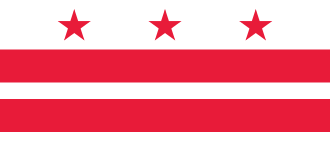
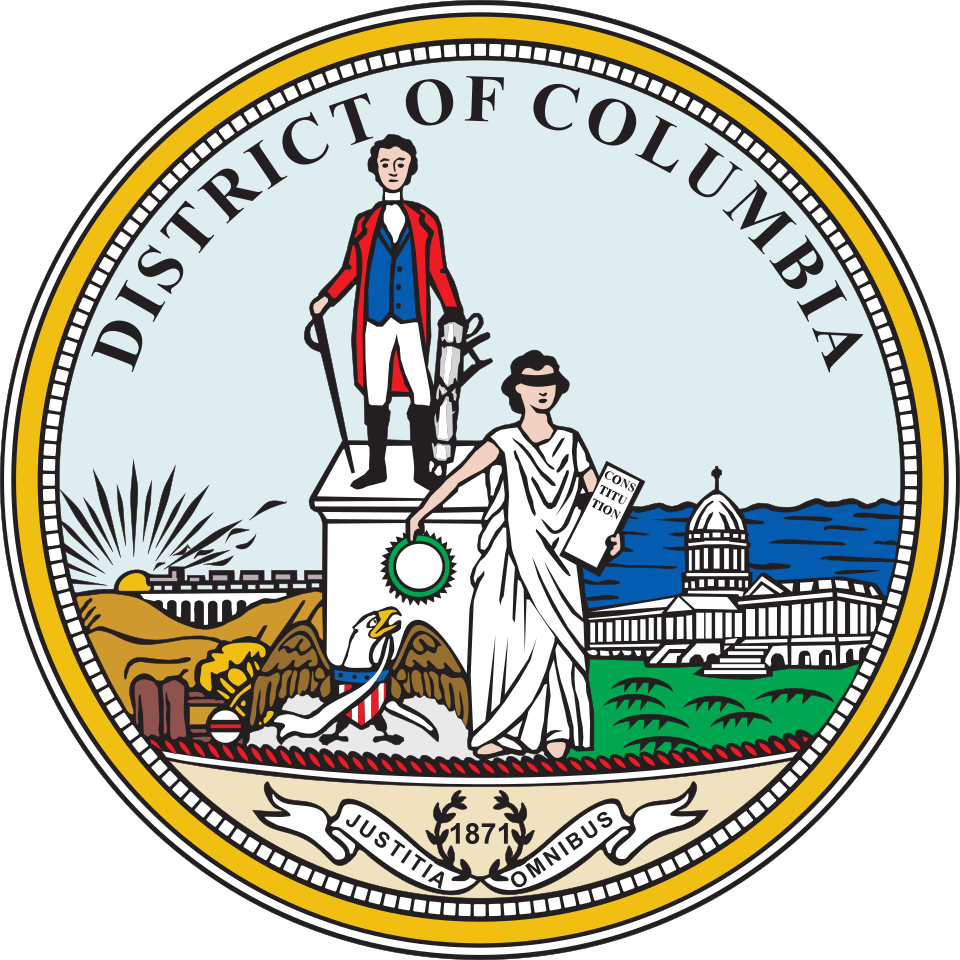
Washington, D.C. flies what its own profession judges the finest flag in the United States, and it is not a new design at all: three red stars over two red bars on white, the coat of arms of George Washington’s family turned into a banner. Adopted in 1938, after more than a century in which the capital had no flag, it topped the North American Vexillological Association’s 2004 survey of 150 American flags. The district’s older emblem, the seal of 1871, is the opposite kind of design — crowded and full of allegory, Washington on a pedestal and Justice laying a wreath, under the motto Justitia Omnibus, “Justice for All” — for a capital whose residents still have no vote in Congress.
Click on a country to learn more
| Territory | District of Columbia — the federal capital, belonging to no state |
|---|---|
| Flag design | Armorial banner of the Washington family arms: argent, two bars gules, in chief three mullets of the second |
| Flag designed by | Charles A. R. Dunn (1921); credited at adoption to Commissioner Melvin C. Hazen and Arthur E. Du Bois |
| Flag Commission | Created by act of Congress, 16 June 1938 |
| Flag adopted | 15 October 1938; first flown 18 October 1938 at the District Building |
| Flag proportions | Hoist divided 3 / 2 / 1 / 2 / 2 tenths (white, bar, white, bar, white) |
| NAVA 2004 survey | 1st of 150 United States city flags (9.17 / 10) |
| Seal adopted | 31 August 1871; revised 1903 |
| Seal motto | Justitia Omnibus — “Justice for All” |
Flag of Washington, D.C. — three red stars above two red bars on white, the arms of the Washington family. Blazon: argent, two bars gules, in chief three mullets of the second.
For most of its history the federal capital had no flag of its own. The push for one came late, and from Congress: an act of 16 June 1938, signed by President Franklin D. Roosevelt, created a District Flag Commission of three federally appointed members. About fifty designs were considered. The commission adopted its choice on 15 October 1938, and the flag was first flown three days later, on 18 October, at the District Building.
The winning design was not invented for the occasion. It is an armorial banner — a coat of arms spread across a flag — of the arms of the Washington family, confirmed to Lawrence Washington of Sulgrave Manor in Northamptonshire in 1592: three red stars above two red bars on a white field. The concept had been drawn as early as 1921 by Charles A. R. Dunn, then working at the Chamber of Commerce, straight from the family arms. At adoption the public credit went instead to Commissioner Melvin C. Hazen, who championed the design, and to Arthur E. Du Bois for the final details; Dunn’s authorship stayed largely unknown until he set it out in a 1957 article, “The Origins of the District of Columbia Flag.”
The design is exact: the ordinance divides the height into tenths — three for the white above, two for each bar, one for the white between them, two for the white below. What it does not do is explain itself. No official symbolism was ever attached to the number of stars or bars; they are simply the Washington arms. Later commentators supplied their own readings — the two bars as the Senate and House in which the district has no vote, the three fields as the original tracts of the territory — but these are later glosses, not the intent of 1938.
The result is the flag vexillologists most admire. In the North American Vexillological Association’s 2004 survey of 150 United States city flags, Washington, D.C. placed first, scoring 9.17 out of 10 — just ahead of Chicago. Its reception was not always warm: chosen without any vote by the district’s own residents, who were themselves voteless, it was received coldly at first. It has since become one of the strongest civic emblems in the country, worn and flown across the city and taken up as the banner of the D.C. statehood movement.
The arms behind the flag are among the most storied in the English-speaking world. Argent, two bars gules, in chief three mullets of the second — a white shield, two red bars, three red stars above — were borne by the Washingtons of Sulgrave Manor, the English ancestors of the first President, and confirmed to Lawrence Washington in 1592. They survive in stone and glass at Sulgrave and elsewhere in England.
Because the arms pair stars with stripes, they are endlessly cited in the popular story that they inspired the Stars and Stripes of the United States. It is a good story, and an old one, but it has never been supported by documentary evidence, and most historians treat it as legend. What is certain is narrower and more interesting: the same medieval English arms that folklore ties to the national flag were, in 1938, made quite deliberately into the flag of the nation’s capital — this time on the record.
Seal of the District of Columbia — Justice crowning a statue of Washington, with the Capitol, an eagle and the motto Justitia Omnibus, dated 1871.
The district’s seal is much older than its flag. It was prescribed by an act of the Council of the District of Columbia on 31 August 1871, the year the district was given a territorial government, and approved by its Board of Commissioners. No single designer is clearly on record. A revised version followed in 1903, refining the detail without changing the scheme.
Where the flag is spare, the seal is an allegory packed with figures. At its centre a statue of George Washington stands on a pedestal, a sword in his right hand and his left resting on the fasces, the bound rods that stand for the Union. Beside him a blindfolded figure of Justice holds the Constitution in one hand and, with the other, lays a wreath at the statue. Behind them are an American eagle amid the produce of the land, the Potomac, the United States Capitol, a rising sun and a railway train — the improving capital of the 1870s. Below runs the motto, and the founding year sits in a wreath beneath the design:
JUSTITIA OMNIBUS — “Justice for All.”
The seal stayed in ordinary official use until 1979, when the district government adopted a simpler flag-based logo for most of its documents. The seal itself remains the district’s formal emblem.
Because it reproduces the coat of arms of George Washington’s family — argent, two bars gules, in chief three mullets of the second — confirmed to Lawrence Washington of Sulgrave Manor in 1592. No official meaning was ever assigned to the number of stars or bars.
Charles A. R. Dunn drew the design in 1921 from the Washington arms. At its adoption in 1938 the credit went publicly to Commissioner Melvin C. Hazen and to Arthur E. Du Bois; Dunn’s role was little known until his own account of 1957.
A District Flag Commission created by Congress on 16 June 1938 adopted the flag on 15 October 1938. It was first flown on 18 October 1938 at the District Building.
Only through the shared coat of arms. The Washington family arms are often said to have inspired the national flag, but that claim is not backed by evidence. The D.C. flag takes the arms directly and is not derived from the Stars and Stripes.
It is Latin for “Justice for All,” the motto on the seal of the District of Columbia, adopted in 1871.
By the profession’s own measure, yes. In the North American Vexillological Association’s 2004 survey of 150 United States city flags, Washington, D.C. finished first with 9.17 out of 10, ahead of Chicago.
Last reviewed by the Emblema Mundi editorial team on 13 September 2026.