Canadian Province
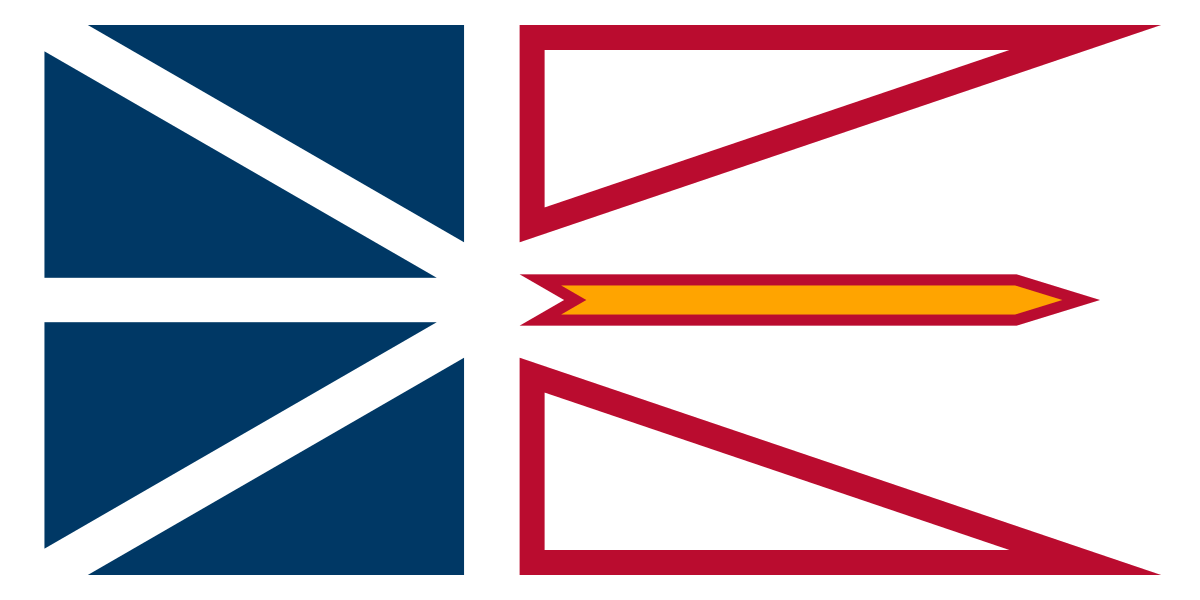
The flag of Newfoundland and Labrador, Canada’s easternmost province, was designed by the Newfoundland artist Christopher Pratt and first flown in 1980. Its blue, white, red and gold design draws on Beothuk and Innu pendants and deliberately recalls the Union Jack, with two red triangles for Newfoundland and Labrador and a gold arrow which, according to Pratt, points to a brighter future. The coat of arms, granted in 1637/8 and forgotten for more than two centuries, was readopted in 1928.
Flag
Not available
Seal
Not available
| Province | Newfoundland and Labrador (French: Terre-Neuve-et-Labrador), the easternmost province of Canada; capital St. John’s |
|---|---|
| Flag | Designed by Christopher Pratt; approved by the House of Assembly on 28 May 1980 and first flown on 24 June 1980; proportion 1:2 |
| Flag colours | Blue (Pantone 2955C), white, red (Pantone 200C) and gold (Pantone 137C) |
| Coat of arms | Granted on 1 January 1637/8; readopted in 1928 by the Dominion of Newfoundland |
| Motto | Quaerite prime Regnum Dei, Seek ye first the kingdom of God (Matthew 6:33) |
The flag of Newfoundland and Labrador.
The flag of Newfoundland and Labrador was introduced in 1980 and designed by the Newfoundland artist Christopher Pratt. The design was approved by the House of Assembly of the province, then called Newfoundland, on 28 May 1980, and the flag was flown for the first time on Discovery Day, 24 June 1980; the same article’s infobox gives 6 June 1980 as its adoption date. The province’s name was changed to Newfoundland and Labrador by an amendment to the Constitution of Canada in December 2001, at the request of the provincial legislature.
The blue (Pantone 2955C) represents the waters of the sea, lakes and rivers; the white represents snow and ice; the red (Pantone 200C) represents human effort; and the gold (Pantone 137C) symbolises the confidence the people of Newfoundland and Labrador have in themselves and in the future.
The design is that of etchings on Beothuk and Innu decorative pendants, worn on a cord around the neck, which Pratt saw at the Provincial Museum. With its blue, red and white colours, the flag deliberately resembles the Union Jack, as a reminder of historic connections with the British Isles. The two red triangles represent the two parts of the province, Labrador on the mainland and the island of Newfoundland. According to Pratt, the gold arrow points towards a brighter future; when the flag hangs as a vertical banner, the arrow becomes a sword, honouring the sacrifices of Newfoundlanders and Labradorians in military service. Together, the red triangles and the gold arrow form a trident, symbolising the province’s ties to the fisheries and the other resources of and under the sea.
In 1904 the British Parliament designated a civil ensign specifically for Newfoundland. The Red and Blue Ensigns bearing the Great Seal of Newfoundland in the fly were the official flags of the colony, later dominion, from 1904 until 1931. Their badge shows Mercury, the god of commerce, presenting to Britannia a kneeling fisherman offering the harvest of the sea, with the words Terra Nova above and the motto Hæc Tibi Dona Fero, These gifts I bring thee, below. Between 1907 and 1931 the Red Ensign was used widely enough, at sea and on land, to be considered the national flag.
The Newfoundland National Flag Act of 1931 made the Union Flag the national flag of Newfoundland, keeping the red and blue ensigns for marine use. The Union Flag remained the national flag until Confederation with Canada in 1949, was then readopted as the official provincial flag and used officially until 1980; the Newfoundland and Labrador branches of the Royal Canadian Legion still fly it today beside the provincial and Canadian flags. The Newfoundland Tricolour, for its part, is an unofficial flag that commonly represents the island alone.
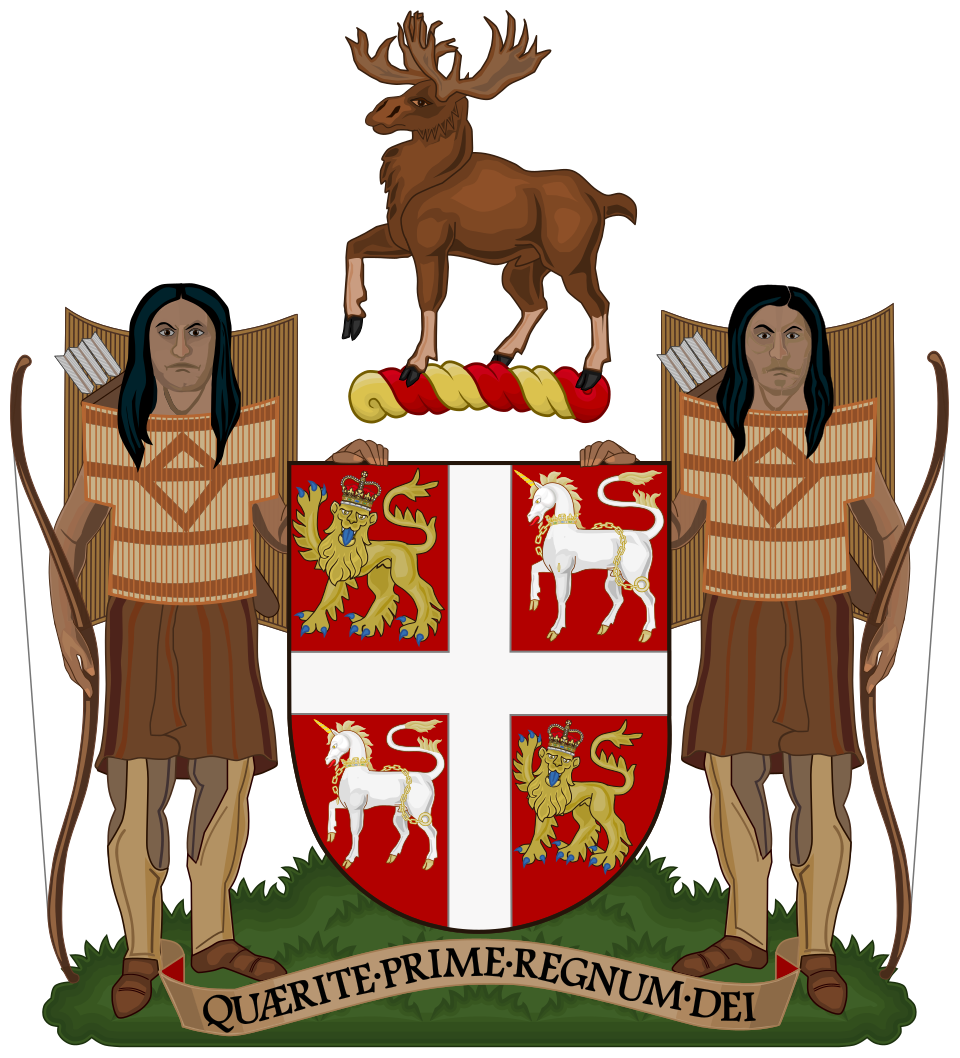
The coat of arms of Newfoundland and Labrador.
Gules a cross argent, in the first quarter a lion passant gardant crowned Or in the second quarter a Unicorn passant argent armed maned and unguled Or gorged with a crown a chain affixed thereto passing between his forelegs and reflexed over his back Or in the third quarter as in the second in the fourth quarter as in the first.
That is: on a red field, a silver cross; in the first and fourth quarters a gold lion passant guardant, crowned; in the second and third a silver unicorn passant, armed, maned and unguled gold, gorged with a crown with a chain passing between its forelegs and over its back. The crest is an elk passant on a wreath of gold and red, and the supporters are two Beothuk garbed for war. The original grant of 1637/8 reads: Gules a Grosse Argent In the first Quarter of the Escocheon a Lyon Passant gardant Crowned Or In the second an Unicorne passant of the second armed maned and unguled of the third gorged with a Crowne whereunto is affixed a chaine passing between his fore leggs and reflexed over his back of the last. In the third as in the second. In the fourth as in the first And for the Creast Upon an Healme Mantled Gules doobled Argent and a Wreath Or & Gules an Elke passant pper The Escocheon supported by two Savages of the Clyme pper armed and apparaled according to their Guise when they goe to Warre And Under all in an Escroll this Motto Quaerite prime Regnum Dei.
On 13 November 1637, the whole of Newfoundland was granted to David Kirke, governor of Newfoundland from 1638 to 1651, together with James Marquess Hamilton, Philip Earl of Pembroke and Montgomery and Henry Earl of Holland. On 1 January 1638 a coat of arms was deemed necessary for the greater honor and splendor of that Countrey and the people therein inhabiting, and the arms were granted by Sir John Borough, Garter King of Arms, under King Charles I; the grant is dated 1 January 1637/8, the legal year then beginning on 25 March.
Kirke, a Royalist, was on the losing side of the English Civil War; he was arrested and died in the Clink, in Southwark, around the end of January 1654, and the arms granted to him were forgotten. They were not used for over 200 years, their existence apparently unknown to both Newfoundland and United Kingdom authorities; the colony used instead, as its Great Seal, the royal coat of arms and a design approved in 1820. In 1893 D. W. Prowse printed the arms in his A History of Newfoundland but wrongly attributed them to John Guy and the London and Bristol Company, an error repeated on a two-cent stamp of 1910.
After the First World War, the Imperial War Graves Commission asked which arms should appear on memorials in French cathedrals commemorating Newfoundland’s part in the war. Sir Edgar Bowring, Newfoundland’s High Commissioner in England, began the search, and his successor, Captain Victor Gordon, received confirmation from the College of Arms in London that the Kirke arms belonged to Newfoundland. The government of the Dominion of Newfoundland officially adopted them in 1928, and they have been used ever since; the Coat of Arms Act (RSNL 1990, chapter C-20) is the current legal authority for their use.
The lions and unicorns recall the royal beasts that support the royal coat of arms of the United Kingdom, the lion standing for England and the unicorn for Scotland. The crest, described as a moose in the article’s section on symbolism, represents Newfoundland’s wildlife, while the blazon calls it an elk. The supporters are fanciful interpretations of the Beothuk, an Indigenous people of the island of Newfoundland, and the compartment is a mossy knoll. The motto, Quaerite prime Regnum Dei, quotes Matthew 6:33: Seek ye first the kingdom of God.
From the 2010s, the arms have been criticised for their portrayal of Indigenous peoples. In 2018 the provincial government confirmed its plan to redesign them, in response to a call for changes from the province’s Indigenous Peoples Commission; Randy Edmunds, MHA for Torngat Mountains, noted at the same time that elk are not native to Newfoundland and Labrador and suggested a caribou instead. In June 2021, Premier Andrew Furey announced that the government had issued a formal notice to the House of Assembly to begin the redesign process.
Newfoundland and Labrador is the easternmost province of Canada, in the country’s Atlantic region. It comprises the island of Newfoundland and the continental region of Labrador, with an area of 405,212 km² (405,720 km²); Newfoundland and its neighbouring islands hold 94% of its population. St. John’s, the capital and largest city, is the seat of the provincial House of Assembly.
Until 1949, the Dominion of Newfoundland was a separate dominion in the British Empire. On 31 March 1949 it became the tenth and most recent province to join Canadian Confederation, as Newfoundland; on 6 December 2001 the Constitution of Canada was amended to change its name to Newfoundland and Labrador.
In a letter of 1499, King Henry VII referred to the land explored in 1497 by John and Sebastian Cabot as the new founde land; in Portuguese it is Terra Nova, which is also the French name of the island, Terre-Neuve. The name Labrador comes from the surname of the Portuguese navigator João Fernandes Lavrador.
The Newfoundland artist Christopher Pratt; the House of Assembly approved his design on 28 May 1980 and the flag was first flown on Discovery Day, 24 June 1980.
Blue for the waters of the sea, lakes and rivers, white for snow and ice, red for human effort, and gold for the people’s confidence in themselves and in the future.
The two red triangles stand for Labrador and the island of Newfoundland; the gold arrow points, according to Pratt, towards a brighter future, and with the triangles it forms a trident for the fisheries.
The Union Flag, adopted as Newfoundland’s national flag in 1931 and used as the official provincial flag from 1949 until 1980.
Fanciful interpretations of the Beothuk, an Indigenous people of the island of Newfoundland; their portrayal has been criticised, and in 2021 the government issued a formal notice to the House of Assembly to begin a redesign process.
Illustrations: Wikimedia Commons. Flag: public domain.
Last reviewed by the Emblema Mundi editorial team on 11 November 2026.