Prefecture
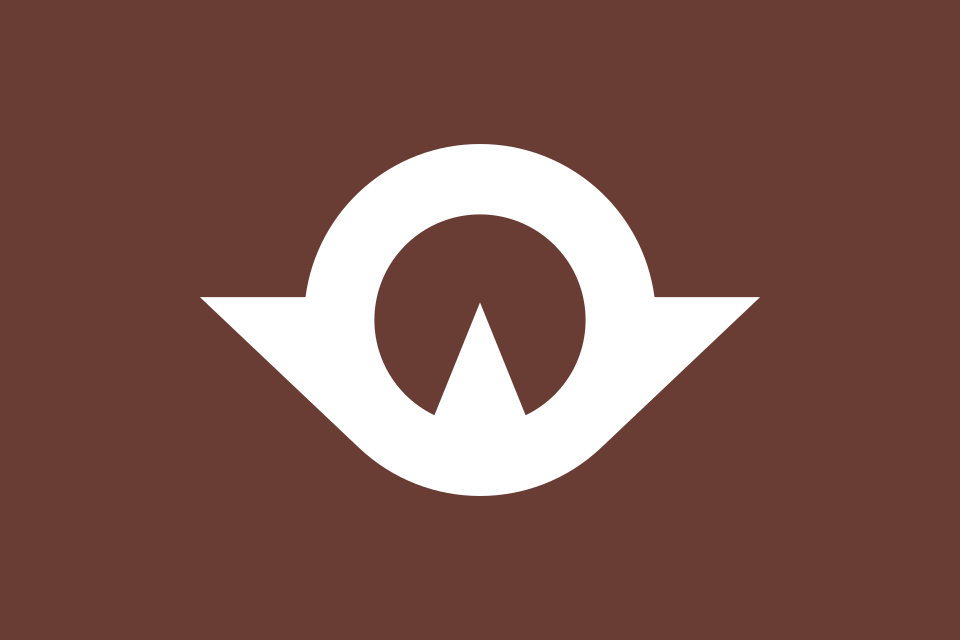
Yamaguchi Prefecture (山口県, Yamaguchi-ken) flies a wine-red flag bearing a white crest that fuses the two kanji of its own name — 山 (yama, “mountain”) and 口 (kuchi, “mouth/opening”) — into a single circular emblem resembling a bird taking flight toward the sun. Both crest and flag were adopted together on 3 September 1962, marking the prefecture’s 90th anniversary. Occupying the westernmost tip of Honshu, Yamaguchi corresponds to the historic Chōshū Domain of the Mōri clan, whose lower-ranking samurai helped drive the Meiji Restoration — a legacy reflected in the unusually large number of Japanese prime ministers born here.
Flag
Not available
| Prefecture | Yamaguchi (山口県, Yamaguchi-ken) |
|---|---|
| Type | Ken (県) — ordinary prefecture |
| Region | Chūgoku (San’yō coast, westernmost Honshu) |
| Capital | Yamaguchi City — a separate municipal government with its own distinct city emblem |
| Established | 15 November 1871 (haihan-chiken), uniting the former Suō and Nagato provinces — the historic Chōshū Domain of the Mōri clan |
| Crest & flag | White circular emblem, kanji 山 + 口 stylised as a bird in flight, on wine-red field; adopted 3 September 1962 |
| Official tree | Red pine (akamatsu) |
| Official flower | Natsumikan (bitter summer citrus) blossom |
| Official bird | Hooded crane (nabezuru), wintering at Yashiro in Shūnan |
Flag of Yamaguchi Prefecture — Wine-red field, white mountain-and-mouth crest, adopted 1962
The flag of Yamaguchi Prefecture is a wine-red (dark maroon) field bearing the prefecture’s white crest (県章, kenshō). The design interlaces the two characters of the prefecture’s own name: 山 (yama, “mountain”) forms the upward, wing-like sweep at the base, while 口 (kuchi, “mouth” or “opening”) is rounded into the circular ring at the centre. Read together, the prefecture’s official description likens the resulting silhouette to a bird in flight toward the sun, expressing the unity and forward momentum (“団結と飛躍”) of the prefecture’s people.
The crest and flag were adopted together on 3 September 1962 (Shōwa 37), by prefectural notice, to commemorate the 90th anniversary of Yamaguchi’s establishment as a modern prefecture. Unlike Tokyo or several other prefectures, whose current emblems descend from an earlier municipal-era mark, Yamaguchi’s crest and flag were designed and adopted as a single, purpose-built prefectural symbol; no wider public design competition or individual designer appears to be recorded in the sources consulted.
The prefecture’s territory corresponds to the former provinces of Suō and Nagato, which together made up the Edo-period Chōshū Domain ruled by the Mōri clan from their castle town of Hagi. Chōshū, alongside Satsuma, supplied much of the leadership behind the Meiji Restoration of 1868. Following the abolition of the domains (haihan-chiken) in 1871, the territory was reorganised into Yamaguchi Prefecture, formally established on 15 November 1871, with its seat placed at Yamaguchi — the old domain’s administrative town, distinct from the former castle town of Hagi.
A wine-red field with a white crest combining the kanji 山 (mountain) and 口 (mouth) into a circular shape resembling a bird in flight toward the sun, symbolising the unity and advancement of the prefecture’s people.
No. Yamaguchi Prefecture is one of Japan’s 47 prefectures, covering the western tip of Honshu; Yamaguchi City is merely its capital, a single municipality within it. The two are separate levels of government, and each has adopted its own distinct emblem — this page describes only the prefectural crest and flag shown above, not the city’s separate symbol.
The crest and flag were both adopted on 3 September 1962, marking the 90th anniversary of the prefecture’s establishment in 1871.
The red pine (akamatsu) is the official tree, the natsumikan blossom (a bitter summer citrus first cultivated at Nagato) is the official flower, and the hooded crane (nabezuru) — which winters each year at Yashiro in Shūnan and is separately protected as a special natural monument — is the official bird.
Last reviewed by the Emblema Mundi editorial team on 2026-07-04.