Prefecture
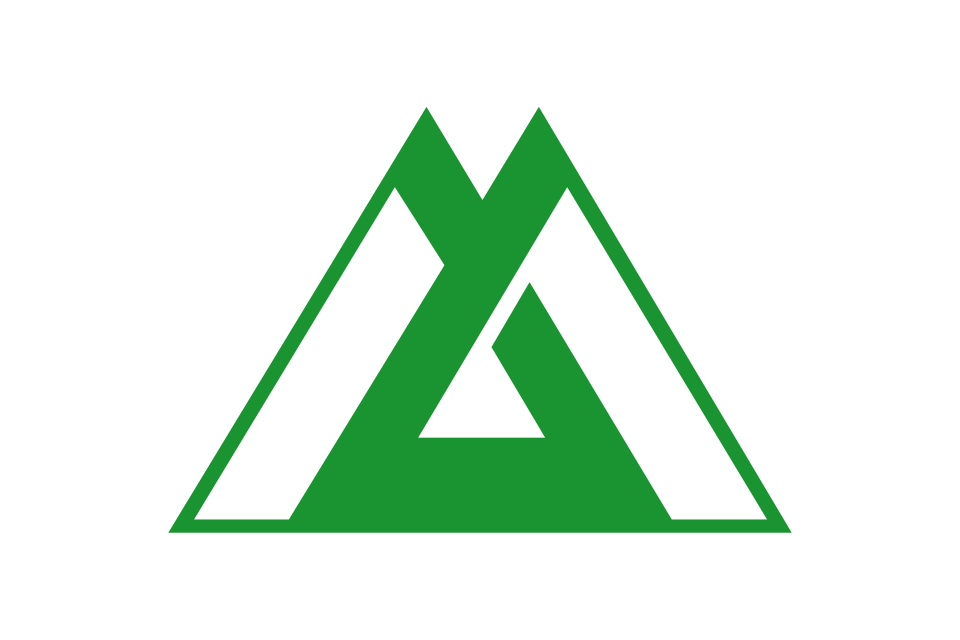
Toyama Prefecture (富山県, Toyama-ken) flies a white flag bearing a green emblem: the hiragana character “to” (と), the first syllable of the prefecture’s name, set within the silhouette of Mount Tateyama — the towering peak that dominates the prefecture’s skyline and its identity. The design was originally chosen by public competition in 1957 and revised in 1988. Note that this page describes the prefectural emblem only — the prefecture’s capital, the city of Toyama, is a separate administrative body with its own distinct municipal emblem.
Flag
Not available
| Prefecture | Toyama (富山県, Toyama-ken) |
|---|---|
| Type | Ken (県) — ordinary prefecture |
| Region | Chūbu (Hokuriku subregion), on the Sea of Japan coast |
| Capital | Toyama City — a distinct municipality with its own separate emblem |
| Established | 1871 as Niikawa Prefecture; absorbed into Ishikawa Prefecture 1876; re-established as Toyama Prefecture, 1883 |
| Emblem (kenshō) | Green hiragana “to” (と) within the outline of Mount Tateyama, on white; adopted 1957, revised 27 December 1988 |
| Official tree | Tateyama cedar (Tateyama-sugi), designated 1966 |
| Official flower | Tulip, designated 1954 |
| Official bird | Rock ptarmigan (raichō), designated 1961 |
Flag of Toyama Prefecture — White field, green emblem, current form since 1989
The flag of Toyama Prefecture is a white field bearing the prefecture’s green emblem (県章, kenshō): the hiragana character “と” (to) — the initial syllable of “Toyama” — drawn so that its curved stroke also traces the jagged silhouette of Mount Tateyama, part of the Northern Alps and one of Japan’s most celebrated sacred mountains. According to the prefectural government, the design expresses the image of Toyama “advancing dynamically toward the open sky.” Green was chosen as the prefectural colour to evoke the abundant nature of the region and vitality for the future.
1957 — Public competition. The prefectural government held a public design competition; a winning design was selected on 16 September 1957 and formally adopted as the prefectural emblem by Prefectural Notice No. 774 on 14 December 1957. In this original version, the interior curve of the “と” character was rendered with softly rounded edges, and the flag displayed the emblem in gold on a green field.
27 December 1988 — Design revision. By Prefectural Notice No. 1393, the emblem’s interior lines were redrawn with sharper, more angular edges. The flag itself changed accordingly: the field became white and the emblem green, taking effect on 1 January 1989 and remaining the current design.
As with most Japanese prefectures, no dedicated flag law fixes the exact specifications; the flag functions as the de facto banner of the emblem through long-standing official use by the Toyama Prefectural Government.
Because the prefecture and its capital share the same name, it is easy to conflate their symbols. The prefectural emblem described here is used exclusively by the Toyama Prefectural Government for prefecture-wide administration. The city of Toyama (Toyama-shi), the prefectural capital and largest city, maintains its own separate municipal emblem and civic identity, adopted independently by the city government. The two should not be interchanged when citing symbolism, adoption dates, or official meaning.
A white field bearing a green emblem: the hiragana character “to” (と), the first syllable of Toyama, set within the outline of Mount Tateyama, read as the prefecture advancing dynamically toward the open sky.
No. The prefecture and the city of Toyama, its capital, are separate administrative bodies, each with its own distinct official emblem. This page covers the prefectural symbol only.
The original design was adopted on 14 December 1957 following a public competition. It was revised — sharpening the character’s interior lines and switching the flag to a white field with a green emblem — on 27 December 1988, effective 1 January 1989.
The Tateyama cedar (designated 1966), the tulip (designated 1954), and the rock ptarmigan (designated 1961), a species protected as a special natural monument on Mount Tateyama.
Last reviewed by the Emblema Mundi editorial team on 2026-07-04.