Prefecture
Tokyo (東京都, Tōkyō-to) flies a purple flag bearing a white six-rayed sun crest — a mark inherited almost unchanged from the former Tokyo City of 1889 and formally adopted when the modern metropolis was created in 1943. A second, very different emblem lives alongside it: a vivid green symbol mark introduced in 1989, popularly (but officially incorrectly) believed to depict a ginkgo leaf — Tokyo’s official tree.
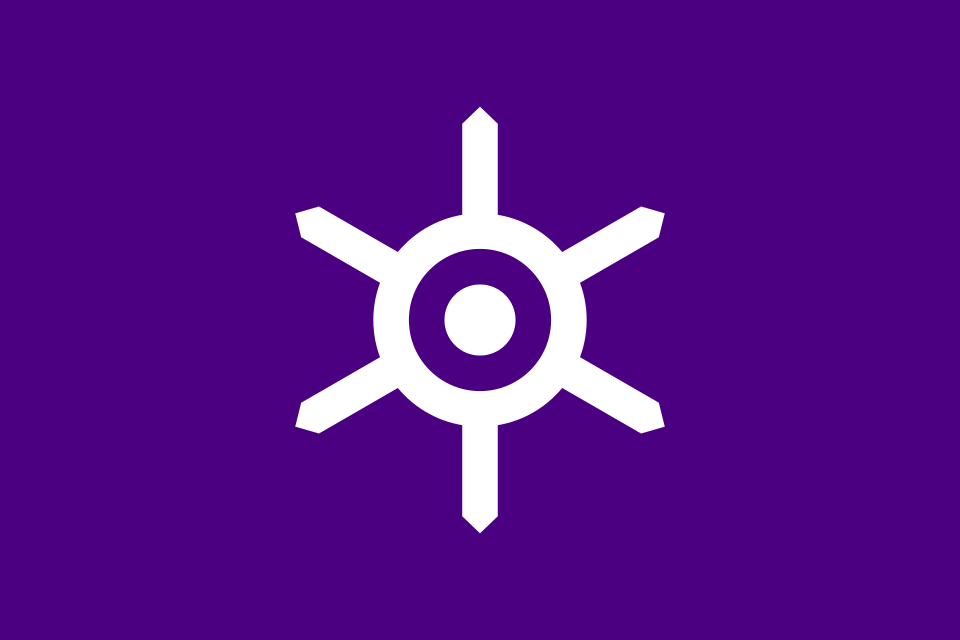
Flag
Not available
| Prefecture | Tokyo (東京都, Tōkyō-to) |
|---|---|
| Type | To (都) — metropolis, unique among the 47 prefectures |
| Region | Kantō |
| Seat of government | Shinjuku |
| Established | 1868 as Tokyo-fu; merged with Tokyo City into Tokyo Metropolis, 1 July 1943 |
| Crest (mon) | Six-rayed sun, white on purple; adopted 2 November 1943, unchanged from 1889 |
| Symbol mark | Green stylised “T”, three arcs; adopted 1 June 1989 |
| Official tree | Ginkgo (ichō), designated 1966 |
| Official flower | Somei-yoshino cherry blossom, designated 1984 |
| Official bird | Black-headed gull (yurikamome) |
Flag of Tokyo — Purple field, white six-rayed sun crest, adopted 1943
The flag of Tokyo is a purple field bearing the prefecture’s white crest (紋章, monshō): six rays of light radiating outward from a small central ring with a dot at its centre, evoking a stylised sun. The Tokyo Metropolitan Government describes the design as representing “light radiating outward, symbolising Tokyo as the centre of Japan”. Purple (murasaki) has long been associated with nobility and high rank in Japanese court tradition.
December 1889 — Tokyo City. The mark was originally selected by the assembly of Tokyo City (東京市), the municipality that then formed the urban core of Tokyo Prefecture (Tokyo-fu), established the same year.
1 July 1943 — Creation of Tokyo Metropolis. As a wartime administrative reform, Tokyo City was abolished and merged directly into Tokyo Prefecture, which was reconstituted as the single Tokyo Metropolis (東京都, Tōkyō-to) — the only prefecture of this type in Japan.
2 November 1943 — Formal adoption. Metropolitan Announcement No. 464 formally adopted the former city’s 1889 mark as the official crest of the new metropolis, without design changes.
In November 1988, the Tokyo Metropolitan Government ran a design competition seeking a modern emblem to complement the historic crest. From twenty finalist entries, submitted to a public postcard vote in early 1989, a design by graphic designer Rei Yoshimura of the studio XICO was selected and formally adopted on 1 June 1989 (Metropolitan Announcement No. 577). A dedicated flag bearing the new mark followed on 30 September 1989.
The mark consists of three identical green arcs forming a stylised letter “T” for Tokyo, expressing (in the Government’s own words) “dynamism, prosperity, richness, and tranquility” for the city’s future. Because Tokyo’s official tree is the ginkgo (ichō) — and the three curved arcs do resemble a ginkgo leaf’s fan shape — the symbol is widely assumed to be a ginkgo. The Tokyo Metropolitan Government has explicitly denied this on its official website, stating the design represents only the letter T.
A purple field with a white crest: a six-rayed sun with a small ring and central dot, representing light radiating outward and Tokyo’s role as the centre of Japan.
No — despite popular belief. The Tokyo Metropolitan Government states explicitly that the 1989 green mark is a stylised letter “T” for Tokyo, not a ginkgo leaf, even though the ginkgo is the prefecture’s official tree.
The crest itself dates to December 1889, chosen by the old Tokyo City assembly. It became the official crest of the new Tokyo Metropolis on 2 November 1943, following the 1943 merger of Tokyo City and Tokyo Prefecture.
The ginkgo (chosen by public vote in 1966, honouring the trees that survived the 1945 firebombings), the Somei-yoshino cherry blossom (designated 1984), and the black-headed gull (yurikamome).
Last reviewed by the Emblema Mundi editorial team on 2026-07-04.