Prefecture
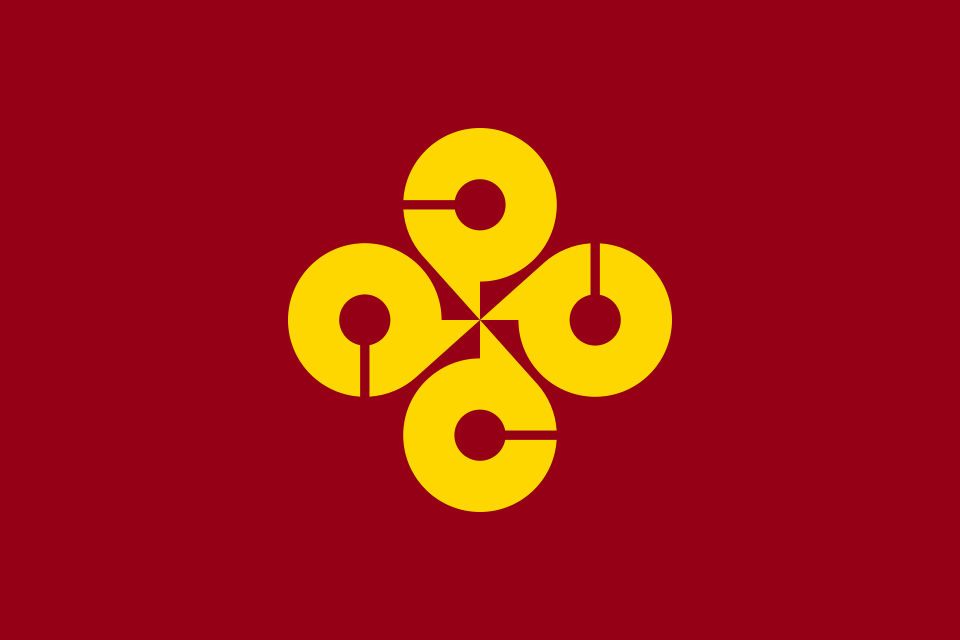
Shimane (島根県, Shimane-ken) flies a wine-red flag bearing a gold emblem formed from four stylised katakana “ma” (マ) characters, arranged into a radiating, cloud-shaped roundel. Adopted in 1968 to mark the Meiji centennial, the design plays on the prefecture’s name and symbolises the unity of its people. Facing the Sea of Japan on the western tip of Honshū, Shimane is home to Izumo Grand Shrine, one of Japan’s oldest and most venerated Shinto sites.
Flag
Not available
| Prefecture | Shimane (島根県, Shimane-ken) |
|---|---|
| Type | Ken (県) — ordinary prefecture |
| Region | Chūgoku, on the Sea of Japan coast |
| Capital | Matsue |
| Established | 1871 (haihan-chiken); present borders fixed 1881, uniting the former Izumo, Iwami, and Oki provinces |
| Emblem (kensho) | Gold four-“ma” cloud roundel on wine-red field; adopted 8 November 1968 (Notice No. 955) |
| Official flower | Peony (botan), designated 1953 |
| Official tree | Japanese black pine (kuromatsu), designated 1966 |
| Official bird | Swan (hakuchō), designated 2000 |
Flag of Shimane — Wine-red field, gold cloud-shaped emblem, adopted 1968
The flag of Shimane is a deep reddish-brown (ebi-cha, “shrimp brown”) field bearing the prefecture’s gold emblem (県章, kensho): four stylised katakana characters “ma” (マ), curved and joined at the centre so that they radiate outward into a single circular, cloud-like roundel. A simplified white-on-red version of the same mark is also used. The Shimane prefectural government describes the design as expressing the unity of the prefecture’s people and its harmonious development and advancement.
The design is built on a visual pun: the Japanese word for “four” is shi (四), and four katakana “ma” read together give “shi-ma” — echoing the first syllables of Shimane. The four characters are curved and interlocked so that, taken together, they resemble a stylised cloud.
This emblem and its accompanying flag were formally adopted on 8 November 1968 (Prefectural Notice No. 955), timed to coincide with that year’s nationwide commemoration of the Meiji centennial (100 years since the 1868 Meiji Restoration). It replaced an earlier prefectural badge in use since 1952, which had featured concentric circles with the romanised text “SIMANE” and the old kanji for “prefecture” (縣).
Shimane in its modern form dates to the 1871 abolition of the han system (haihan-chiken), which consolidated the historical provinces of Izumo, Iwami, and Oki. After several boundary adjustments, the prefecture’s present borders were fixed in 1881. The region’s Izumo heartland, associated in Shinto myth with the god Ōkuninushi and home to Izumo Grand Shrine, gives the prefecture a cultural weight disproportionate to its modest population.
In 1990 the prefecture also introduced a supplementary logo mark, nicknamed “Shimanesque Shimane,” depicting a dynamic rising sun to represent future growth; unlike the 1968 emblem, this newer mark is a promotional logo rather than the prefecture’s official crest.
A wine-red field with a gold emblem: four katakana “ma” characters curved into a circular, cloud-shaped roundel, symbolising the unity and harmonious development of the prefecture’s people.
The emblem and flag were formally adopted on 8 November 1968 (Prefectural Notice No. 955), chosen to mark that year’s Meiji centennial. An earlier circular badge design had been in use since 1952.
It is a wordplay on the prefecture’s name: four (shi, 四) “ma” (マ) read together as “shima”, echoing “Shimane.” The four katakana are stylised and joined into a single radiating roundel.
The peony (botan, designated 1953), long cultivated on Daikon Island; the Japanese black pine (kuromatsu, designated 1966); and the swan (hakuchō, designated 2000) — whooper and tundra swans that winter on Lake Shinji.
Note: an English-language vexillology source describes the emblem as evoking the Izumo Grand Shrine torii gate. Official Japanese-language sources (the prefecture itself and the National Governors’ Association) consistently describe it instead as four katakana “ma” forming a cloud shape, which this page follows as the better-supported account.
Last reviewed by the Emblema Mundi editorial team on 2026-07-04.