Prefecture
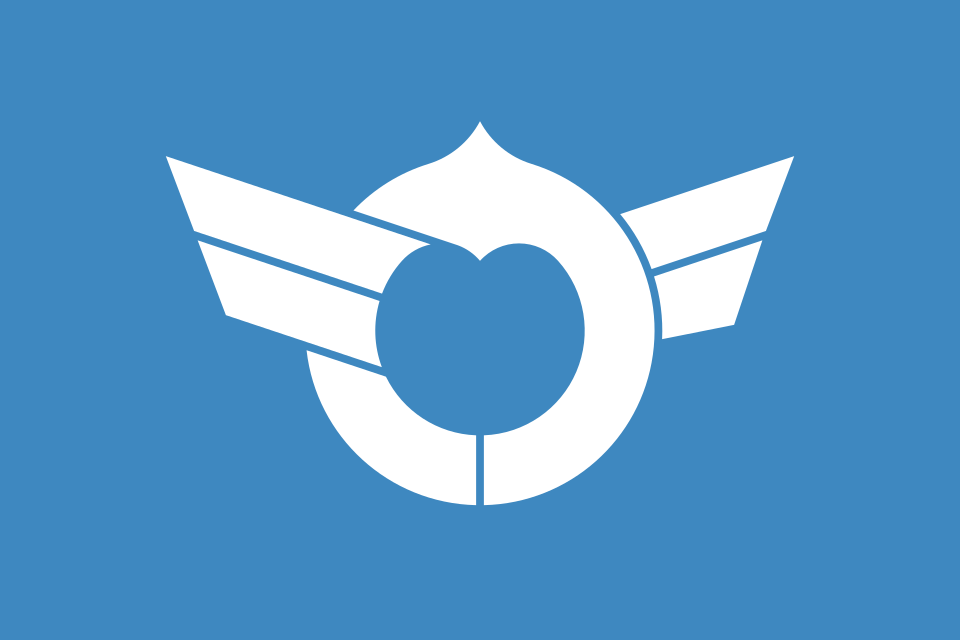
Shiga (滋賀県, Shiga-ken) flies a light-blue flag bearing a white circular crest (県章, kenshō) that fuses the katakana characters for “Shi” and “Ga” around a central space standing for Lake Biwa (琵琶湖), Japan’s largest lake, which dominates the prefecture’s geography and economy. Two wing-like forms crown the design, said to symbolise harmony and the prefecture’s progress. The crest was adopted in 1957; the dedicated flag followed in 1968.
Flag
Not available
| Prefecture | Shiga (滋賀県, Shiga-ken) |
|---|---|
| Type | Ken (県) — ordinary prefecture |
| Region | Kansai (Kinki) |
| Capital | Ōtsu |
| Established | Modern boundaries reached 28 September 1872, following the 1871 haihan-chiken reform and the 1872 merger of Ōtsu and Inugami Prefectures; corresponds to the former Ōmi Province |
| Crest (kenshō) | White, stylised katakana “Shi” and “Ga” forming a circle around Lake Biwa, with two wings; adopted 3 May 1957 (Notification No. 138) |
| Flag | Light-blue field bearing the white crest; adopted 16 September 1968 (Notification No. 355) |
| Official tree | Japanese maple (momiji), designated October 1966 |
| Official flower | Rhododendron (shakunage), designated February 1954 |
| Official bird | Little grebe (kaitsuburi), designated July 1965 |
Flag of Shiga — Light-blue field, white circular crest, adopted 1968
The flag of Shiga is a light-blue field — said to echo the colour of Lake Biwa’s surface — bearing the prefecture’s white crest (県章, kenshō). The crest stylises the katakana characters “シ” (shi) and “ガ” (ga), spelling Shiga, and arranges them into a circular form. The open space at the centre of the circle represents Lake Biwa, and two wing-like elements rise from the top of the design. According to the prefectural government, the circular shape and wings together symbolise “harmony and the harmonious development (advancement) of the prefecture.”
3 May 1957 — The crest. The emblem was selected through a public design competition and formally adopted by Shiga Prefectural Notification No. 138. This is the design still in use today, unifying the prefecture’s name and its defining natural landmark, Lake Biwa, into a single mark.
16 September 1968 — The flag. More than a decade later, the prefecture formalised a dedicated flag — the existing crest rendered in white on a light-blue field — by Notification No. 355.
Shiga’s modern territory corresponds closely to the historical Ōmi Province (近江国). After the 1871 abolition of the han system (haihan-chiken), the region was briefly split between Ōtsu Prefecture in the south and Nagahama (later renamed Inugami) Prefecture in the north. Ōtsu Prefecture was renamed Shiga Prefecture on 19 January 1872, and the two prefectures were merged on 28 September 1872, essentially establishing the prefecture’s present-day boundaries. A short-lived 1876–1881 extension gave Shiga a stretch of coastline near Tsuruga, in what is now Fukui Prefecture, before that area was separated back out.
Lake Biwa is Japan’s largest freshwater lake and occupies roughly one-sixth of Shiga’s surface area, making it the natural centrepiece of the prefecture’s identity, economy, and, by extension, its official symbols. Beyond the crest itself, the prefecture adopted a separate “Mother Lake” (母なる湖) awareness symbol in 2001 depicting the lake’s outline, distinct from the official crest and flag described above.
A light-blue field with a white crest: the katakana characters for “Shi” and “Ga” arranged into a circle, with the inner space representing Lake Biwa and two wings at the top symbolising harmony and the prefecture’s progress.
The crest was adopted on 3 May 1957 (Notification No. 138), chosen by public design competition. The dedicated flag bearing the crest on a light-blue field followed on 16 September 1968 (Notification No. 355).
Lake Biwa is Japan’s largest lake and dominates Shiga’s geography, historically shaping the prefecture’s economy and identity. The crest’s circular inner space evokes the lake, and the flag’s light-blue background is said to reflect the colour of its waters.
The Japanese maple (momiji, designated 1966 by public vote), the rhododendron (shakunage, designated 1954 via an NHK-run vote), and the little grebe (kaitsuburi, designated 1965).
Last reviewed by the Emblema Mundi editorial team on 2026-07-04.