Prefecture
Saga (佐賀県, Saga-ken) flies a dark green flag bearing a white camphor blossom with crimson stamens, formally adopted in 1968. It is a distinct design from the prefecture’s older official crest (県紋章), adopted in 1936, which depicts three stylised characters for “power” arranged in a circle of unity. Note that Saga Prefecture and its capital, Saga City, are separate levels of government with their own separate emblems — this page covers only the prefecture.
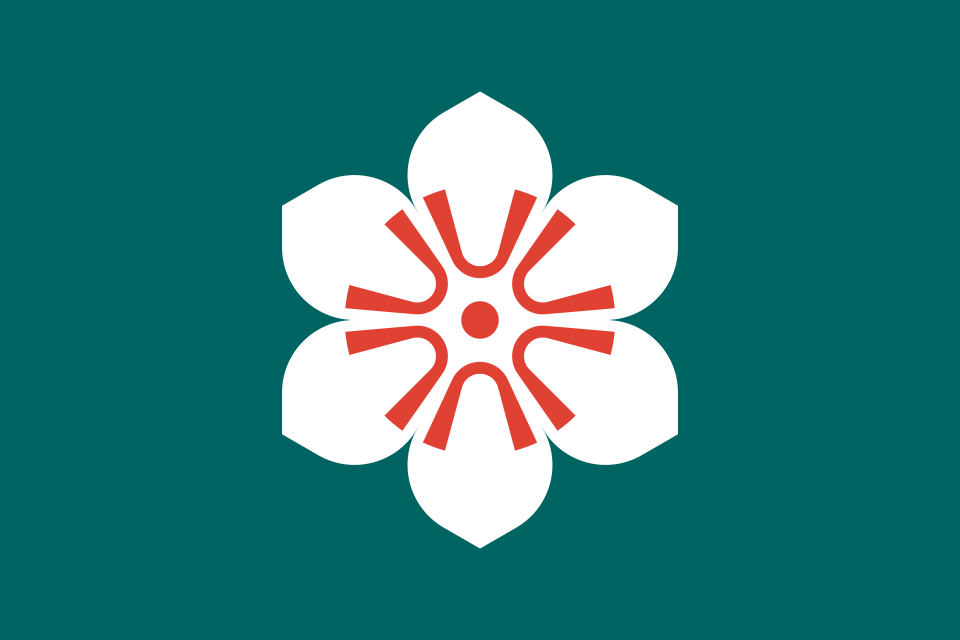
Flag
Not available
Emblem

Not available
| Prefecture | Saga (佐賀県, Saga-ken) |
|---|---|
| Type | Ken (県) — ordinary prefecture |
| Region | Kyūshū, facing the Ariake Sea and Genkai Sea |
| Capital | Saga City (a distinct municipal entity with its own emblem) |
| Established | Modern Saga Prefecture traces to the 1871 haihan-chiken; after several mergers and a 1876 absorption into Nagasaki Prefecture, it was re-established in its current form on 9 May 1883, corresponding to the former Hizen Province and the Nabeshima clan’s Saga Domain |
| Crest (mon) | Three characters for “power” (力) in a circle; adopted 1 April 1936, Notice No. 192 |
| Flag | White camphor blossom, crimson stamens, on dark green; adopted 11 December 1968, Notice No. 450 |
| Symbol mark | Green abstract ring motif (“Saga Symphony Green”); adopted 1 June 1992, Notice No. 299 |
| Official tree / flower | Camphor tree (kusunoki) and its blossom |
| Official bird | Eurasian magpie (kasasagi / kachigarasu) |
Flag of Saga Prefecture — Dark green field, white camphor blossom, crimson stamens, adopted 1968
The flag of Saga Prefecture is a dark green field bearing a stylised white camphor blossom (楠花) with crimson stamens at its centre. According to the prefectural government, the white petals symbolise “sincerity and purity”, the crimson stamens represent “sincerity and passion”, and the deep green ground — drawn from the colour of camphor foliage — stands for “hope and peace”. The camphor tree is Saga’s official prefectural tree, so the flag’s design and the prefecture’s natural symbol are directly linked.
Separately, the prefecture’s older official crest (紋章, monshō), still technically in force alongside the flag, depicts three stylised characters for “power” (力, chikara) arranged in a circle, evoking the sound of the prefecture’s name (“Sa-ka”) and symbolising residents joining hands, uniting their strength, and prospering together.
1 April 1936 — the prefectural crest. Saga Prefecture formally adopted its circular three-power crest by Prefectural Notice No. 192. It remains the prefecture’s oldest official emblem and continues to be used for ceremonial purposes such as commendations and permits.
11 December 1968 — the prefectural flag. Three decades later, by Prefectural Notice No. 450, Saga adopted its flag, in a 2:3 proportion, with the camphor blossom occupying five-sevenths of the flag’s height. This is the flag most commonly flown and displayed today.
1 June 1992 — the symbol mark. A further, more modern green symbol mark was introduced by Notice No. 299, intended for wider promotional and informational use (excluding the official seal and flag), representing an expanding ring of abundance centred on Saga’s people, land, and culture.
Because the prefectural capital shares its name with the prefecture itself, it is easy to conflate the two. Saga Prefecture (Saga-ken) is one of Japan’s 47 first-level administrative divisions; Saga City (Saga-shi) is the municipality that serves as its capital and seat of prefectural government. Each has adopted its own separate official emblem and flag, and the facts on this page describe the prefecture-level crest and flag only.
A dark green field bearing a white camphor blossom with crimson stamens. White represents sincerity and purity, crimson represents sincerity and passion, and the dark green — echoing camphor foliage — represents hope and peace.
No. Saga Prefecture and its capital, Saga City, are two separate levels of government, each with its own distinct official crest. This page covers only the prefectural crest and flag; Saga City maintains a separate municipal emblem.
The prefectural crest was adopted on 1 April 1936 (Notice No. 192). It depicts three stylised characters for “power” (力, chikara) arranged in a circle, read as evoking the name Saga and symbolising residents uniting their strength in cooperation.
The camphor tree (kusunoki) serves as both official tree and, via its blossom, official flower — directly reflected in the prefectural flag. The Eurasian magpie (kasasagi, also called kachigarasu locally) is the official bird.
Last reviewed by the Emblema Mundi editorial team on 2026-07-04.