Prefecture
Niigata Prefecture (新潟県, Niigata-ken) flies a red flag bearing a golden crest: the kanji character 新 (shin, “new”) set above a stylised, necklace-like ring formed from the katakana ガタ (gata) — together spelling out the prefecture’s name. Adopted on 23 August 1963, the design is officially described as symbolising harmony and hope, entrusted with the prefecture’s smooth development. Note that Niigata Prefecture is a distinct level of government from its capital, Niigata City, which has its own separate emblem.
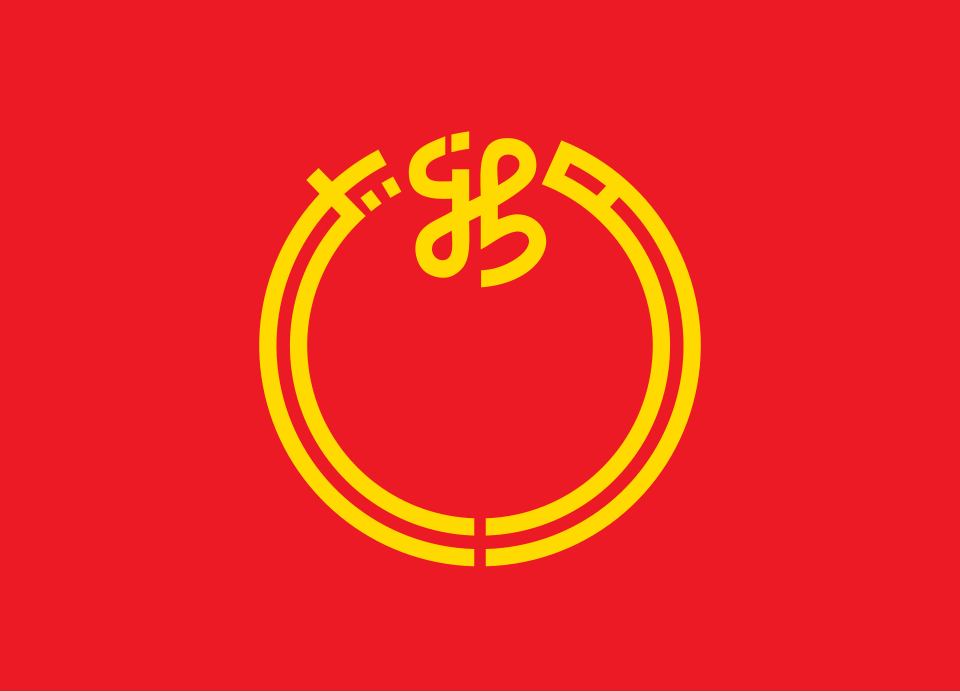
Flag
Not available
| Prefecture | Niigata (新潟県, Niigata-ken) |
|---|---|
| Type | Ken (県) — ordinary prefecture |
| Region | Chūbu (often grouped with Kōshin’etsu or Hokuriku; no single official classification) |
| Capital | Niigata City (a separate administrative entity with its own distinct emblem) |
| Established | 1871 (haihan-chiken), from the former Echigo and Sado provinces; reached current boundaries in 1886 |
| Crest (kenshō) | Gold kanji 新 above a circular katakana ガタ, on red; adopted 23 August 1963 |
| Official tree | Snow camellia (yuki-tsubaki), designated 27 August 1966 |
| Official flower | Tulip, designated 23 August 1963 |
| Official bird | Japanese crested ibis / toki (Nipponia nippon), designated 13 September 1965 |
Flag of Niigata Prefecture — Red field, golden crest, adopted 1963
The flag of Niigata Prefecture is a red field charged with the prefecture’s golden crest (県章, kenshō): the kanji 新 (shin, meaning “new”) rendered in a flowing, cursive-style stroke and placed at the top of a circular, chain-like arrangement of the katakana characters ガ and タ (gata). Read together, the two elements spell Nii-gata. According to the prefectural government’s own description, the emblem’s roundness and interlocking form express “harmony and hope,” entrusting the design with a wish for the prefecture’s continued, smooth development. Some secondary sources also read the circular katakana motif as evocative of snowflakes or sea waves, alluding to Niigata’s heavy winter snowfall and its long coastline on the Sea of Japan — though this poetic reading does not appear in the prefecture’s own official wording. Gold is the specified colour for formal use, with white permitted as a simplified alternative.
1871 — Haihan-chiken. Niigata Prefecture was created in the wake of the abolition of the han (feudal domain) system, consolidating territory that had previously belonged to Echigo Province (越後国) on the mainland and Sado Province (佐渡国), the island in the Sea of Japan. Sado briefly existed as its own short-lived prefecture (Aikawa) before being absorbed into Niigata. The prefecture reached its present-day boundaries in 1886, when the Higashi-Kanbara district was transferred from Fukushima Prefecture.
23 August 1963 — Crest and flag adopted. Nearly a century after the prefecture’s founding, the prefectural government formally adopted both the crest and the flag by public notice, which also specifies their exact construction: the circular katakana motif has a diameter equal to 46% of the flag’s length, and the kanji 新 a height of roughly 17% of the flag’s length. The same 1963 notice also designated the tulip as the prefectural flower. Use of the crest and flag is restricted to official prefectural government activities; other organisations or individuals may apply to the governor for permission to use them unofficially.
Because the prefecture and its capital share the same name, it is easy to conflate their symbols. Niigata Prefecture and the City of Niigata (新潟市) are separate levels of government, each maintaining its own distinct emblem and flag. This page describes only the prefectural crest and flag adopted in 1963; the city government uses an entirely different mark of its own.
A golden crest on red: the kanji 新 (“new”) above a circular, chain-like arrangement of the katakana ガタ (gata), spelling Niigata. It officially symbolises harmony and hope for the prefecture’s smooth development.
No. Niigata Prefecture and its capital, Niigata City, are distinct administrative entities, each with its own separate official emblem and flag. This page covers only the prefectural symbols adopted in 1963.
The crest and flag were adopted together on 23 August 1963, by a prefectural public notice that also fixed their precise proportions and construction.
The snow camellia (yuki-tsubaki, designated 1966), the tulip (designated 1963, reflecting Niigata’s leading role in Japanese bulb and cut-flower production), and the Japanese crested ibis or toki (designated 1965), the subject of a long-running conservation and breeding programme centred on Sado Island.
Last reviewed by the Emblema Mundi editorial team on 2026-07-04.