Prefecture
Miyagi (宮城県, Miyagi-ken) flies a green flag bearing a white crest (県章, kenshō) in which three bush-clover leaves are stylised into the hiragana character 「み」 (mi) — the first syllable of the prefecture’s name. The design was chosen from over 1,600 public submissions and formally adopted in 1966. Centred on the former castle town of Sendai, seat of the Date clan for over two and a half centuries, Miyagi is the political and economic hub of the Tōhoku region.
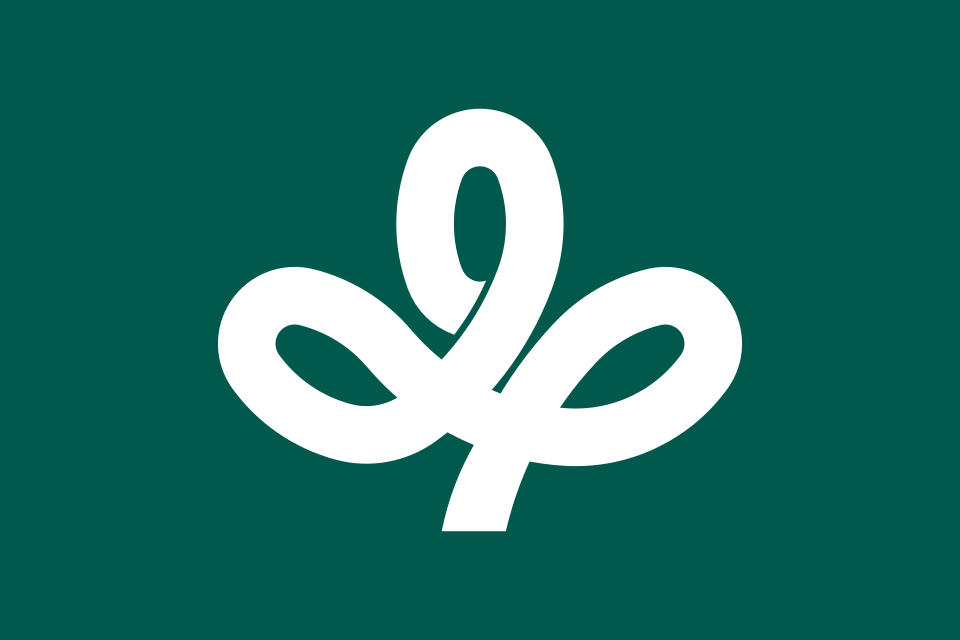
Flag
Not available
| Prefecture | Miyagi (宮城県, Miyagi-ken) |
|---|---|
| Type | Ken (県) — ordinary prefecture |
| Region | Tōhoku |
| Capital | Sendai |
| Established | 1871, in the haihan-chiken reform that replaced the former Sendai Domain of the Date clan; reorganised under the name Miyagi in the early 1870s |
| Crest (kenshō) | White stylised hiragana “み” (mi), formed from three bush-clover leaves, on green; adopted 15 July 1966 |
| Official flower | Miyagi bush clover (miyagino-hagi), designated 1955 |
| Official tree | Japanese zelkova (keyaki), designated 1966 |
| Official bird | Wild goose (gan), designated 1965 |
| Official animal | Japanese deer (shika), designated 1965 |
Flag of Miyagi — Green field, white bush-clover crest, adopted 1966
The flag of Miyagi is a green field bearing the prefecture’s white crest (県章, kenshō): three leaves of the bush clover (hagi), Miyagi’s official flower, arranged so that together they form the hiragana character 「み」 — the opening sound of “Miyagi”. According to the prefecture’s own description of the design, the central leaf represents the prefecture’s ongoing development, the left leaf represents harmony and cooperation among its people, and the right leaf represents love of one’s home region.
Unlike crests that descend from old feudal or municipal marks, Miyagi’s emblem is a product of the postwar era. In the run-up to its adoption, the prefectural government held an open competition and received 1,615 design submissions from the public. A dedicated flag-selection committee reviewed the entries and settled on the bush-clover-and-“mi” design, which was formally promulgated on 15 July 1966 by Miyagi Prefectural Announcement No. 499. The original flag used a 7:10 proportion; this was revised to the standard 2:3 ratio in 1999, with no change to the emblem itself.
Although the crest itself carries no explicit reference to it, Miyagi’s identity is inseparable from the history of Sendai, its capital and by far its largest city. Sendai was built as the castle town of the Date clan, a powerful tozama (outside) daimyō house whose most celebrated ruler, Date Masamune, founded Sendai Castle in 1601 and made the domain one of the wealthiest in Japan, rated at 625,000 koku. When the Meiji government dismantled the domain system in the 1871 haihan-chiken reform, the former Sendai Domain became the basis for a new prefecture, which was consolidated and renamed Miyagi in the reorganisations that followed. Today Miyagi remains the demographic and economic centre of the Tōhoku region.
A green field with a white crest: three bush-clover leaves arranged to form the hiragana character 「み」 (mi), the first syllable of Miyagi, referencing the prefecture’s official flower.
The crest and flag were formally adopted on 15 July 1966, chosen from 1,615 public design submissions. The flag’s proportions changed from 7:10 to 2:3 in 1999, but the emblem design itself was unaffected.
Each of the three leaves carries a meaning: the central leaf stands for the prefecture’s ongoing development, the left leaf for harmony and cooperation among its people, and the right leaf for love of one’s home region.
The Miyagi bush clover (designated 1955, and the source of the crest’s leaf motif), the Japanese zelkova (designated 1966), the wild goose (designated 1965), and the Japanese deer (designated 1965).
Last reviewed by the Emblema Mundi editorial team on 2026-07-04.