Prefecture
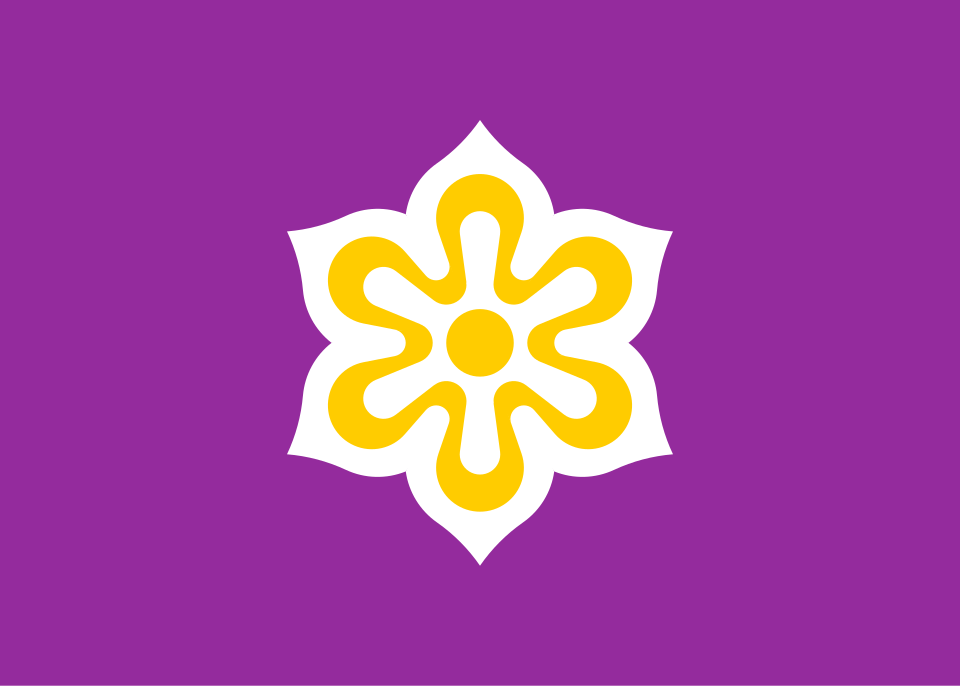
Kyoto Prefecture (京都府, Kyōto-fu) flies a wine-red flag bearing a white-and-gold six-lobed crest enclosing a humanoid rendering of the character “京” (kyo). Both were formally adopted on 2 November 1976, chosen by public design competition to mark the 30th anniversary of Japan’s postwar Constitution. This is the modern prefectural government’s own emblem — a separate thing from the city of Kyoto’s own municipal symbol, and from the many older imperial-court emblems associated with Kyoto’s eleven centuries as Japan’s capital.
Flag
Not available
| Prefecture | Kyoto (京都府, Kyōto-fu) |
|---|---|
| Type | Fu (府) — urban prefecture, one of only two in Japan |
| Region | Kansai (Kinki) |
| Capital | Kyoto City (a separate municipal entity with its own emblem) |
| Established | 1868 as Kyoto-fu; boundaries fixed by 1876, merging former Yamashiro, Tango, and part of Tanba provinces |
| Crest / flag | Six-lobed shape with central humanoid “京”, white/gold on wine-red; adopted 2 November 1976 (Notices No. 627/628) |
| Official tree | Kitayama cedar (Kitayama-sugi), designated 1966 |
| Official flower | Weeping cherry (shidare-zakura), designated 1954 |
| Official bird | Streaked shearwater (ō-mizunagidori), designated 1965 |
Flag of Kyoto Prefecture — Wine-red field, six-lobed crest with central “京”, adopted 1976
The flag of Kyoto Prefecture is a wine-red (magenta-red) field bearing the prefecture’s crest (府章, fushō) in white outlined with gold: a six-lobed shape said to express the dignified, elegant character of an ancient capital, within which the character “京” (kyo, from Kyoto) is stylised into a humanoid form. According to the Kyoto Prefectural Government, the design as a whole represents “the unity of the prefecture’s people and the bonding of their collective strength.” The flag’s field-to-emblem proportions are fixed by prefectural regulation.
Despite Kyoto’s eleven centuries as the imperial capital of Japan (794–1868), the prefectural crest in use today is comparatively recent. A first, little-used prefectural flag is recorded from around 1870, in the early years after the Meiji-era prefecture was created. The design seen today, however, was chosen through a public design competition held to commemorate the 30th anniversary of the promulgation of Japan’s postwar Constitution (promulgated 3 November 1946). The winning design was formally adopted as both the prefectural crest and flag on 2 November 1976, by Prefectural Notices No. 627 (crest) and No. 628 (flag).
It is worth stressing what this crest is not: it is not a relic of the old imperial court, and it is not the emblem of Kyoto City (京都市), the municipality that has served as the prefecture’s seat of government since 1868. The city maintains its own separate civic emblem and administration, distinct from the prefectural government whose crest is described here.
Kyoto Prefecture as it exists today is a Meiji-era administrative creation. Following the 1868 restoration and the 1871 abolition of the domains (haihan-chiken), the prefecture absorbed the whole of the former Yamashiro Province, part of Tanba Province, and, by 1876, the districts of Tango Province to the north — consolidating the prefecture’s present-day boundaries along the Sea of Japan and inland Kansai.
A wine-red field with a white-and-gold crest: a six-lobed shape evoking the dignity of an ancient capital, enclosing a stylised, humanoid “京” at its centre, representing the unity and combined strength of the prefecture’s people.
No. Kyoto Prefecture and Kyoto City are distinct administrative bodies, each with its own official emblem — a common point of confusion given they share a name and the city is the prefectural capital. This page covers only the prefectural crest and flag, adopted in 1976 by the Kyoto Prefectural Government. The city’s own emblem, and the many symbols historically tied to Kyoto’s centuries as the imperial capital, are separate subjects.
Both date to 2 November 1976 (Prefectural Notices No. 627 and No. 628), selected by public design competition to mark the 30th anniversary of the promulgation of Japan’s postwar Constitution. An earlier, rarely used prefectural flag is recorded from around 1870.
The Kitayama cedar (designated 1966, valued for its straight, polished timber), the weeping cherry (designated 1954), and the streaked shearwater (designated 1965), a seabird that nests on Kanmuri-jima island off the coast of Maizuru.
Last reviewed by the Emblema Mundi editorial team on 2026-07-04.