Prefecture
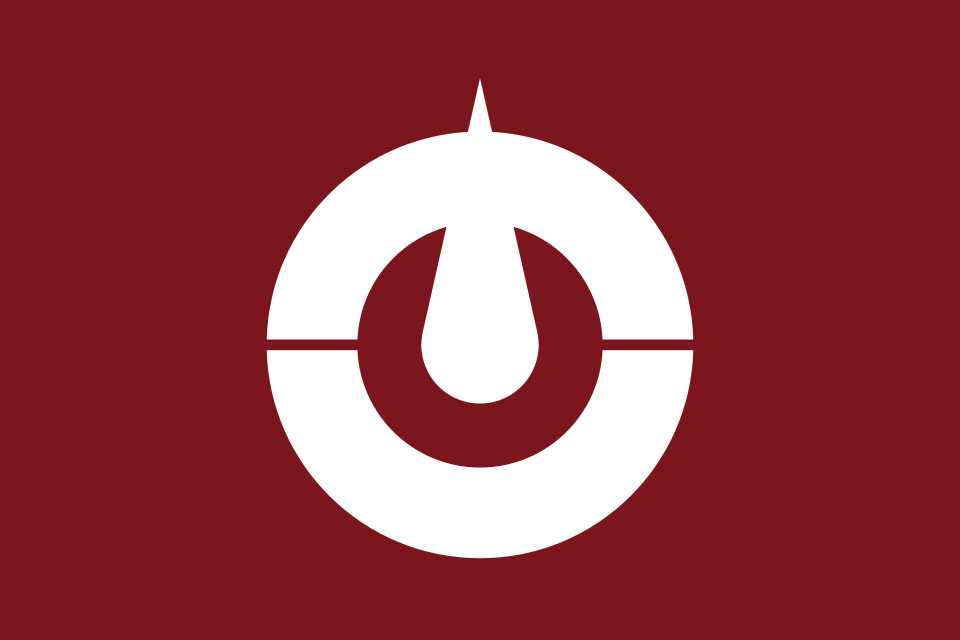
Kōchi (高知県, Kōchi-ken) flies a maroon flag bearing a white prefectural emblem: a broken ring with a sword-point shape rising from its centre, stylising the katakana letter “ko” together with a nod to Tosa, the province’s historic name. Chosen by public contest and adopted in 1953, the emblem represents the entire prefecture on the Pacific coast of Shikoku — not to be confused with the separate emblem of Kōchi City, the prefectural capital that shares its name.
Flag
Not available
| Prefecture | Kōchi (高知県, Kōchi-ken) |
|---|---|
| Type | Ken (県) — ordinary prefecture |
| Region | Shikoku, facing the Pacific Ocean |
| Capital | Kōchi City (a distinct municipality with its own emblem) |
| Established | 1871 (Meiji-era abolition of domains), corresponding to the former Tosa Province |
| Emblem (kenshō) | White stylised katakana “ko” in a ring, on maroon; adopted 15 April 1953 |
| Flag | Maroon field, white emblem centred; customary use, no formal flag ordinance |
| Official tree | Yanase sugi (a regional Japanese cedar) |
| Official flower | Yamamomo (Chinese bayberry), designated 1954 |
| Official bird | Fairy pitta (yairochō), designated 1964 |
Flag of Kōchi Prefecture — Maroon field, white emblem, adopted 1953
The flag of Kōchi Prefecture is a maroon (wine-red) field bearing the prefecture’s white emblem (県章, kenshō) centred on it: a ring broken by a horizontal bar, with a pointed, sword-like or teardrop shape rising from its middle. According to the Kōchi prefectural government, the design is an impression of “Tosa” (土佐), the region’s historic name, built around the katakana character “ko” (コ) from Kōchi. The upward-pointing tip is said to represent advancement (向上), while the surrounding circle stands for peace and cooperation (平和と協力). No prefectural ordinance formally regulates the flag’s exact proportions, but the maroon-field, centred-emblem version shown here is the version in universal customary use.
1953 — National Sports Festival. The emblem was created to mark Kōchi’s hosting of the 8th National Sports Festival (国民体育大会, Kokutai), held that year in Shikoku, and to give visual form to the idea of “southern Tosa” (南国土佐) as a symbol of the prefecture.
Public design contest. The prefectural government solicited designs from the general public; 358 entries were submitted and judged.
15 April 1953 — Formal adoption. The winning design was formally adopted as the official prefectural emblem on this date, and has remained unchanged since.
Because the prefectural capital is also called Kōchi (Kōchi-shi, 高知市), sources discussing “Kōchi’s emblem” can refer to two entirely different marks. This page describes only the prefectural emblem and flag, adopted in 1953 as described above. Kōchi City, the municipality, maintains its own separate civic emblem and flag, distinct in design and history from the prefecture’s.
Kōchi Prefecture corresponds almost exactly to the former Tosa Province, one of Japan’s traditional provinces, ruled in the Sengoku period by the Chōsokabe clan and, from the early Edo period until the Meiji Restoration, by the Yamauchi clan as the Tosa Domain. Tosa produced several key figures of the Bakumatsu era, most famously Sakamoto Ryōma, born in Kōchi City, whose role in brokering the alliance that toppled the shogunate made him one of modern Japan’s most celebrated historical figures. Following the 1871 abolition of the domains (haihan-chiken), the former Tosa Domain became Kōchi Prefecture.
A maroon field with a white emblem: a broken ring with a rising sword-point or teardrop shape, stylising the katakana letter “ko” together with a reference to Tosa, the historic name of the region.
No. Kōchi Prefecture and Kōchi City (its capital) are separate administrative levels, each with its own official emblem. This page describes only the prefectural emblem, adopted in 1953; the city’s emblem and flag are distinct.
The emblem was adopted on 15 April 1953, selected from 358 public submissions in a design contest held to mark Kōchi’s hosting of the 8th National Sports Festival that year. The maroon flag bearing it is in customary use, though no dedicated flag ordinance exists.
The Yanase sugi (a regional Japanese cedar) is the official tree, the yamamomo (Chinese bayberry, designated 1954) is the official flower, and the fairy pitta (yairochō, designated 1964), a strikingly multicoloured migratory bird, is the official bird.
Last reviewed by the Emblema Mundi editorial team on 2026-07-04.