Prefecture
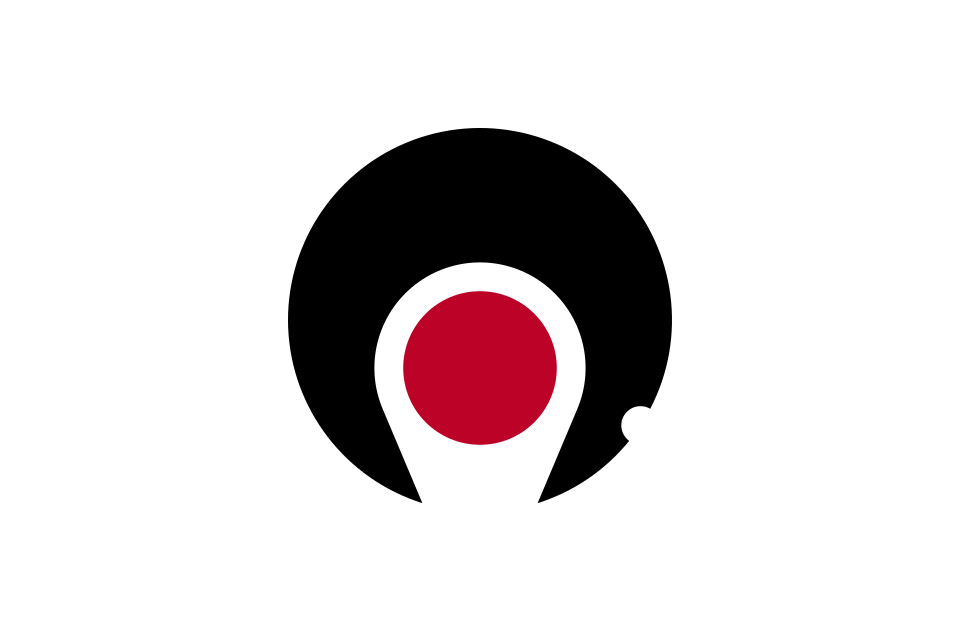
Kagoshima Prefecture (鹿児島県, Kagoshima-ken), at the southern tip of Kyūshū, flies a white flag bearing a black-and-red geographic emblem: the silhouette of its two peninsulas cradling a red circle for Sakurajima, one of Japan’s most active volcanoes. Adopted in 1967 after a public design competition, the emblem is often mistaken for the historic Shimazu clan crest — the cross-in-a-circle mon of the samurai family that ruled the former Satsuma Domain from this same land for centuries — but the two symbols are unrelated.
Flag
Not available
| Prefecture | Kagoshima (鹿児島県, Kagoshima-ken) |
|---|---|
| Type | Ken (県) — ordinary prefecture |
| Region | Kyūshū (southernmost on the main islands; includes the Ōsumi and Amami island groups) |
| Capital | Kagoshima City (鹿児島市) — a separate municipal entity with its own emblem |
| Established | 1871 (haihan-chiken), uniting the former Satsuma and Ōsumi provinces; the Amami Islands, under separate US administration from 1946, reverted to Kagoshima Prefecture on 25 December 1953 |
| Crest (kenshō) | Black silhouette of the Satsuma and Ōsumi Peninsulas with a red circle for Sakurajima; adopted 10 March 1967 |
| Symbol mark | Blue stylised letter “K”, evoking wind and waves; adopted 16 March 1994 |
| Official tree | Camphor tree (kusunoki), designated 1970; the golden shower tree (kaikōzu) was designated separately in 1966 |
| Official flower | Miyama kirishima azalea/rhododendron, designated 1954 |
| Official bird | Lidth’s jay (ruri-kakesu), designated 1965 — found only on Amami Ōshima and its neighbouring islets |
Flag of Kagoshima — White field, black peninsula silhouette, red Sakurajima circle, adopted 1967
The flag of Kagoshima Prefecture is a white field bearing the prefecture’s crest (県章, kenshō) in black and red. The black shape, often described as resembling an inverted horseshoe, stylises the outline of the Satsuma and Ōsumi Peninsulas that flank Kagoshima Bay, with a small indentation on the right marking Shibushi Bay. At the centre of the black form sits a red circle representing Sakurajima, the still-active volcano rising from the bay between the two peninsulas. The design has drawn some local criticism over the years for omitting the prefecture’s outlying islands — the Ōsumi and Amami groups — from the picture.
A second, later emblem exists alongside the crest: a blue symbol mark adopted on 16 March 1994, combining wind and wave motifs into a stylised letter “K” for Kagoshima, meant to convey the prefecture’s dynamism and forward momentum. A flag bearing this mark travelled to space aboard Space Shuttle Discovery in 2009 with astronaut Kōichi Wakata, whose father’s hometown is in Kagoshima Prefecture (Wakata himself was born in Saitama).
The prefectural crest was adopted on 10 March 1967, chosen through a public design competition intended to foster regional identity and civic pride, in the style common to many Japanese prefectural emblems created in the postwar decades. Its subject is explicitly geographic: the peninsulas and the volcano that define Kagoshima Bay, described by the prefectural government as symbolising the natural grandeur of the land and the passion, harmony, and unity of its people.
This is a modern civic symbol, distinct from the region’s much older heraldic tradition. For over two and a half centuries of the Edo period, Kagoshima was the seat of the Satsuma Domain, ruled by the powerful Shimazu clan from Kagoshima Castle — one of the most influential domains of the era and a driving force behind the Meiji Restoration. The Shimazu mon, a cross set within a circle, is one of the best-known samurai crests in Japanese history, but it plays no part in the current prefectural emblem, which was designed roughly a century after the domain’s abolition. Present-day Kagoshima Prefecture was formed in 1871 through the haihan-chiken reforms, uniting the former provinces of Satsuma and Ōsumi (and, eventually, the outlying Ryūkyū-adjacent islands to the southwest) into a single administrative unit.
A white field with a black silhouette of the Satsuma and Ōsumi Peninsulas, indented on the right for Shibushi Bay, and a red circle at the centre representing Sakurajima, the active volcano in Kagoshima Bay.
No. The Shimazu clan, which ruled the Satsuma Domain from Kagoshima for centuries, used a circular cross mon. The modern prefectural emblem, designed by public competition in the 1960s, is unrelated: it is a geographic silhouette of the peninsulas and Sakurajima, not a samurai family crest.
The emblem (kenshō) was adopted on 10 March 1967, selected through a public design competition. A separate blue “K” symbol mark, evoking wind and waves, was adopted later, on 16 March 1994.
Both — and this is a frequent source of confusion. Kagoshima Prefecture (鹿児島県) is one of Japan’s 47 prefectures, while its capital, Kagoshima City (鹿児島市), shares the same name but is a separate municipal government with its own distinct emblem. This page describes the prefecture’s crest and flag only.
Last reviewed by the Emblema Mundi editorial team on 2026-07-04.