Prefecture
Ibaraki (茨城県, Ibaraki-ken) flies a blue flag bearing a white spiral rose-bud emblem, designed by graphic designer Kazumasa Nagai and formally adopted on 13 November 1991 to mark the 120th anniversary of the prefecture’s founding. The rose motif itself is older still, echoing a design first associated with the prefecture in 1911 and playing on the character ibara (茨, thorn bush) in the prefecture’s own name.
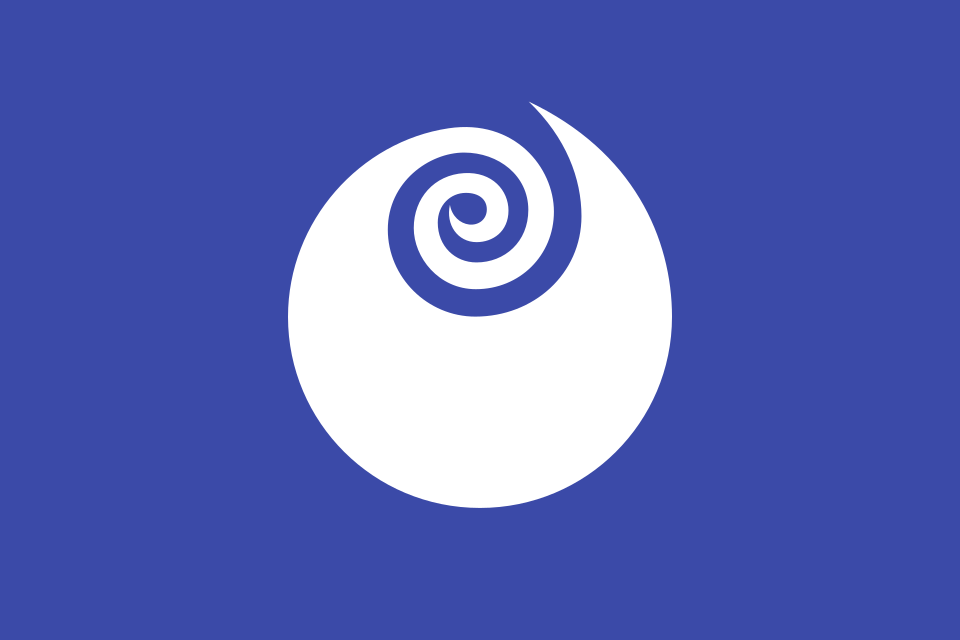
Flag
Not available
| Prefecture | Ibaraki (茨城県, Ibaraki-ken) |
|---|---|
| Type | Ken (県) — ordinary prefecture |
| Region | Kantō |
| Capital | Mito |
| Established | 1871, in the haihan-chiken abolition of the han system, on the former territory of Mito Domain (a senior Tokugawa branch house); reached its present boundaries by 1875 after absorbing districts of former Shimōsa Province |
| Crest (emblem) | White spiral rose bud on blue; adopted 13 November 1991, designed by Kazumasa Nagai |
| Previous emblem | Katakana-based rose design (イハラキ), traceable to 1911 and formalised in 1966 |
| Official flower | Rose (bara), designated 28 March 1966 |
| Official tree | Plum (ume), designated 6 October 1966 |
| Official bird | Eurasian skylark (hibari), designated 3 November 1965 |
Flag of Ibaraki — Blue field, white spiral rose-bud emblem, adopted 1991
The flag of Ibaraki is a blue field — officially rendered in the specific shade known as “Ibaraki Blue” — bearing the prefecture’s white emblem (県章, kenshō): a rose bud rendered as a dynamic spiral, evoking a flower just beginning to open. The prefectural government describes the design as expressing “advancement, creativity, dynamism, and development.” Commentators have also noted a visual resemblance, when rotated, to the whirlpool emblem of Naruto City, though the two designs are unrelated.
1871 — Haihan-chiken. Ibaraki Prefecture was created in the sweeping haihan-chiken (廃藩置県) reform of August 1871, which abolished Japan’s feudal domains (han) nationwide. Its core territory had been the Mito Domain, seat of one of the three senior Tokugawa branch houses (gosanke). Successive mergers with neighbouring districts, including parts of the former Shimōsa Province, brought the prefecture to its present borders by 1875.
1911 — An early rose mark. A rose-based design incorporating the katakana characters for “Ibaraki” (イハラキ) appears to be the earliest emblem associated with the prefecture, though the exact circumstances of its adoption are not well documented in available sources.
1966 — Formalisation. This katakana-rose design was refined and formally established as the prefecture’s official emblem, the same year the rose was separately designated Ibaraki’s official flower.
13 November 1991 — The Nagai redesign. To mark the 120th anniversary of the prefecture’s founding, the government commissioned designer Kazumasa Nagai to create a new emblem. His spiral rose-bud design replaced the older katakana mark and remains in use today, carried on the prefectural flag in white against blue.
The rose motif plays on the prefecture’s own name: Ibaraki is written 茨城, combining ibara (茨, “thorn bush”) and ki (城, “castle”). Local tradition, recorded in the 8th-century Hitachi Fudoki gazetteer, associates the name with a fortress built of thorny brambles to defend against raiders in the ancient Ibaraki district of Hitachi Province. Roses, as the most prominent thorned flower, became a natural civic emblem drawing on this etymology — a connection reinforced when the rose was made the official prefectural flower in 1966.
A blue field with a white emblem: a spiral rose bud representing a flower just opening, symbolising advancement, creativity, dynamism, and development according to the prefectural government.
Graphic designer Kazumasa Nagai created the current spiral rose-bud emblem, formally adopted on 13 November 1991 to mark the prefecture’s 120th anniversary. It replaced an earlier emblem in use since 1966.
The rose plays on the prefecture’s name, written with the character ibara (茨, “thorn bush”), and echoes an early-20th-century emblem tradition. The rose was formally designated Ibaraki’s official flower in 1966, the same year an earlier rose-based emblem was formalised.
The rose (bara, designated 1966) is the official flower, the plum tree (ume, designated 1966) is the official tree — famously grown at Mito’s Kairakuen Garden — and the Eurasian skylark (hibari, designated 1965) is the official bird.
Last reviewed by the Emblema Mundi editorial team on 2026-07-04. The exact circumstances of the 1911 katakana rose design’s adoption are thinly documented in available sources; this page notes that uncertainty rather than asserting undocumented detail.