Prefecture
Hokkaido (北海道, Hokkaidō) flies a dark blue flag bearing a red seven-pointed star rimmed in white light — an emblem adopted in 1967 for the island prefecture’s centennial, but rooted in the five-pointed “Hokushin” (North Star) mark flown a century earlier by the Meiji-era pioneers of the Kaitakushi, the Hokkaido Development Commission.
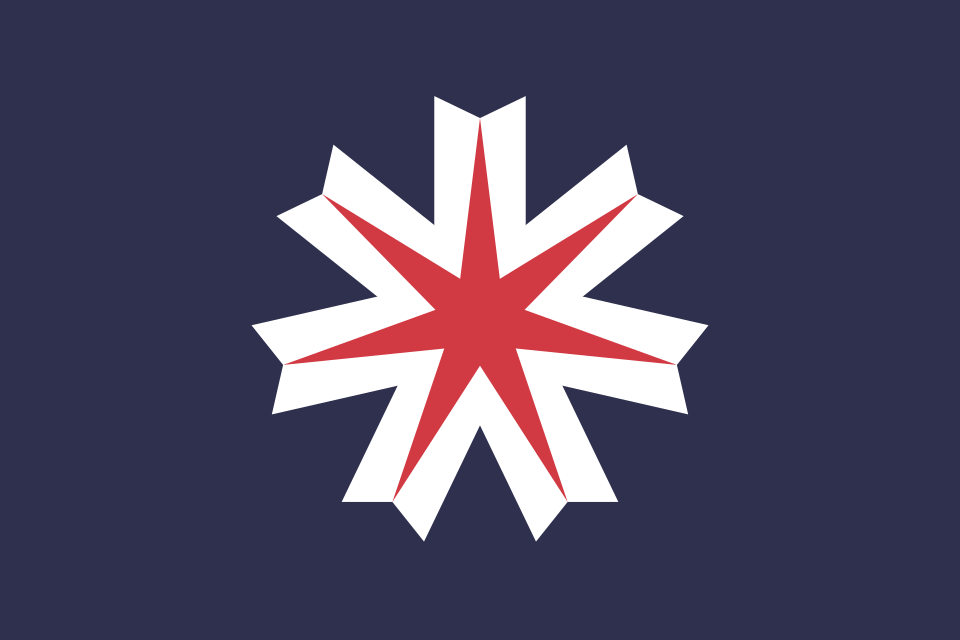
Flag
Not available
| Prefecture | Hokkaido (北海道, Hokkaidō) |
|---|---|
| Type | Dō (道) — circuit, unique among the 47 prefectures |
| Region | Hokkaido (prefecture and region share one name) |
| Capital | Sapporo |
| Administrative history | Kaitakushi (Development Commission), 1869–1882; three separate prefectures (Hakodate, Sapporo, Nemuro), 1882–1886; Hokkaido Agency (Hokkaido-chō), 1886–1947; full prefectural status under the revised Local Autonomy Law, 1947 |
| Emblem (Hokkaido-shō) | Red seven-pointed star, white halo, on dark blue; adopted 1 May 1967 |
| Historical precursor | Five-pointed “Hokushin” star flag of the Kaitakushi, flown from 1872 |
| Official tree | Ezo spruce (ezomatsu, Picea jezoensis) |
| Official flower | Rugosa rose (hamanasu, Rosa rugosa) |
| Official bird | Red-crowned crane (tanchō, Grus japonensis) |
Flag of Hokkaido — Dark blue field, red seven-pointed star with white halo, adopted 1967
The flag of Hokkaido is a dark blue field charged with the prefecture’s emblem (北海道章, Hokkaidō-shō): a red seven-pointed star surrounded by a ring of white light. According to the prefecture’s own explanation of the design, the navy blue stands for the northern seas and sky, the red star for the indomitable energy of Hokkaido’s people, and the white halo for brilliance and the region’s snow and wind. Taken together, the star is read as a symbol of hope and continuing development for the island.
1869–1882 — The Kaitakushi. Following the Meiji Restoration, the government created the Hokkaido Development Commission (開拓使, Kaitakushi) in 1869 to administer and settle Japan’s northern frontier. From February 1872, the Commission flew a flag bearing a red five-pointed star on a blue field, popularly known as the “Hokushin” (北辰, North Star) flag, on its official ships and buildings. A proposal that same year by Vice-Minister Kuroda Kiyotaka to redesign the star with seven points was considered but not adopted at the time, and the Commission stopped flying the flag around 1878. The five-pointed star nonetheless became a lasting emblem of the pioneer era — it survives today, for instance, in the gold star of the Sapporo Beer logo, and on Meiji-era landmarks such as Sapporo’s Clock Tower.
1882–1886 — Three prefectures. The Kaitakushi was abolished in 1882 and its territory divided into three short-lived prefectures: Hakodate, Sapporo, and Nemuro.
1886–1947 — The Hokkaido Agency. The three-prefecture arrangement proved unworkable for governing such a vast, sparsely settled territory, and in 1886 they were consolidated under the Hokkaido Agency (北海道庁, Hokkaidō-chō), a special national administrative body rather than an ordinary prefecture.
1947 — Full prefectural status. Hokkaido became a prefecture on equal legal footing with Japan’s other 46 under the revised Local Autonomy Law. It remains the only prefecture designated dō (道, “circuit”), a term historically used for large regional divisions.
1 May 1967 — The modern flag and emblem. Ahead of the 1968 centennial of Hokkaido’s modern development, prefectural authorities organised a design competition through the Hokkaido Centennial Project. From more than 7,500 submitted proposals, the Hokkaido Flag and Hokkaido Emblem Establishment Committee selected a design credited to Kenichi Kuritani and instructors of the Hokkaido Design Institute, formally adopted by Hokkaido Notification No. 775. The new emblem revived the old Kaitakushi star — this time reworked with seven points, echoing Kuroda’s rejected 1872 proposal — to represent Hokkaido’s pioneering spirit and its continued growth a century on.
A dark blue field bearing a red seven-pointed star rimmed in white light. Blue represents the northern seas and sky, red the vigour of Hokkaido’s people, and the white halo the region’s snow and brilliance.
The seven-pointed star modernises the five-pointed “Hokushin” star flown by the Kaitakushi pioneer commission from 1872. A seven-point version had actually been proposed as early as 1872 by Vice-Minister Kuroda Kiyotaka but was rejected then; it was revived for the emblem adopted in 1967.
Both were formally established on 1 May 1967 (Hokkaido Notification No. 775), chosen from over 7,500 entries as part of a design competition tied to the 1968 centennial of Hokkaido’s development.
The Ezo spruce (ezomatsu), the rugosa rose (hamanasu), and the red-crowned crane (tanchō).
Last reviewed by the Emblema Mundi editorial team on 2026-07-04.