Prefecture
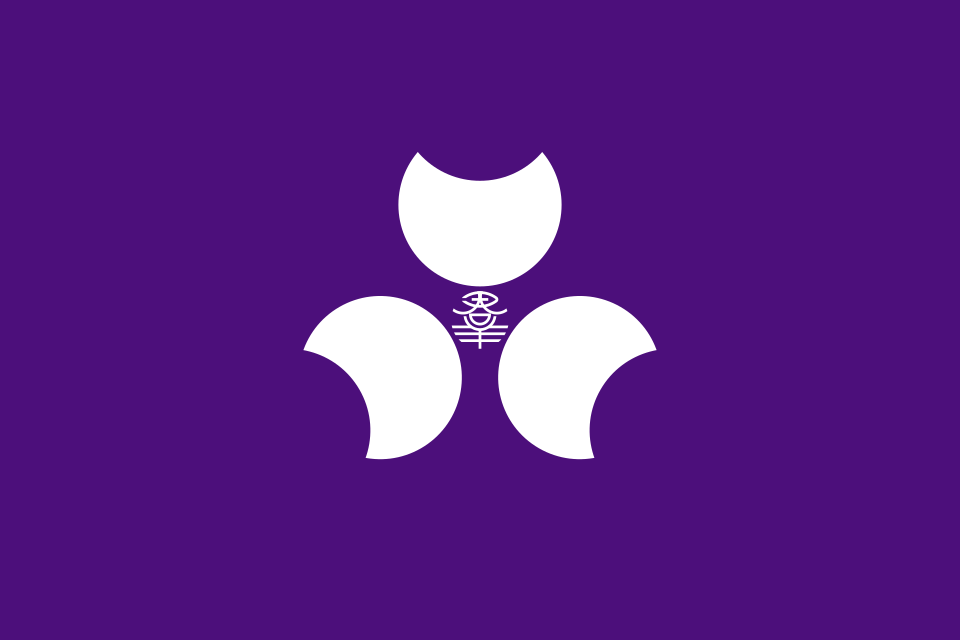
Gunma (群馬県, Gunma-ken) flies a purple flag bearing three white crescent shapes arranged around a small, archaic character for “gun” (群) — the first character of the prefecture’s name. The crescents stand for the Jōmō Sanzan, the “Three Mountains of Jōmō”: Akagi, Haruna, and Myōgi. The design was adopted as a flag in 1968, but its central emblem dates back to a public design competition held in 1926.
Flag
Not available
| Prefecture | Gunma (群馬県, Gunma-ken) |
|---|---|
| Type | Ken (県) — ordinary prefecture |
| Region | Kantō |
| Capital | Maebashi |
| Established | 1871, haihan-chiken reform; corresponds to the former Kōzuke Province |
| Emblem (kenshō) | Archaic character “羣” (gun) encircled by three mountain shapes; adopted 1 October 1926 |
| Flag | Purple field, white three-crescent motif with central “群” character; adopted 25 October 1968 |
| Official tree | Japanese black pine (kuromatsu), designated 1966 |
| Official flower | Renge-tsutsuji (Japanese azalea), selected 1951 |
| Official bird | Copper pheasant (yamadori), designated 1964 |
Flag of Gunma — Purple field, three white crescents for the Jōmō Sanzan, adopted 1968
The flag of Gunma is a purple field bearing a white device made of three crescent-moon shapes, arranged in a triad — one above, two below — around a small, stylised archaic character for “gun” (羣, an older form of 群) at the centre. The three crescents represent the Jōmō Sanzan (上毛三山, “Three Mountains of Jōmō”): Mount Akagi, Mount Haruna, and Mount Myōgi, the trio of peaks that anchor Gunma’s landscape and identity. According to the prefectural government, the crescent forms were chosen to express an image of “a developing Gunma,” while the central character symbolises the unity and harmony of the prefecture’s residents. The purple background was selected as a refined colour considered fitting for the prefecture’s cultural heritage as the historic Kōzuke Province (上野国), one of Japan’s classical provinces with strong courtly and literary associations.
1 October 1926 — the prefectural emblem. Gunma’s emblem (県紋章, kenshō) was established by prefectural ordinance and selected through a public design competition held in connection with the construction of the prefectural government building. Its design placed the archaic character for “gun” at the centre, encircled by stylised representations of the three Jōmō mountains, expressing the harmony of the prefecture’s citizens.
25 October 1968 — the prefectural flag. More than four decades later, and to mark the centenary of the Meiji Restoration, Gunma adopted a dedicated flag (Proclamation No. 553). Entries from an initial public design call were reportedly judged unsuitable, and the final design was created by Yasujirō Tajima of the prefecture’s Textile Industry Testing Laboratory. The flag reworked the three encircling mountain shapes of the 1926 emblem into three cleaner crescent forms and set them, together with the central character, in white against a purple field — the design still flown today.
English-language coverage of Gunma’s symbols is thinner than for Tokyo, and some secondary sites (including automated extracts of encyclopaedic content) describe the flag inconsistently. The description above follows the Gunma prefectural government’s own account and is corroborated by independent vexillological references; readers seeking the fullest detail should consult the official Japanese-language source linked below.
A purple field with a white device: three crescent shapes arranged around a small archaic character for “gun” (群). The crescents represent the Jōmō Sanzan — Mount Akagi, Mount Haruna, and Mount Myōgi.
The prefectural emblem dates to 1 October 1926, chosen through a public design competition. The flag itself came later, adopted on 25 October 1968 to mark the centenary of the Meiji Restoration.
Purple was chosen as a refined colour considered fitting for Gunma’s rich cultural heritage as the historic Kōzuke Province, one of Japan’s classical provinces.
The Japanese black pine (designated 1966, notable for thriving on Mount Akagi’s inland slopes), the renge-tsutsuji azalea (selected 1951), and the copper pheasant (yamadori, designated 1964).
Last reviewed by the Emblema Mundi editorial team on 2026-07-04.