Prefecture
Fukui Prefecture (福井県, Fukui-ken) flies a navy-blue flag bearing a white circular emblem formed from three interlaced katakana characters — フ (fu), ク (ku) and イ (i) — spelling out the prefecture’s name and shaped to resemble young leaves unfolding from a seedling. The design was fixed in 1952 and remains one of the oldest Japanese prefectural emblems with a formally specified colour scheme. Note that Fukui Prefecture and its capital, Fukui City, are separate administrative bodies with separate emblems — this page covers only the prefectural symbol.
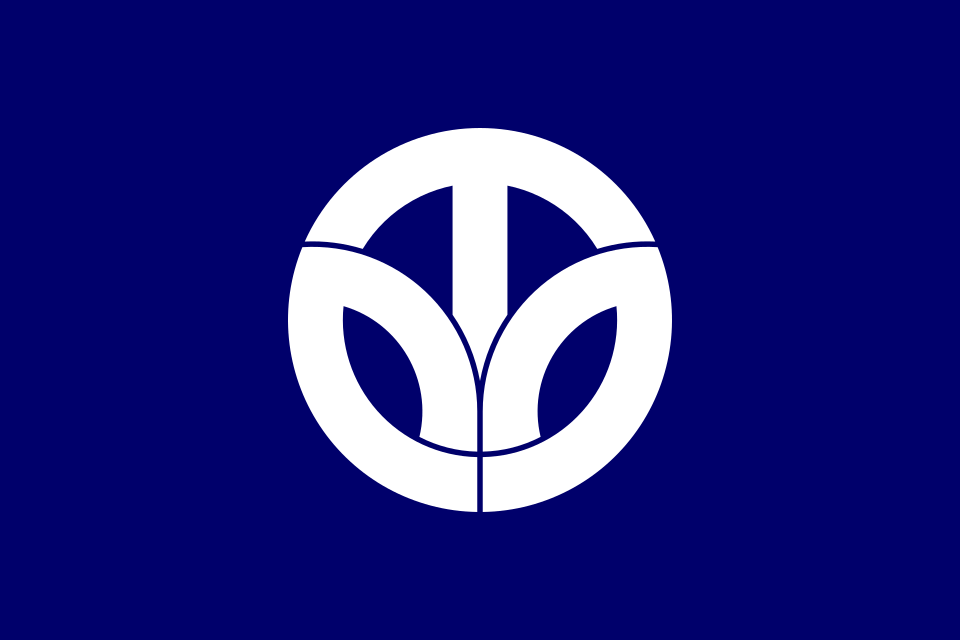
Flag
Not available
| Prefecture | Fukui (福井県, Fukui-ken) |
|---|---|
| Type | Ken (県) — ordinary prefecture |
| Region | Chūbu (Hokuriku sub-region), Sea of Japan coast |
| Capital | Fukui City (a separate municipal entity with its own emblem) |
| Established | Modern boundaries fixed 7 February 1881, merging the Reihoku area (from Ishikawa) with Reinan (from Shiga); corresponds to the former provinces of Echizen and Wakasa, first organised into prefectures after the 1871 haihan-chiken |
| Crest / emblem (kenshō) | Circular device combining katakana フ・ク・イ; design decided 28 March 1952, implementing regulation promulgated 1 April 1952 (Notice No. 117) |
| Flag | Navy-blue (indigo) field, emblem in white; officially specified colours, ratio 2:3 |
| Official flower | Narcissus (suisen) |
| Official tree | Pine (matsu) |
| Official bird | Dusky thrush (tsugumi) |
Flag of Fukui Prefecture — Navy-blue field, white katakana emblem, design fixed 1952
The flag of Fukui Prefecture is a navy-blue (indigo) field bearing the prefecture’s white emblem (県章, kenshō): the three katakana characters that spell out “Fukui” — フ (fu), ク (ku) and イ (i) — interlaced into a single rounded, circular device. According to the prefectural government, the resulting shape resembles young leaves emerging from between a seedling’s twin cotyledons, expressing harmony, cooperation, and the people’s wish for the prefecture’s continued growth. The implementing regulation is unusually precise for its time: it specifies that the line thickness of the device must equal one-seventh of the outer circle’s diameter, with spacing between lines set at one-tenth of that thickness, and that the emblem must appear in indigo or black when used alone, or in white against an indigo ground when used on the flag itself.
Fukui Prefecture corresponds to the historical provinces of Echizen (north) and Wakasa (south). Following the abolition of the domains (haihan-chiken) on 14 July 1871, the region was initially split into several short-lived prefectures, which were consolidated by the end of that year into Fukui Prefecture and Tsuruga Prefecture. Fukui Prefecture itself was briefly renamed Asuwa Prefecture in early 1872 and folded into Tsuruga Prefecture in January 1873. In August 1876 Tsuruga Prefecture was dissolved outright, its northern Reihoku area transferred to Ishikawa Prefecture and its southern Reinan area to Shiga Prefecture — leaving no prefecture named Fukui at all for several years. The prefecture in its present form was finally re-established on 7 February 1881, when Reihoku was separated from Ishikawa and Reinan from Shiga and merged, with the city of Fukui designated as the seat of government.
The prefectural emblem was decided considerably later, on 28 March 1952 (Shōwa 27), according to Japanese-language reference sources including the Japanese Wikipedia article on the prefectural flag. The implementing regulation that formally fixed its technical specifications was promulgated shortly afterward, on 1 April 1952, as Fukui Prefectural Notice No. 117 — the date cited by some English-language sources for the emblem’s adoption. A dedicated prefectural flag bearing the design followed; vexillological references place its formal adoption around 28 May 1952, though this secondary date is less consistently corroborated than the emblem’s own regulation.
Because the prefectural capital happens to share its name with the prefecture itself, it is easy to conflate the two. Fukui Prefecture (the broader administrative region, covering former Echizen and Wakasa) and Fukui City (Fukui-shi, the municipality that serves as its capital) are legally distinct local governments, each maintaining its own separate official emblem and flag. The design described on this page — the katakana フクイ device on a navy field — belongs to the prefectural government; Fukui City has its own, differently designed municipal crest, which is outside the scope of this page.
A navy-blue field with a white circular emblem formed from the katakana characters フ, ク, and イ (spelling “Fukui”), interlaced so the shape resembles young leaves opening from a seedling — a symbol of growth and cooperation.
No. Fukui Prefecture and Fukui City, its capital, are separate administrative bodies with separate official emblems. This page describes only the prefectural flag and crest; the city maintains its own distinct municipal design.
Japanese sources give 28 March 1952 as the date the design was decided. Its implementing regulation, which fixed the technical specifications and colours, was promulgated shortly after on 1 April 1952 (Notice No. 117) — the date some English sources cite instead.
The narcissus (suisen), chosen for blooming through the harsh winter winds and snow of the Sea of Japan coast; the pine (matsu); and the dusky thrush (tsugumi), a migratory bird that winters in the prefecture after arriving from Siberia.
Last reviewed by the Emblema Mundi editorial team on 2026-07-04.