Prefecture
Ehime (愛墉県, Ehime-ken), on the island of Shikoku, flies a tricolour flag adopted in 1952: yellow, green, and yellow stripes bearing a white mikan (mandarin orange) blossom — a tribute to the citrus fruit for which the prefecture is famous. A separate prefectural crest, a red-green-blue pinwheel designed by Shigeo Fukuda in 1989, exists alongside it but is used far less often in everyday practice.
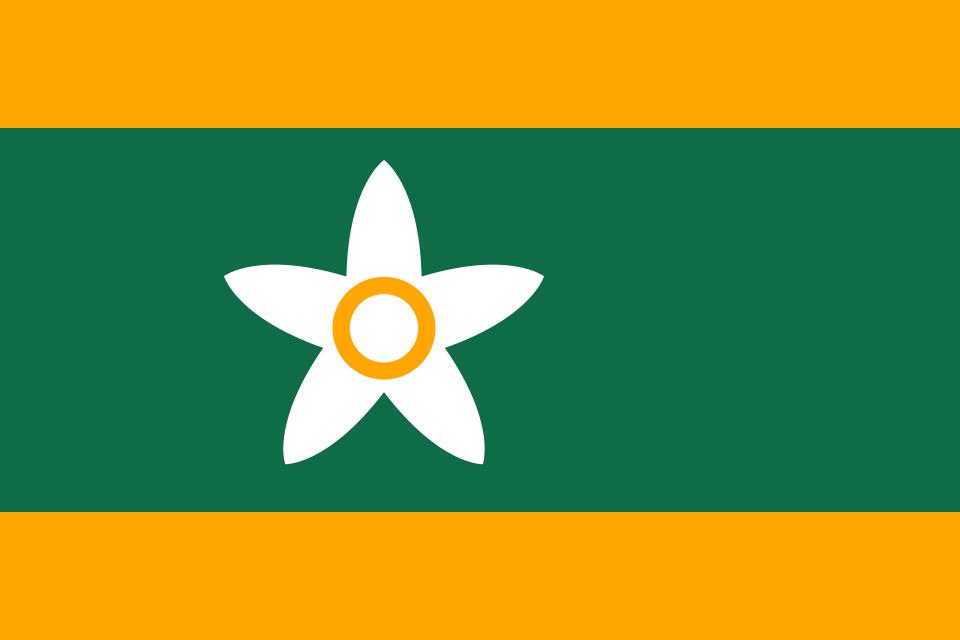

Flag
Not available
Emblem
Not available
| Prefecture | Ehime (愛墉県, Ehime-ken) |
|---|---|
| Type | Ken (県) — ordinary prefecture |
| Region | Shikoku, facing the Seto Inland Sea |
| Capital | Matsuyama |
| Established | 20 February 1873, by merger of Ishizuchi and Kamiyama prefectures (former Iyo Province); present borders since December 1888 |
| Flag | Yellow–green–yellow triband with white mikan blossom; adopted 5 May 1952 |
| Crest (kensho) | Red–green–blue pinwheel swirl by Shigeo Fukuda; adopted 1 November 1989 |
| Official flower | Mikan blossom, designated 1952 |
| Official tree | Pine (matsu), designated 1966 |
| Official bird | Japanese robin (komadori), designated 1970 |
Flag of Ehime — Yellow–green–yellow triband, white mikan blossom, adopted 1952
Crest of Ehime — Red–green–blue pinwheel swirl, designed by Shigeo Fukuda, adopted 1989
The flag of Ehime is a horizontal triband of yellow, green, and yellow, with a white five-petalled mikan blossom — centred on a small orange ring — set toward the hoist side. According to the prefecture, the white petals stand for “simplicity and purity,” the green field for “peace and hope,” and the yellow bands for “happiness.” The mikan (a satsuma-type mandarin orange) is Ehime’s official prefectural flower and one of its best-known agricultural products.
Since 1989 Ehime has also had a separate prefectural crest (県章, kensho): a pinwheel-like arrangement of six curved blades in red, green, and blue — unusual among Japanese prefectural crests, most of which are rendered as a single-colour mon. The Ehime government describes the red as representing the sun and the mikan blossom, the green as the natural blessings symbolised by Mount Ishizuchi (Shikoku’s highest peak), and the blue as the benefits of the Seto Inland Sea — together evoking a healthy, bright future for the prefecture’s residents.
1871 — Abolition of the domains. The haihan-chiken reform dissolved the feudal domains of former Iyo Province into a patchwork of short-lived prefectures, which were quickly consolidated into two: Matsuyama-ken in the north and Uwajima-ken in the south.
1872 — Renamed. Matsuyama-ken became Ishizuchi-ken and Uwajima-ken became Kamiyama-ken, named respectively after Mount Ishizuchi and a nearby shrine.
20 February 1873 — Ehime Prefecture created. The two prefectures were merged into a single Ehime Prefecture, taking its name from an epithet of a princess-deity named in the Kojiki as an origin myth for Iyo Province.
1876–1888 — Kagawa interlude. Ehime briefly absorbed neighbouring Kagawa Prefecture in 1876; Kagawa was separated again in December 1888, fixing Ehime’s borders essentially as they are today.
1952 — The flag. The mikan-blossom tricolour flag was adopted on 5 May 1952, chosen through a public design competition.
1989–1999 — A short-lived emblem flag. Alongside adopting the Fukuda crest on 1 November 1989, then-governor Sadayuki Iga also introduced a separate white “emblem flag” bearing the new crest, intended to promote it. That flag was discontinued on 31 May 1999 after officials judged it had “completed its role,” leaving the 1952 flag as Ehime’s sole flag in everyday use.
Note: two earlier prefectural crests preceded the current one — a 1937 design stylising the katakana “エヒメ” (Ehime) in a circle, and a 1973 design based on the hiragana character “え” (e) adopted for the prefecture’s centennial. Both were retired when the Fukuda crest was adopted in 1989.
A yellow–green–yellow triband with a white mikan blossom, centred on a small orange ring, set toward the hoist. White represents simplicity and purity, green represents peace and hope, and yellow represents happiness.
Yes. Since 1 November 1989, Ehime has used a distinct prefectural crest designed by Shigeo Fukuda: a pinwheel-like swirl of red, green, and blue blades. In practice, the 1952 flag remains the prefecture’s everyday emblem, and the tricolour crest is seen far less often.
The mikan-blossom flag was adopted on 5 May 1952. Between 1989 and 1999 the prefecture also flew a separate white “emblem flag” bearing the new crest to promote it, but this was discontinued in 1999 and the original 1952 flag remains the sole official flag today.
Red represents the sun and the mikan blossom, green represents the natural blessings symbolised by Mount Ishizuchi, and blue represents the benefits of the Seto Inland Sea — together meant to evoke a healthy, bright future for residents.
Last reviewed by the Emblema Mundi editorial team on 2026-07-04.