Prefecture
Chiba Prefecture (千葉県, Chiba-ken), occupying most of the Bōsō Peninsula east of Tokyo, flies a sky-blue flag bearing a white crest (県章, kenshō) that combines the stylised katakana characters チ (chi) and ハ (ha) — the opening syllables of the prefecture’s name. Adopted in 1909, it is, by most accounts, the oldest prefectural crest in Japan still in official use. Note that this page describes the prefecture’s emblem — a separate, distinct emblem belongs to Chiba City, the prefectural capital that shares its name.
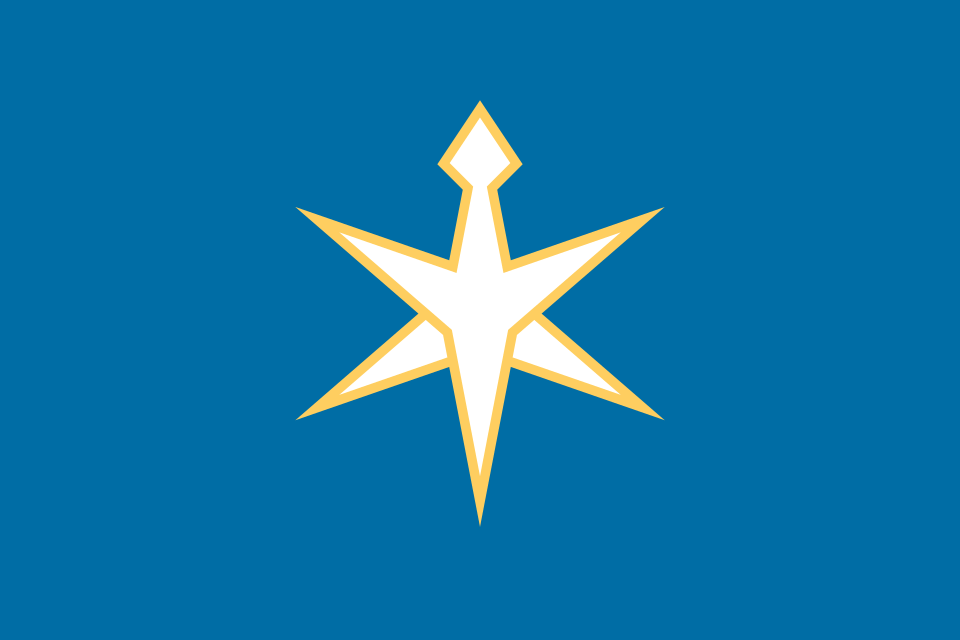
Flag
Not available
| Prefecture | Chiba (千葉県, Chiba-ken) |
|---|---|
| Type | Ken (県) — ordinary prefecture |
| Region | Kantō |
| Capital | Chiba City (a separate municipal government with its own emblem) |
| Established | 15 June 1873, from the merger of Kisarazu Prefecture and Inba Prefecture (former Kazusa, Awa, and Shimōsa provinces) |
| Crest (kenshō) | Katakana チ + ハ combined, white on blue; adopted 28 December 1909 (Notice No. 378) |
| Flag | Sky-blue field, white crest edged in pale yellow; adopted 29 July 1963 (Notice No. 328) |
| Official tree | Kusamaki (Japanese podocarp), designated 1966 |
| Official flower | Nanohana (rapeseed/canola blossom), chosen by public vote 1954 — widely recognised though apparently never given a formal designation notice |
| Official bird | Hojiro (meadow bunting), designated 1965 |
Flag of Chiba Prefecture — Sky-blue field, white チ+ハ crest edged in pale yellow, flag adopted 1963
The flag of Chiba Prefecture is a sky-blue field bearing the prefecture’s white crest (県章, kenshō) at its centre, the white edged in a thin band of pale yellow. The crest itself is a graphic fusion of two katakana characters — チ (chi) and ハ (ha) — drawn from the name Chiba, interlocked into a single rounded emblem rather than shown as two separate letters. According to the prefectural government, the sky-blue ground represents “hope and development,” while the pale-yellow trim alludes to the nanohana (rapeseed blossom) associated with the region.
Chiba Prefecture occupies the historical provinces of Shimōsa, Kazusa, and Awa on the Bōsō Peninsula. Following the 1871 abolition of the han (feudal domain) system, the area was briefly reorganised into Kisarazu Prefecture (covering former Kazusa and Awa) and Inba Prefecture (covering former Shimōsa). These two were merged on 15 June 1873 to form the single Chiba Prefecture, taking its name from the town of Chiba, which was subsequently developed as the prefectural capital.
The prefectural crest was established considerably later, by Prefectural Notice No. 378 of 28 December 1909, fusing the チ and ハ katakana into the emblem still used today. Because the underlying design has never been revised, it is frequently cited as the oldest prefectural crest in Japan still in active use — Tokyo’s crest is older in origin (1889) but belonged initially to the former Tokyo City, not to a prefecture. Under Japan’s former copyright law, the Chiba crest design entered the public domain on 1 January 1940. The dedicated flag displaying the crest on a sky-blue ground was adopted decades later, on 29 July 1963.
No contemporary record of an individual designer for the 1909 crest appears to survive in accessible sources; it should be treated as an anonymous or committee design of the period rather than attributed to a named artist.
A sky-blue field with a white crest, edged in pale yellow, that fuses the katakana characters チ (chi) and ハ (ha) — the start of “Chiba” — into a single rounded mark. Blue stands for hope and progress; the yellow trim recalls the nanohana flower.
No. Chiba Prefecture and its capital, Chiba City, are two distinct levels of government, and each maintains its own separate official emblem. This page, and the crest described above, relate solely to the prefectural government (pref.chiba.lg.jp) — not to the city’s own municipal emblem.
The crest was formally established on 28 December 1909 (Prefectural Notice No. 378), making it, by most accounts, the oldest prefectural crest in Japan still in official use. The matching sky-blue flag followed much later, on 29 July 1963.
The kusamaki (Japanese podocarp) is the official tree (designated 1966), the nanohana (rapeseed blossom) is the widely recognised prefectural flower (chosen by public vote in 1954, though seemingly without a later formal notice), and the hojiro (meadow bunting) is the official bird (designated 1965).
Last reviewed by the Emblema Mundi editorial team on 2026-07-04.