Prefecture
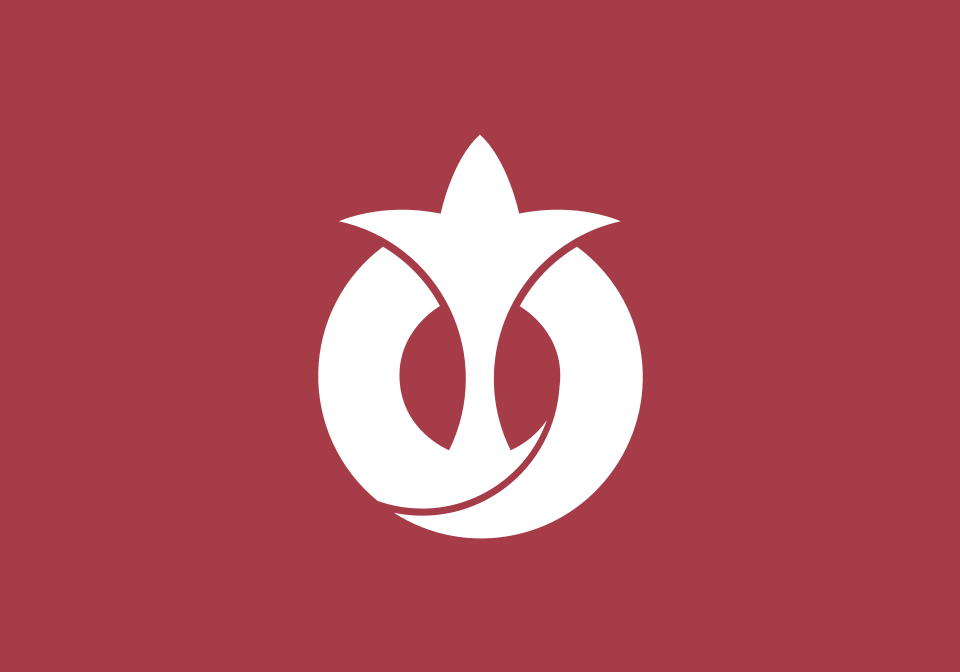
Aichi (愛知県, Aichi-ken) flies a maroon flag bearing a white crest that fuses the three hiragana syllables of its own name — あ (a), い (i), and ち (chi) — into a single emblem evoking a rising sun over cresting waves. Adopted in 1950, the design looks toward the Pacific coast the prefecture faces. Aichi is also historically known as the birthplace of Japan’s three great unifiers — Oda Nobunaga, Toyotomi Hideyoshi, and Tokugawa Ieyasu — and today is centred on Nagoya, one of the country’s foremost industrial and manufacturing hubs.
Flag
Not available
| Prefecture | Aichi (愛知県, Aichi-ken) |
|---|---|
| Type | Ken (県) — ordinary prefecture |
| Region | Chūbu, on the Pacific coast |
| Capital | Nagoya |
| Established | 1871 (haihan-chiken) as Nagoya and Nukata Prefectures; renamed Aichi and merged into its present form in 1872 |
| Crest (mon) | Hiragana あ・い・ち merged into a rising-sun-over-waves motif, white on maroon; adopted 15 August 1950 |
| Official tree | Hananoki (native red maple), designated 1966 |
| Official flower | Kakitsubata (rabbit-ear iris), designated 1954 |
| Official bird | Oriental scops owl (konohazuku), designated 1965 |
Flag of Aichi — Maroon field, white あ・い・ち crest, adopted 1950
The flag of Aichi is a maroon (wine-red, enji-iro) field bearing the prefecture’s white crest (県章, kenshō). At first glance the design reads as a single flame-like peak rising from a rounded, wave-like base — but the Aichi Prefectural Government’s own explanation is that it is not one character but three: the hiragana あ (a), い (i), and ち (chi), spelling out “Ai-chi,” interlocked into a single figure. The tall central peak carries the main weight of the あ, while the curved strokes that wrap around and beneath it complete the い and ち. The whole is officially described as kyokujitsu hatō (旭日波頭) — “rising sun over the crest of a wave” — symbolising the hopes of a prefecture that faces the Pacific Ocean and looks toward overseas development. No official record has been found explaining why maroon specifically was chosen as the field colour.
The crest was adopted on 15 August 1950, selected from roughly 1,600 designs submitted in a nationwide public competition. The timing coincided with Aichi hosting the 5th National Athletic Meet (kokutai) that year, an occasion that also prompted the adoption of the prefectural song, “Warera-ga Aichi” (“We Are Aichi”), the same year. Unlike some prefectures, Aichi has no separate ordinance formally defining the flag’s exact proportions; its use follows established convention, and since 1 January 2001 the design has been in the public domain under Japanese copyright law.
The crest is sometimes summarised, including in some of Emblema Mundi’s own country-level notes, as simply “stylising あ.” That shorthand captures the dominant visual impression — the central peak does resemble a stylised あ on its own — but understates the design. Aichi Prefecture’s own materials are consistent (confirmed across the prefecture’s English-language site and multiple independent Japanese-language sources) in describing the mark as combining all three syllables of “あいち,” not あ in isolation, over the rising-sun-and-waves motif.
Modern Aichi corresponds to the former provinces of Owari and Mikawa. Following the 1871 abolition of the han system (haihan-chiken), Owari (minus the Chita Peninsula) became Nagoya Prefecture, while Mikawa and the Chita Peninsula formed Nukata Prefecture. In April 1872, Nagoya Prefecture was renamed Aichi Prefecture, and on 27 November of that year it absorbed Nukata Prefecture, uniting Owari and Mikawa into the prefecture’s present form.
The region is often called the “homeland of the samurai” for having produced Japan’s three great unifiers of the Sengoku period: Oda Nobunaga and Toyotomi Hideyoshi, both born in Owari (in or near present-day Nagoya), and Tokugawa Ieyasu, born at Okazaki Castle in Mikawa. Today the prefecture’s capital, Nagoya, is one of Japan’s largest cities and a centre of heavy industry and automotive manufacturing.
A maroon field with a white crest merging the hiragana あ, い, and ち into one figure, read officially as a rising sun over cresting waves (旭日波頭).
Not quite. The dominant central peak is often described informally as a stylised あ, but the prefecture’s own explanation is that all three characters of “あいち” are combined in the single design, with あ as the central, most prominent element.
On 15 August 1950, chosen from about 1,600 public submissions in connection with Aichi hosting the 5th National Athletic Meet that year.
The hananoki (a rare native red maple, chosen by public ballot in 1966), the kakitsubata or rabbit-ear iris (designated 1954), and the Oriental scops owl (konohazuku, designated 1965).
Last reviewed by the Emblema Mundi editorial team on 2026-07-04.