Country
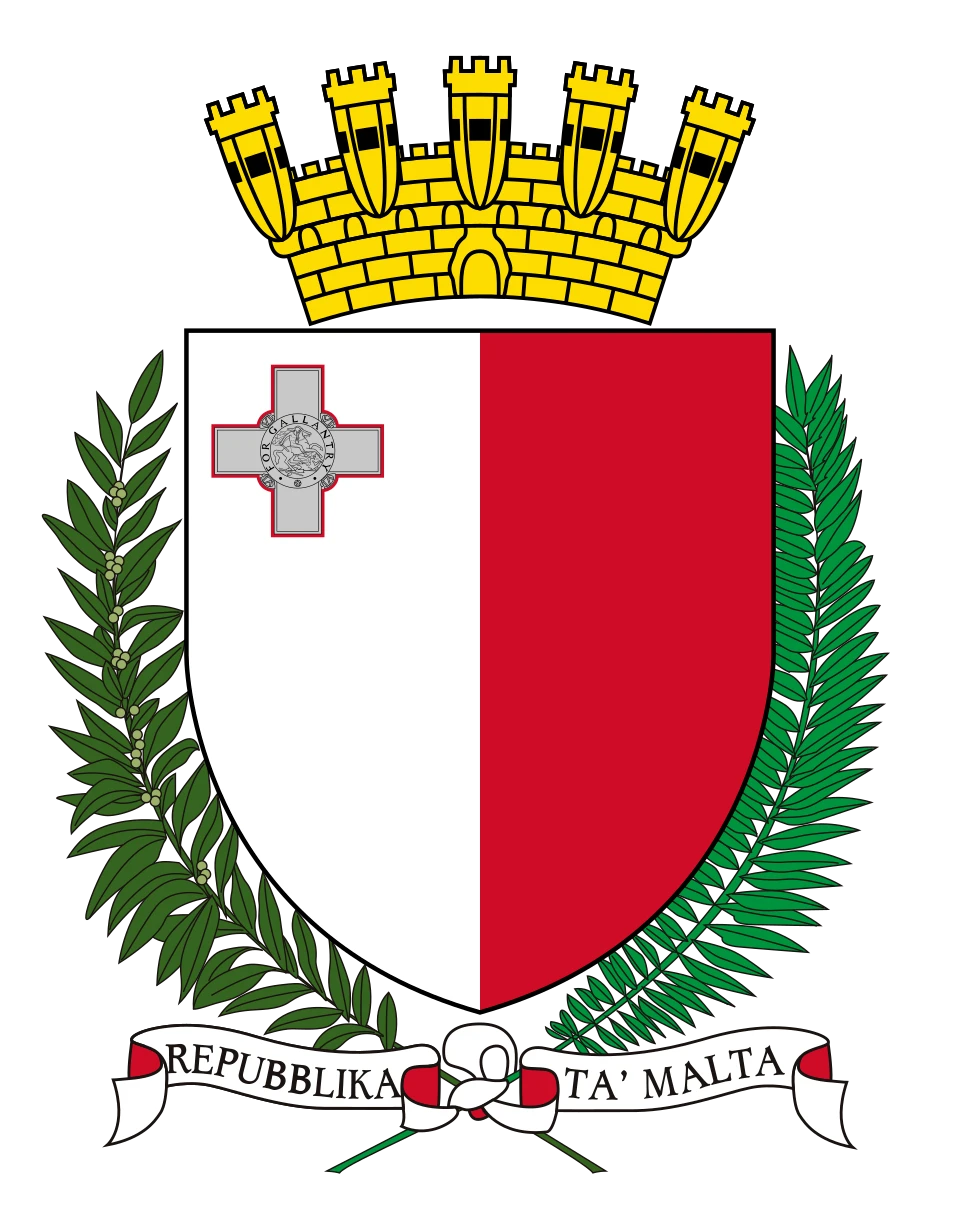
Malta is the only nation in the world whose flag bears the George Cross — a British honour awarded collectively to the entire island by King George VI on 15 April 1942 for its extraordinary courage during the Siege of Malta in World War II. The coat of arms, adopted at independence on 21 September 1964, pairs the ancient white-and-red shield — traditionally attributed to Roger I of Sicily after the Norman conquest of 1091 — with two dolphin supporters carrying a palm branch and an olive twig. Above, a mural crown shaped like a fortress honours the fortified cities — Valletta, Mdina, Birgu — that have defined Malta’s strategic destiny at the heart of the Mediterranean.
Flag
Not available
Coat of Arms
Not available
| Official name | Repubblika ta’ Malta |
|---|---|
| Coat of arms | Shield with Maltese flag, two dolphin supporters, mural crown, helmet |
| Arms adopted | 21 September 1964 (independence); restored 1988 |
| National flag | Bicolour — white (hoist) and red (fly), George Cross in canton |
| George Cross awarded | 15 April 1942 by King George VI |
| Flag formalised | 1964 (independence); George Cross with red fimbriation |
| Capital | Valletta |
| Government | Unitary parliamentary republic |
| Head of State | Myriam Spiteri Debono (since 2024) |
| Colours origin | Attributed to Roger I, Count of Sicily (1091) |
Coat of Arms of Malta — Dolphin supporters, mural crown, palm and olive
The coat of arms of Malta, adopted at independence on 21 September 1964, is a full heraldic achievement centred on the island’s ancient white-and-red colours.
The shield bears a representation of the Maltese flag: a bicolour of white (dexter) and red (sinister), with the George Cross in the upper white canton, edged in red. This simple design descends from the arms of Mdina, Malta’s old capital, which tradition attributes to a grant by Roger I, Count of Sicily, after the Norman conquest of Malta in 1091.
When Malta became a republic in 1974, Prime Minister Dom Mintoff mistook the mural crown for a symbol of royalty and sought to replace the arms. A class of art students taught by Esprit Barthet produced a new design, and the non-heraldic emblem by Edward Abela was adopted. It proved controversial and was replaced by the restored heraldic arms after the Nationalist Party won the 1987 election.
Under British rule, Malta had three successive colonial badges:
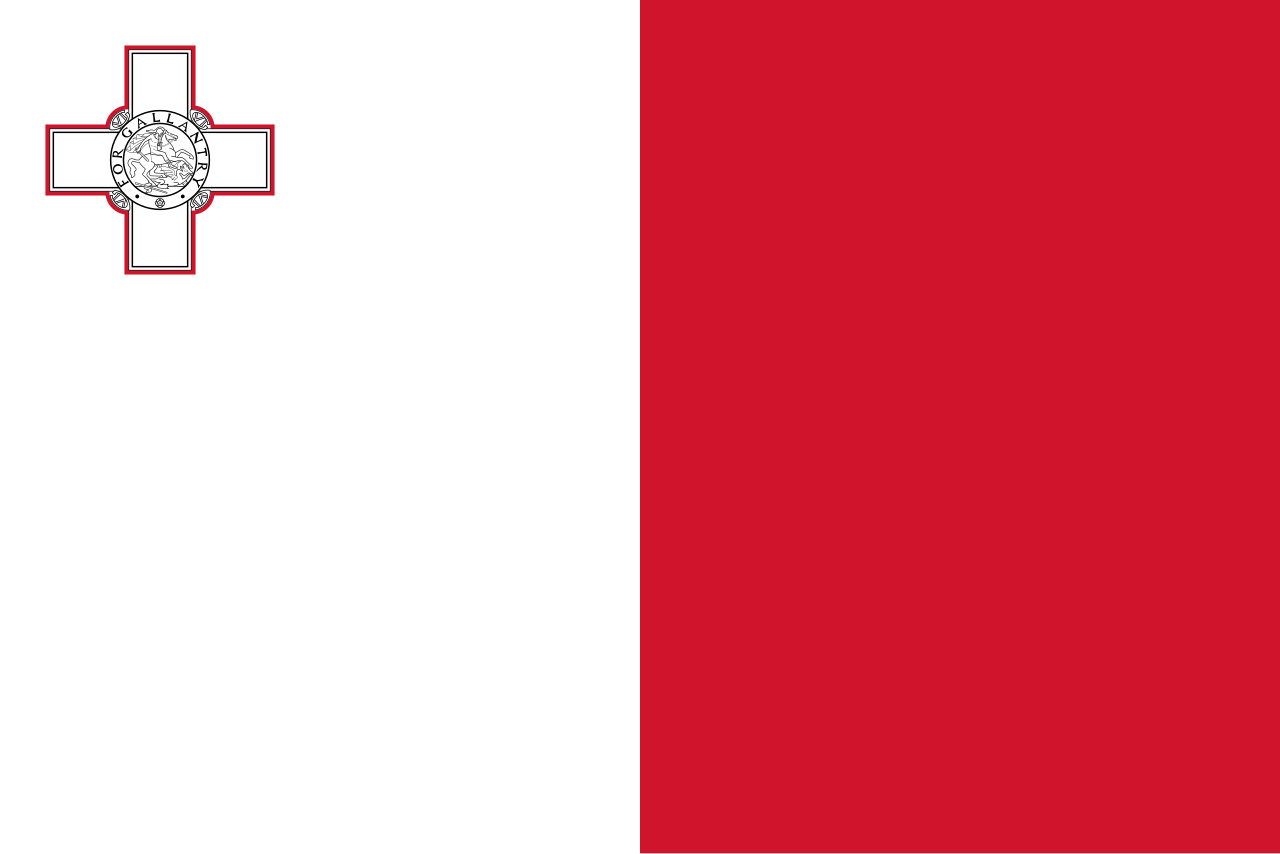
Flag of Malta — Bicolour with the George Cross, the only national flag bearing this honour
The Maltese flag is a bicolour of white (hoist) and red (fly), with the George Cross — edged in red — in the canton of the white stripe. It is the only national flag in the world to bear the George Cross and one of the few to feature English-language text.
The white-and-red colours are traditionally traced to Roger I, Count of Sicily, who conquered Malta from the Arabs in 1091. According to legend, Roger tore a piece from his own red-and-white chequered banner and gave it to the Maltese as a mark of gratitude for their assistance. Whether historical or mythical, the bicolour has been associated with Malta — and especially with the old capital Mdina — for over nine centuries.
On 15 April 1942, at the height of the Siege of Malta, King George VI awarded the George Cross to the entire island — an unprecedented collective honour — “to bear witness to a heroism and devotion that will long be famous in history.” Malta endured over 3,000 bombing raids by the Luftwaffe and the Regia Aeronautica, making it one of the most bombed places on Earth.
On 28 December 1943, the George Cross was added to the flag on a blue canton in the upper white stripe.
When Malta became independent on 21 September 1964, the blue canton was removed and the George Cross was given a red fimbriation (narrow border) to distinguish it from the white background. This is the design that flies today.
Malta’s heraldic heritage is shaped by centuries of successive rulers, each of whom left a mark on the island’s symbolic vocabulary. The Knights of the Order of St John (1530–1798) are the most prominent heraldic influence: the Maltese Cross — a white eight-pointed cross on red — became one of the most recognisable symbols in world heraldry, though it is distinct from the national arms.
Before the Knights, Malta’s heraldic identity was tied to the Kingdom of Sicily and the Crown of Aragon. The arms of Mdina (white and red) and Valletta (a gold shield with a dog holding a flaming torch) reflect this layered history. Municipal heraldry remains active: most kunsilli lokali (local councils) across Malta and Gozo maintain official coats of arms.
On 15 April 1942, King George VI awarded the George Cross to the entire island of Malta in recognition of the extraordinary bravery and endurance of its people during the devastating Axis bombing campaigns of World War II — the Siege of Malta. The George Cross was added to the flag on 28 December 1943 on a blue canton, and retained with a red fimbriation after independence in 1964.
The two dolphins supporting the shield symbolise Malta’s maritime identity as a Mediterranean island nation. One holds a palm branch (victory) and the other an olive twig (peace). They were adopted as supporters when the coat of arms was created at independence on 21 September 1964.
According to tradition, the white and red were granted by Roger I, Count of Sicily, after the Norman conquest of Malta in 1091. These colours — said to derive from Roger’s own banner — became the arms of the old capital Mdina and eventually of Malta itself. They have been in continuous use for over nine centuries.
The current coat of arms was adopted at independence on 21 September 1964. Between 1975 and 1987, a non-heraldic emblem designed by Edward Abela replaced it under Dom Mintoff’s government. The heraldic arms were restored after the Nationalist Party won the 1987 election.
The mural crown is a golden crown shaped like a fort with five octagonal turrets, representing Malta’s historic fortifications. It surmounts a helmet draped with red and white ribbons. Despite Dom Mintoff’s belief that it symbolised royalty, the mural crown is a civic — not royal — symbol, traditionally used to denote a republic or a fortified city.
Last reviewed by the Emblema Mundi editorial team on 2026-06-22.